
Meet the sponsors that make Shift UX 2026 possible
From AI to the global economy, everything is changing everywhere all at once, and the job you had yesterday may not resemble your role today, much less tomorrow. Which is why, instead of treating UX as a job title, Shift UX 2026 frames UX as a powerful toolkit for everyone to use to solve complex problems in any setting, ranging from finance and healthcare to education and transportation.
Let’s meet the sponsors that make the first-ever Shift UX 2026 conference possible.
Platinum

The UX practice at Bloomberg brings together researchers, product designers, data visualization experts, and prototypers to create intuitive experiences for clients navigating the global economy. We turn complex data into clear, useful insights by understanding user needs and designing thoughtful, human-centered products that help solve our customers’ complex, real-world problems. Learn more »
Palladium
Nava is a public benefit corporation on a mission to make government services work better for the people they’re meant to serve. Federal, state, and local government agencies across the country have trusted Nava to modernize critical public services over the last decade. We combine our deep technology and domain expertise to help government agencies improve how people access essential services, reduce administrative burden, and build systems that are flexible to constant improvement. Learn more »
Gold

Justworks helps small and growing businesses take care of their people and run with confidence. Its platform brings payroll, benefits, HR tools, and compliance support together in one place, simplifying the essential administrative work behind building a great team.
By pairing straightforward technology with expert support from real people, Justworks gives business owners more time to focus on their employees, their customers, and the work that moves their organizations forward. Learn more »

Design at Amazon spans devices to fashion, logistics to streaming, voice to retail—creating experiences that touch customers everywhere. With curiosity, rigor, and care, we design from every perspective and scale, from smallest moments to largest systems. Learn more »
Silver

Aboard is a solution engineering firm. We combine AI-accelerated software delivery with the skills and craft we developed across two decades of software consulting. AI is powerful, but only if you manage the risks. And that’s why we don’t put AI in charge—we put it to work, to help us build reliable custom software for industry leaders in a fraction of the time it used to take. We typically partner with clients for a year or more to clear their roadmaps, integrate AI into existing data and workflows, and ship platforms that actually fit their needs. Learn more »
Supporting Sponsor
The Sensemakers Club is a community-powered education space where curious people come to grow without performing or pretending to have it all figured out. Learn more »
Ready to meet these sponsors? Join us September 23-25, 2026 in New York City (or remotely)!
Taking back control of UX and research: An interview with Shift UX curator Jemma Ahmed
 Jemma Ahmed has been working for two decades in the space where consumer, design, product, marketing and cultural insight meet. A mixed methods insight practitioner, her work focuses on how technology can empower minority Global communities. With expertise in data science, market research and user research, she has delivered projects at scale which have had significant business and societal impact.
We sat down with her to ask why she believes this conference is essential for all UXers—regardless of whether they have “UX” in their titles.
Why is Shift UX needed right now?
I could tell you everything that every other conference is talking about right now.
I could tell you that you need to think about the skills that are needed as we march forward in an AI-mediated environment.
I could talk to you about the importance of coming together when the social contract of work is changing. I could talk to you about the importance of community and agency.
That would all be true. And I hope that anyone who attends the conference will walk away with those things.
But for me, Shift UX is so important right now because it is a space that will cut through the noise with honesty.
In a world where everyone is an AI or LinkedIn influencer and everyone and their mother with a blue tick is offering a perspective, there is just so much noise and clutter and—often AI generated—opinion going on out there. And that doesn’t help anyone.
A curated conference like Shift UX is trusted because everyone who steps on that stage has researched their topic and is a deep expert in what they are talking about and has worked with other people with deep expertise.
What you’re hearing from the speakers is about as accurate a signal as any of us can give right now. And in a world that is just so cluttered and noisy, making decisions off information that you can trust really matters right now.
Is UX dead?
Absolutely categorically not.
UX, when you kind of slip it all back, is about figuring out what a human need is and building something which helps that human and reduces harm to them. That skill has been going on since the days when we were trying to figure out like why a wheel is round and not square. That is a perennial skill and it’s not going anywhere. The shape of it might shift, the job title might shift, the spaces it’s practiced in might shift, but that fundamental isn’t dead and it isn’t going anywhere.
If we need UX more than ever, why is it so freaking hard to get a job right now?
I am job hunting and I have got all the feels for this question. From my vantage point and the people that I’ve spoken to and the people that I conducted research with going into Shift UX is that…Yeah, in some spaces there is a downturn of traditional UX jobs.
But that doesn’t mean that they are going away.
Some of them require different skills. A lot of them are going under different job titles, like in research. You might not be being called user researchers anymore. You might be called strategists. Your work might be sitting in policy teams, but the work is still going on, perhaps in different places with different titles and different spaces than it has been before.
What are you most excited about from the Research As Strategy track at Shift UX?
We are actually completely decoupling research as a profession and research as a skill. If anything, I’m going to ban the word research because we’re not living through that anymore.
Organisations are functioning as a knowledge economy. From very, very rigorous research being conducted by specialised teams, all the way through to lived experience, AI generated lit reviews, and everything in between, we have got more insight or sometimes insight-shaped things than ever. But how you function in a knowledge economy is very, very different. And I’m excited to get into this.
I’m excited to help people understand how you collate that volume of information and signal and yet stop people becoming data blind. Identify those hinge questions.
I’m curious about helping people understand the different spaces and places and consequences of working in a knowledge economy means for a researcher and their role, and how people who are doing research contribute back up to that knowledge economy.
I’m ready to dig into what it actually means to help an organisation metabolise the knowledge that is collecting. That is not having a seat at the table, my friends. That is using relational power when you might not have those institutional power markers anymore to make your voice heard.
I’m also really curious to dive into what the skills are that are needed to actually help organizations consume and ingest knowledge well. Often those conversations can be hard-hitting and difficult. That’s often the role of knowledge: to add friction and to have difficult conversations. That’s predicated on psychological safety on non-suppression of voices and we are going to be understanding how to have those conversations.
Regardless of whether you’re a researcher or a person who does research… these matter. I don’t care whether you are a user researcher, a market researcher, a data analyst, whether you are working in-house as a consultant or a contractor or you are an agency.
This space, regardless of whether you have got UX in your title or not, is for you.
If you work in spaces where you are creating and designing for humans, this conference is for you. I hope it will help you learn some of the fundamental shifts in skills that we’re seeing: how you metabolize knowledge, how you stop seeing operations as admin and start seeing it as strategic orchestration, and how you actually go about working with sense-making. These are skills that—regardless of whether your title is UX or not— if you are building human-centered things, matter moving forward.
What worries you if user experience designers and researchers (UXers) as a field don’t get on top of what’s happening right now?
So I think there has been a very, very human toll of the changes that we’ve seen in our field. I have friends, peers, mentors who’ve been long-term unemployed as a result of the shifts that we’re seeing. I don’t want that for them. I don’t want that for you.
Equally, I have seen people feel devalued, feel like this is being something that is done to them, that their career is not in their hands anymore. And let’s face it, if you get into this work, it’s because you more often than not care about the human at the end of it.
I want, if nothing else, for people to walk away with a sense of agency.
I want our field to start having agency and start making the decisions that affect us rather than it being a thing done to us.
So, what worries me is that if we don’t get our handle on this, there is a very, very human cost—to jobs, to worth, to identity. I hope Shift UX gives us a space to really start taking back control.
Low-cost tickets now available for the Shift UX 2026 conference
The world has always needed people who take responsibility for humanizing systems, services, products, and technologies. In 2026, that need is exploding…and demand will inevitably catch up. Are you prepared for the new wave of user experience?
That’s exactly what Shift UX 2026 is all about, and why we want to make sure it’s accessible to as many UXers as possible.
Our team has been hard at work shaping Shift UX 2026 into the groundbreaking event it’s meant to be, and we can’t wait to see so many of your faces there!
But we know that not everyone has the budget or circumstances that allow them to attend conferences like ours, which is why we’re offering exclusive low-cost tickets to the first-ever Shift UX conference.
Attend virtually on Sep 24-25 and obtain access to the conference session recordings, notes, and slide decks!
You’re eligible for this lower-priced ticket if you’re…
- Unemployed
- A full-time student
- Reside in one of the following countries: Ukraine, India, Pakistan, Nigeria, Brazil, Indonesia, Philippines, South Africa
Join us at Shift UX in just a few short weeks by registering here.
See you soon!
Unlock new user insights with Body Talk
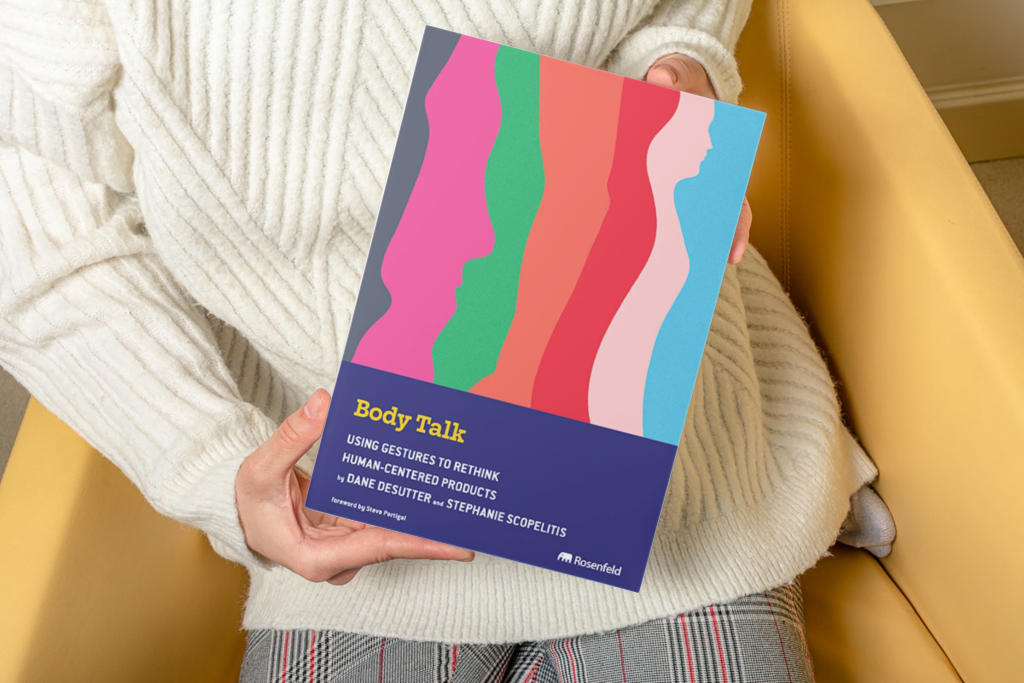
Ever shipped a product or feature that tested well, seemed obviously right, and then just… didn’t land? There’s a decent chance the missing signal wasn’t in anything anyone said. It was in the room — in a shrug, a leaned-in posture, a hand that traced a shape nobody wrote down. A new book from Rosenfeld Media makes the case that this overlooked layer of communication deserves a seat at the table in human-centered design, and it’s now open for pre-order.
Body Talk: Using Gestures to Rethink Human-Centered Products, by Dane DeSutter and Stephanie Scopelitis, is available to pre-order now through October 20, 2026 at 15% off. Here’s what it covers and why it matters.
What does “body talk” actually mean?
People think, communicate, and coordinate with more than words. Gestures — hand movements, posture, gaze, the way someone orients toward or away from another person — carry meaning that speech alone can’t capture. DeSutter and Scopelitis walk through the entire product lifecycle showing how tuning into gesture, both the user’s and your own, deepens research, sharpens ideation, strengthens design validation, and makes it easier to ground fast-moving technology in real human experience.
Is gesture just about the hands?
No, and this is one of the book’s core reframes. A gesture can be a hand movement, sure, but it’s also a shifted posture, a held gaze, a turned shoulder, a lifted chin, or a raised eyebrow in context. The book treats gesture as any visible bodily action that helps people make meaning while they think, talk, and work together. If you’ve only been watching what users say and click, you’ve been missing a whole channel of data.
Who should read this book?
If you talk to users or customers, shape product design or strategy, or lead the people who do, this book is likely speaking directly to you — whether your title is researcher, designer, engineer, or product manager. It’s also built for leaders, educators, healthcare professionals, and facilitators whose work depends on reading people accurately and getting things done together.
If you’ve ever wondered why a promising idea fizzled in the room, the answer may have been sitting in gestures nobody was trained to notice.
What will I actually be able to do after reading it?
The book is hands-on, not just conceptual. You’ll come away able to:
- Recognize how gestures reveal people’s mental models and help them think.
- Read the meaning in gestures that words leave out entirely.
- Understand how the thinking, communicating, and coordinating body work as one system.
- Actually spot the gestures that matter, instead of missing them.
- Evaluate and analyze gestures for their communicative impact.
- Use gesture to build trust and belonging within teams, and collaborate more richly as a result.
- Read gesture in context — tied to your goals, your relationships, and how ideas move through a group.
- Prototype and build the right thing, together, faster.
- Analyze and interpret gestures captured on video.
- Use AI and software to search video at scale and locate movement patterns.
What’s inside, chapter by chapter?
The book moves from foundational theory into applied practice across eight chapters — starting with why gesture-awareness matters, into how to actually “see” it, how to analyze gesture data, and finally how to build stronger teams and design better products by paying attention to what bodies are already telling you.
What are people saying about it?
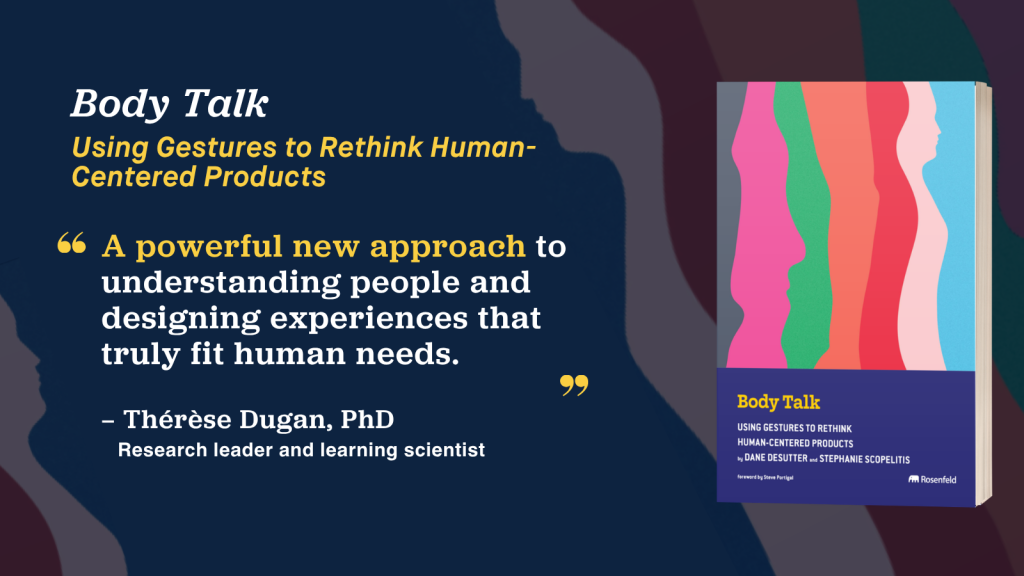
Early readers across design, research, and academia are calling it a genuine shift in perspective — from design leaders praising its focus on understanding human needs beyond words, to researchers highlighting how it grounds gesture in real practice, to reviewers noting that even in an AI-saturated moment, human-centered products still start with old-fashioned human observation.
Order a copy before October 20 to save 15%.
About the authors
 Dane DeSutter is an embodiment and gesture scientist who has spent over a decade studying how the body externalizes and supports complex cognition and putting those insights to work in product development. He uses spontaneous co-speech gestures to probe the fine details of people’s mental models across domains as varied as spatial reasoning in science, physician-patient dynamics in clinical environments, wearables, developer experience, and human-AI interaction. He is currently a Senior Product Researcher at Microsoft. Read more »
 Stephanie Scopelitis is an educator, learning scientist, and qualitative researcher. Her life as a professional dancer carried her into a deeper study of human interaction and the body. She has built her work on a fundamental belief: we understand and navigate the world through our bodies. Read more »
Learn to automate intentionally with What Your Machines Should Do
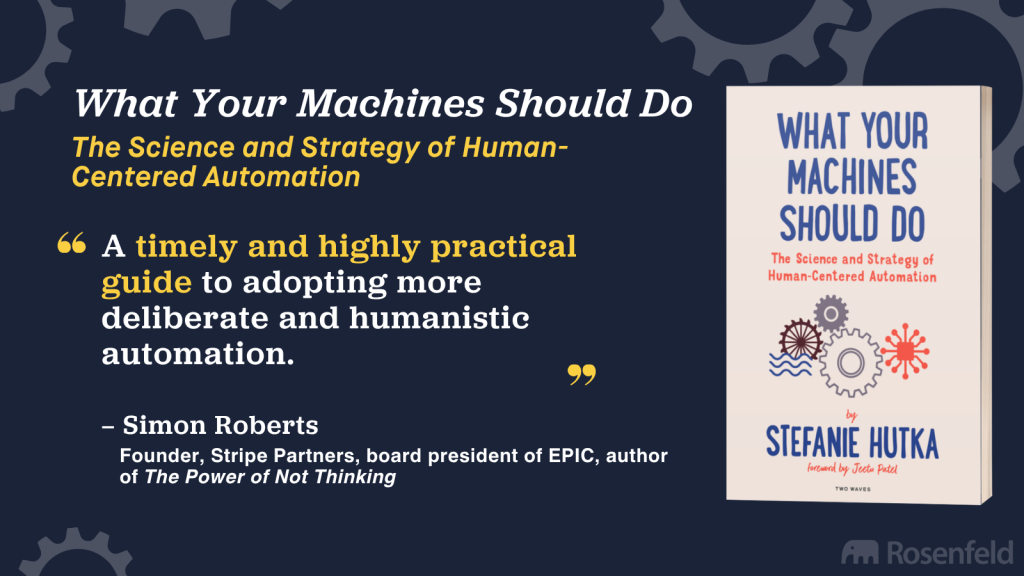
Every team building with AI eventually runs into the same wall: it’s easy to automate something, but much harder to know if you’re automating the right thing, at the right time, in the right way. That gap (between what’s technically possible and what actually serves people) is the subject of a new book from Rosenfeld Media, and it’s now open for pre-order.
What Your Machines Should Do: The Science and Strategy of Human-Centered Automation, by Stefanie Hutka, is available to pre-order now through November 10, 2026 at 15% off. Here’s what the book covers and who it’s for.
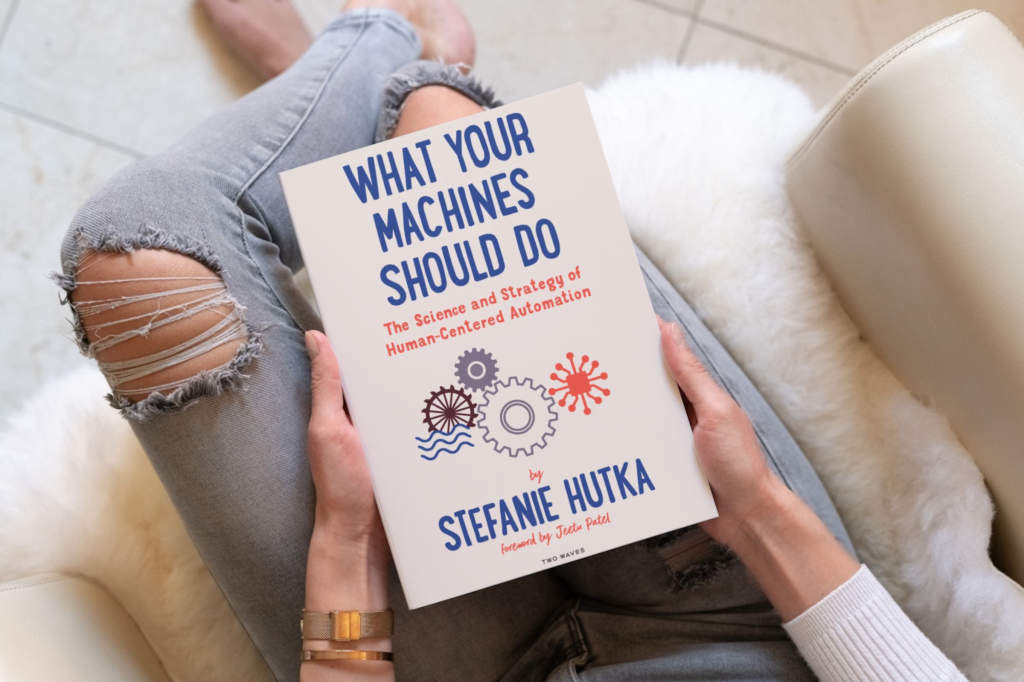
How do I decide what to automate — and what to keep human?
That’s really the central question the book sets out to answer. Hutka’s argument is that AI isn’t a brand-new phenomenon requiring brand-new thinking — it’s the latest stage of a much longer automation story, and there’s decades of hard-won research in human factors, cognitive science, and systems design that already tells us how automation succeeds or fails.
Most organizations skip that research. They chase full automation because it’s exciting or because a competitor is doing it, without checking whether their team is actually ready or whether it will genuinely improve the customer experience. Hutka calls this mismatch the Automation Strategy Gap, and the book is a practical toolkit for closing it: how to set direction on purpose, roll things out in the right sequence, and make sound calls in the day-to-day work of building automated systems.
Who should read this book?
If any of these sound like you, this one’s for your shelf:
- You’re an IC trying to manage up. You want your team and leadership to have a realistic, grounded sense of what the technology can (and can’t) actually do — instead of hype-driven assumptions.
- You’re a manager making the calls. Every week you’re deciding what gets automated, what gets adopted off the shelf, and what stays firmly in human hands.
- You’re a senior leader setting strategy. You need technical capability and customer/business value to actually line up, not drift apart.
What are the key takeaways?
By the end of the book, you’ll walk away able to:
- Weigh customer value, organizational readiness, and technical maturity to prioritize what to automate and how.
- Build real intuition — through hands-on exercises — for the technology’s actual capabilities and limits.
- Judge an automation solution at three levels: the user, the task, and the wider ecosystem it lives in.
- Surface the assumptions already baked into your organization, since automation just accelerates whatever system you already have.
- Treat automation as a way to reinforce strategy rather than let it quietly replace strategy.
- Spot likely downstream consequences early, so you can head off risk and catch opportunity.
- Design systems that expand what people can think and do, instead of hollowing it out.
- Evaluate automated systems honestly, both before launch and after.
What’s covered chapter by chapter?
The book moves from mindset to method across 11 chapters, starting with why intentional automation matters, through frameworks like the Autonomy Decision Matrix and building “could we / should we” judgment, into setting direction, anticipating consequences, and finally evaluating and adapting your systems over time.
Order a copy before November 10 to save 15%.
Who is Stefanie Hutka?
 Stef Hutka helps teams bring useful, usable AI, XR, and robotics products to market. She is the founder of Sendfull, a boutique consultancy for emerging technology teams. Previously, Stef led design research and strategy for 0-to-1 product launches at Adobe, Meta, and DAQRI. Stef also teaches UX and systems thinking at UC Berkeley, and writes the leading Substack on emerging product design research (sendfull.substack.com). She holds a PhD in Psychology from the University of Toronto, focused on cognitive neuroscience. Read more »
Announcing the Conference Program for Shift UX 2026
We are thrilled to announce the program for Shift UX 2026, a hybrid conference for designers, researchers, product managers, content designers, and adjacent practitioners navigating a moment when traditional UX roles are blurring or disappearing.
Key Highlights
- Keynotes from industry leaders: Hear from Catt Small, Staff Product Designer at Dropbox & Author of The Staff Designer, in the opening keynote, and Jesse James Garrett, AI Transformation Consultant & Private Leadership Advisor at Intentional Associates, in the closing keynote.
- Live sensemaking sessions: Watch ideas get synthesized in real time across three dedicated sensemaking blocks — on research and knowledge, on moving from operations to orchestration, and on human-centered tooling — led by practitioners like Dan Brown, Co-founder of EightShapes, and Sophia Prater, UX Strategy Consultant and Coach at OOUX.
- Two focused day-long tracks: Day one centers on strategic research and knowledge sensemaking into the operating models organizations need to remain human-centered in a post-AI era, while day two explores tools that extend human capability, then brings the conference’s ideas together through live sensemaking and a closing keynote.
- Practical talks on AI-era operations: Sessions like “From Operations to Orchestration,” “Shared Accountability in Enterprise UX,” and “The Judgment Layer: Operations After Throughput” dig into how design orgs coordinate and stay accountable as workflows become more automated.
- Networking built into the schedule: In-person attendees get topic-table lunches and multiple coffee breaks, while remote attendees get dedicated chat sessions plus a remote social (Cozy Juicy Real) and remote after-party — giving both formats structured time to connect.
- Flexible attendance formats: The full schedule is mirrored for both in-person (New York City) and remote attendees, so highlights and access to speakers aren’t limited to those on-site.
Why attend?
- Future-proof your skillset by diving into four forward-focused practice pillars that resist automation: strategic research, sensemaking, operations as orchestration, and human-centered tooling
- Uncover new opportunities by exploring the intersections between these pillars — spaces where UX practitioners are uniquely positioned to add value
- Gain language and frameworks that make your skills, experience, and impact more visible and valued, whatever role you’re in or moving toward
- Connect with peers and talent navigating similar shifts — blurred roles, evolving team structures, and new ways of measuring UX impact
- Learn from expert-led workshops and the Leaders Salon designed to help you translate your experience into what’s next, whether that’s growing in your current role, leading a team, or branching into coaching, consulting, or teaching
Join us at Shift UX 2026 as we navigate this exciting frontier together. Stay tuned for more announcements!
Introducing the Shift UX VIP Leaders Salon – led by Peter Merholz
UX leadership has always been demanding. Right now, it’s something else entirely — leadership mandates to fold AI into the work, teams anxious about their futures, and all of it stacked on top of a job that was already full. Something has to give, and for a lot of leaders, that something is starting to feel like their own sense of purpose.
Recent research on UX and research professionals found them to be among the least happy people in their field, and the isolation that’s always come with UX leadership hasn’t gone away. It’s gotten worse.
Shift UX is built around one premise: roles disappear, but the work matters more than ever. For leaders specifically, that premise raises a harder question — if your title no longer defines your value, what does?
That’s the question The Shift UX VIP Leaders Salon exists to answer.
What is the Leaders Salon?
A companion event to the Shift UX conference, the Salon is an all-day gathering for UX leaders at director level and above, facilitated by Peter Merholz. It’s built for stepping back, gaining real perspective, and leaving ready to lead from clarity instead of reaction.
Join us September 23, 9:00 AM – 5:00 PM ET.
How the day works
Rather than a day of lectures, the Leaders Salon is built around one question, answered four times from four different angles: your organization, your positioning, your practice, and your own next move.
Peter opens with a framing talk grounded in his own research — a 458-person sentiment survey and a listening tour of twenty UX executives — on the phase shift the profession is moving through.
From there, you’re placed into a small “home group” of peers in a similar organizational situation, a group that stays with you all day and becomes a real network afterward, not just a name badge exchange.
The day moves through a sequence of hands-on exercises: naming what your organization actually believes UX is for (not the mission statement version — the real one), literally designing a product box that states UX’s value proposition and defending it in front of the room, and building a concrete playbook of practices for leading through uncertainty. It closes with a personal plan for your own next move, informed by a full map of the field’s real, current opportunities — built collectively, by the whole room.
Everything runs under the Chatham House Rule, so the conversation can be as candid as it needs to be.
What you walk away with
- The product box you built — a physical artifact of what you believe UX is for
- The room’s full playbook of leadership practices, transcribed and sent the next morning
- An option map of the moves available to UX leaders right now, with real people attached to each one
- A complete workbook of the day
- A small group of peers who understand your situation well enough to still be useful months from now
Salon participants are also part of the VIP UX Leader cohort for Shift UX, with an invitation to a VIP reception where you can keep the conversation going and meet Shift UX speakers and sponsors. Secure your spot before prices increase on September 3.
About Peter Merholz

Peter Merholz brings over 25 years of UX leadership experience, including co-founding premier consultancy Adaptive Path, co-authoring Org Design for Design Orgs, serving as both a full-time and fractional UX executive, and most recently as an independent consultant and coach with clients including Chase Bank, Starbucks, Dexcom, Target, Lloyds Bank, Grab, IKEA, and LEGO. Read more >>
What Actually Gets You Hired in UX Right Now
 It’s a strange moment to be job hunting in UX. Everyone agrees the field needs human-centered thinking more than ever, yet strong candidates with solid portfolios are struggling to land roles. If demand for the skill is rising, why does the job search feel harder than ever?
We sat down with Jon Fukuda, Co-founder at Limina.co and one of the curators at Shift UX 2026, to unpack what companies are actually screening for now, why understanding how work flows through an organization is becoming a defining capability in UX, and what it takes to move from making things to making organizations work.
Why does the UX job market feel so contradictory right now?
The industry has outgrown the language it built for itself. For years, UX organized around disciplines — UX, UI, research, content, service design, design ops. Those labels helped build expertise, but they also created boundaries that don’t really exist anymore.
AI has accelerated the blur even further. Researchers are prototyping. Designers are coding or writing. Engineers are shaping experiences. Product managers are doing more discovery work. Operations teams are orchestrating how it all comes together. The work is more integrated than the job titles suggest, and that mismatch is exactly what makes the market feel confusing from the outside.
Is the traditional UX job disappearing?
Not exactly — but a particular way of practicing UX is, and that’s worth naming instead of avoiding.
UX has long been treated as a specialized function that lives somewhere between product management and engineering. That’s changing. Understanding people is becoming everyone’s responsibility, not just a researcher’s or a designer’s job to hold. That doesn’t mean human-centered thinking matters less — with AI producing experiences faster than ever, it arguably matters more. The real question isn’t whether UX survives as a discipline. It’s whether practitioners can evolve from producing artifacts to orchestrating systems, decisions, and outcomes.
What are hiring managers actually screening for besides craft skills?
Companies aren’t hiring for portfolio polish alone anymore — they’re hiring for adaptability. The questions organizations are asking candidates have shifted:
- Can this person work across functions?
- Can they use AI well?
- Can they influence decisions?
- Can they connect customer insight to business outcomes?
- Can they improve how work actually happens?
The market isn’t rejecting UX skills — it’s rewarding people who can integrate those skills into how an organization operates. That’s a different value proposition than what most practitioners were trained for, and it means putting the portfolio aside long enough to tell a different kind of story: one that shows how you add value not just in the moment, but toward where the organization is headed.
Why does understanding operations matter to a UX career at all?
Because operations determines whether good ideas survive contact with an organization. It’s less a discrete skill to list on a resume and more an awareness of how work actually moves through a company.
Brilliant research disappears. Beautiful design systems fail. Great strategies stall. Not because the thinking was wrong — but because the organization couldn’t repeatedly turn insight into action. Operations is about creating awareness of how work actually flows: where value is created, where waste accumulates, and how decisions ripple across teams. Practitioners who develop that awareness don’t just make teams faster — they make good work sustainable, which is exactly the kind of impact hiring managers are now screening for.
Why can a team of talented people still deliver a bad customer experience?
Customers don’t experience org charts. They experience the seams between them.
It’s entirely possible to work with an organization where every individual team is excellent — great researchers, great designers, excellent engineering, tight operations — and the customer experience still suffers, because nobody is looking across the whole system. The breakthrough in those situations isn’t hiring better designers. It’s helping everyone see that their work is connected. That’s the shift from a narrow, siloed operations mindset to full systems thinking — and it’s often the difference between a team that looks good on paper and one that actually delivers.
Does this shift apply to you if “UX” isn’t in your job title?
Yes — the list of people this affects is longer than most assume: product managers, engineering leaders, researchers, content strategists, accessibility specialists, service designers, ops leaders, and ideally executives too.
Human experience — whether it shows up in a product, a service, or the employee experience — isn’t owned by one department. It’s shared and produced by systems of people working together. If you’re involved in or influence how customers and employees experience something, you’re already doing UX work, whether you carry the title or not — and that’s exactly why the hiring bar has moved.
What’s the risk if UX practitioners don’t adapt?
Mistaking disruption for irrelevance.
AI is stepping into tasks that used to belong to researchers and designers, doing them 20 to 50 times faster and cheaper — tokens are cheaper than salaries. That creates real anxiety, and it’s easy to see people’s sense of self-worth take a hit. If the field spends the next five years defending yesterday’s job descriptions, it risks becoming a production service rather than a strategic capability — a cost center instead of a competitive advantage.
What’s the upside if the field gets this right?
AI isn’t replacing the need for human judgment — it’s increasing the importance of it. But judgment only creates value if it influences systems, decisions, and strategy, and that’s the opportunity in front of the field right now: a real chance to redefine UX’s value proposition and move from cost center to strategic driver of innovation.
Underlying all of it is one idea: awareness. The more awareness practitioners have — not just of customers and the products or services they touch, but of the discrete functions, features, and business objectives that make up the larger system, and of how the organization itself works — the more likely they are to succeed at operational excellence and fluid business orchestration. That expansion of awareness, more than any single skill, is what will define who actually gets hired — and who thrives — in the next era of UX.
Apply for a scholarship to attend Shift UX 2026
Shift UX 2026 is giving out 40 full scholarships to attend the conference, with a limited number available for both the in-person and virtual experiences:
-
In-person: 100% off the current ticket price, less a US$50 “hold my place” fee (paid when registering). Provides full, in-person access to the conference main stage program, exhibition floor, and all networking activities and sponsored presentations (travel and hotel not included).
-
Virtual: 100% off the current ticket price, less a US$25 “hold my place” fee (paid when registering). Provides full viewing access to the conference livestream as well as participation in all speaker Q&A sessions.
We’re committed to diversity and inclusion at our conferences. When applying, please let us know if you are part of an underrepresented community.
We encourage you to apply if you are:
-
a full-time student
-
unemployed or under-employed within the UX field (unable to find full-time work)
The deadline to apply is EOD August 11, 2026.
UX is shifting. What does that mean for us? An interview with Shift UX curator, Abby Covert
 Abby Covert is an information architect, writer, and community organizer who specializes in helping people make sense of messes. She has written three books on sensemaking: How to Make Sense of Any Mess (2014), Stuck? Diagrams Help. (2022), and Timeless Sensemaking for Modern Sensemakers (2026). In 2020, she left a 20-year consulting career to focus on independent publishing and community building. Today, she joins us as one of the curators of the upcoming Shift UX conference, taking place live in New York City and online this September 23-25, 2026. We sat down to ask her about the shift that’s happening in user experience (UX), and what that means for the rest of us.
Why is Shift UX needed now?
Shift UX is needed right now because people are scared. People are experiencing the shift that is happening all throughout UX and the industries that it touches, but we’re not collectively given a place and a space to deal with that…There’s a level of grief that we need to deal with that’s probably best done in a community.
Some people think that UX is dead. Do you think it really has a future?
User experience is not dead. That’s so silly. I feel like user experience existed before we branded it, and it’s going to exist far after we decide that it’s not called that anymore.
The skills within UX and the people who have invested time in deeply understanding user-centered thinking and human-centered design…those people will always have work.
Why speak on your particular pillar?
Sense-making is just the thing that runs through all of it, you know? It’s like, you can’t get anything done with more than one person without having to add that layer of making sense on top of it.
In the process of understanding how we’re addressing the shift is understanding that sense-making is something we have to weave throughout the whole thing in order to be able to wrangle it at all.
It’s an embarrassment of riches when it comes to messes, but man, we’re going to need new skills to figure out: what do we do now? The thing that is shifting is having an increased need for things like discernment. We have the ability to do anything we want, and we have all of the tools we’ve ever asked for. But now we have to pick. We can’t fix all of it—we don’t have the energy or the time or the people—so how we decide what goes first, next, and last is a big focus of the sensemaking community.
Can you speak on your background and how it relates to systems-level thinking?
I’ve been an information architect for more than 20 years, and so I’ve moved through a lot of different periods of technology and change. With that, what I’ve seen is that we have to have a basic set of sense-making skills to get through whatever the brunt force of the chaos is that’s coming at us. So I’ve kind of made that my collective charge to do.
What does a conference look like in this shift, and how do we serve people with so much ambiguity? These speakers don’t have all the answers and aren’t going to pretend like they do. So how do we make that a really productive exercise for everybody and also start to build a community of all of these different silos that have started to form as we’ve fractured as a community as a whole?
Why should someone attend Shift UX?
Lou Rosenfeld has been at the center of every shift that we’ve experienced as a community for 30-plus years. So I want to be a part of this conference because of that. I think that if there’s going to be a room that really makes an impact on the questions that we’re laying out for the community, I think it’s going to be a room that Lou has curated.
We really are at a nexus of a shift. [Shift UX] is going to be the room that admits it and starts to work through it collectively with some of the people that we haven’t mixed together in a long while, if ever.
What worries you if the field doesn’t make this shift well?
The underfunding of user experience that’s happened just in the last 5 years has absolutely increased the, as Cory Doctorow puts it, enshittification, um, of the world. So, yeah, I mean, I think that the circumstance is actually pretty dire. If we can’t move through this collectively, it means we have to move through it alone, and I think that’s gonna be harder. We all have a collective incentive to move through it, but whether or not we do it together or alone, I think is really the question that we’re asking.
On the flip side, what does the shift going well mean for you and for all the practitioners out there?
How we’ll know that it has shifted as opposed to we are shifting is when everybody can go back to work and feel like they know what they’re doing again. There were a couple of years there where we knew what we were doing. We knew what our value was. People were hiring us. People in school wanted to grow up to be us. None of that is really true anymore. It’s definitely something that I think we will absolutely know when we’re through, and I hope it’s very soon.
Any final thoughts on why UXers should attend Shift UX?
We’re going to do some really excellent experiments in what it means to engage an audience this large in wading through a topic this big. So for what it’s worth, I think that we’re going to be trying some things from a sense-making standpoint that are worth being part of.
If that intrigues you at all, come on through.


