
Last week in the Rosenverse: Healthcare design & leaving corporate tech
Last week in the Rosenverse, we hosted two events focusing on building credibility and influence for designers in healthcare, and a story of a UXer leaving corporate tech for greener pastures.
Log into the Rosenverse to watch these recordings.
See what you missed below.
Diagnosis UX: Building Influence in Healthcare Design

“Find the people who already care about what we care about, even if they don’t call it UX.”
April 9: Watch Eric Shumake address a question that never goes away: how designers and researchers build credibility and influence in environments where design doesn’t always have a seat at the table.
We walked through:
- Making the case for UX investment when stakeholders focus on clinical outcomes and operational costs
- Navigating regulated environments without losing your design instincts
- How AI is reshaping clinical workflows and what that means for UX teams
Learn to grow your influence—whether you’re early in your healthcare career or looking to have more impact in your current role. Watch the recording »
Exit Interview: 20 Years of Tech, One Very Big Bet, and a Lot of Heat Pumps
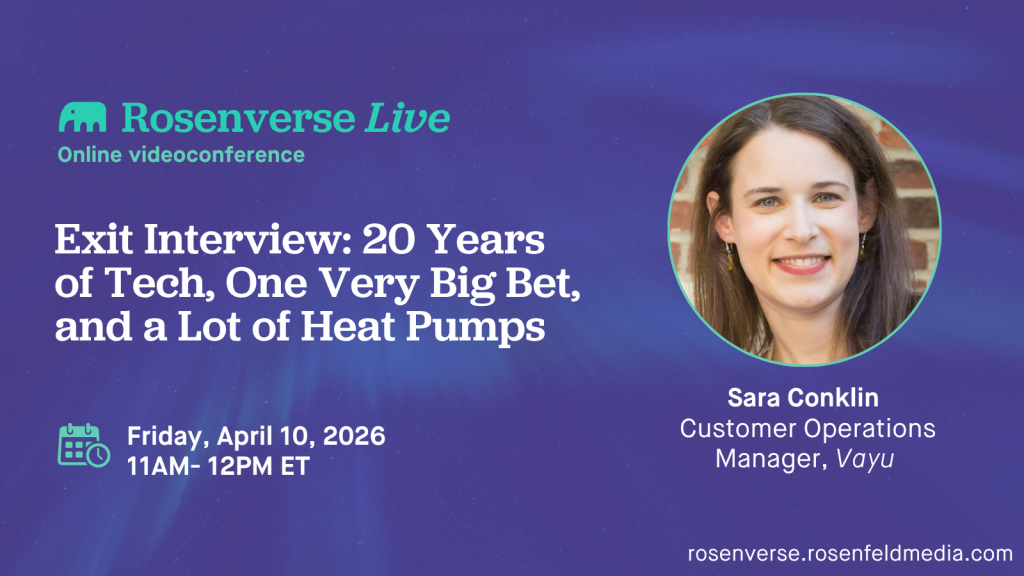
“The title is becoming less important. Focus on the outcome you want to create and whether it feels meaningful.”
April 10: What do you do when you decide your skills deserve better problems?
Sara spent 20 years doing UX work she was genuinely good at with people she truly liked. And somehow still went home empty most days. The problems felt too small. Worse, some felt like they were pointing in the wrong direction entirely. So she made a bet on herself.
She walked away from a senior UX career in corporate tech and spent 18 months building something new from scratch. She journeyed through certifications, new knowledge, trial and error, and eventually a new career in residential electrification.
Now, instead of maximizing clicks and driving consumption, she helps people feel more comfortable in their homes while reducing their bills and their climate impact. These days she sizes HVAC equipment, pulls permits, coordinates subcontractors, and gets fossil fuels out of people’s homes. She also opportunistically uses her UX background to make the whole operation run better.
This is a story about reinvention, risk-taking, and landing somewhere you’d never have predicted you’d find meaning. Watch the recording »
Catch up on last week’s recordings, and mark your calendar for upcoming events.
See you in the Rosenverse!
Why OKRs, agile, and their ilk fail with Jeff Gothelf
AI is reshaping product development faster than most organizations can even rethink how they work—and that gap sits at the heart of this conversation with product design guru Jeff Gothelf. Lou and Jeff explore why proven methods like Agile and OKRs so often become “process theater” instead of real change, and what it actually takes to shift organizations from output-driven cultures to outcome-driven ones.
Jeff explains that most transformations fail because incentives still reward shipping outputs, not creating real value. Meaningful change tends to emerge only in pockets led by leaders willing to experiment and treat ways of working as something to test and evolve.
They also explore how AI is shifting risk upstream—from engineering to vision, validation, and decision-making—making design and research more critical than ever. Along the way, they reflect on consulting as organizational therapy, the need to prove design’s value in the AI era, and why companies that relentlessly embrace new technology are best positioned to endure.
What You’ll Learn from this Episode:
- Why Agile, OKRs, and similar frameworks often fail to create real change
- The critical shift from measuring output to measuring outcomes
- The two traits shared by successful pockets of transformation in large companies
- How to run small, time-boxed experiments to change ways of working at scale
- Why AI makes design, research, and product thinking more valuable
- How to explain and prove the value of “thinking before the prompt” in AI-driven organizations
Q&A with Jeff Gothelf
This Q&A is drawn from this podcast episode.
Q: Why is this shift from outputs to outcomes so important?
A: Because outputs can look productive without actually solving the right problem. Outcomes force teams to ask whether their work is making a real difference.
Q: What does customer-centricity mean in practice?
A: It means starting with the customer’s problem, not the team’s solution. When teams stay close to customer needs, they make better decisions about what to build and what to measure.
Q: What is one of the biggest mistakes teams make?
A: Teams often fall in love with a solution too early. They rush to build before they fully understand the problem they are trying to solve.
Q: How do OKRs support this way of working?
A: OKRs are most useful when they help teams define success in terms of outcomes. They become much less effective when they turn into a list of tasks or deliverables.
Q: What is the biggest takeaway from the episode?
A: The takeaway is that strong product work depends on clarity, focus, and learning. Teams need to stay centered on customer value and measure whether their work is actually changing behavior or improving results.
About our guest
Jeff Gothelf is a product and strategy coach who helps organizations build better products, stronger teams and more adaptable cultures. With more than 20 years of experience, he brings deep expertise in product strategy, cross-functional collaboration, agile-friendly product design and experimentation. He has worked with companies like AOL, TheLadders and Neo Innovation to lead customer- centric transformations and deliver measurable business results.
Quick Reference Guide:
0:10 – Meet Jeff Gothelf; Lou and Jeff discuss bridging the gap between ritual and cultural change
7:44 – Good ideas without a clear understanding of why
9:42 – What it takes for organizations to successfully communicate and incentivize
15:21 – 5 reasons to use the Rosenverse
17:37 – Consultants validate insiders; AI shifts risk toward design clarity
24:20 – AI speeds output, but critical thinking, research, and testing prove designers’ value
27:50 – Jeff and Lou speculate on Amazon’s future
30:49 – Jeff’s gift for listeners
Resources and Links from Today’s Episode:
4 Hands-on virtual workshops to level up your AI skills
Is your UX team actually getting value from AI? Whether you’re a designer, UX researcher, or product manager, staying ahead of AI isn’t optional anymore. Throughout 2026, Rosenfeld Media is offering a series of virtual workshops to equip you with the skills and confidence to assess, implement, and design AI-powered experiences.
Our first dates kick off this spring — save your spot before April 15 to lock in early bird pricing.
View the full workshop series »
 Service Designers as AI-Readiness Leaders: Orchestrating Change Across the Organization
with Erika Flowers | April 27-28, 2026
In this interactive workshop, NASA Digital Service alum Erika Flowers shows how service designers can lead their organizations through AI readiness: the process of aligning people, processes, and systems before technology enters the scene.
 AI for UX Researchers
with Llewyn Paine | April 29-30, 2026
In this workshop, learn a framework for understanding AI’s capabilities within the context of user research and workshop opportunities for AI to evolve the role of research, making the researcher even more valuable in this new world.
 Designing for AI: New Techniques
with Dan Saffer | May 4 & 6, 2026
This workshop will teach a handful of new techniques that designers, product managers, and researchers can take back and start using immediately.
 Designing AI to Make Users Smarter
with Christopher Noessel | May 6-7, 2026
AI is full of promise for users, but it introduces risk as well: over-reliance and deskilling. The good news is that you as a designer can do something about each of these. And Chris Noessel will show you how.
Announcing the themes for Designing with AI 2026
With the constant influx of new AI models and tools, it can be hard to distinguish hype from true value. Learn from experienced design practitioners where AI delivers on its promises, where it hasn’t, and the processes they’re using to leverage AI to its full potential.
Join leading experts at Designing with AI 2026 as they share firsthand AI case studies and the lessons learned along the way. Our two-day conference is split into two themes:
-
Managing AI-augmented product design work
- As AI shifts design work in unprecedented ways, UX leaders are tasked with creating clarity. Deciding how to align people, process, and AI infrastructure requires both strategy and empathy. These case studies demonstrate how leaders are balancing conflicting AI pressures and justifying their teams’ value, even amid constant change.
-
The new AI-augmented design process
- AI is reshaping the traditional design process. There are new steps to adopt and new skills to learn–all while navigating increasingly blurred boundaries across design, research, product, and engineering. These case studies demonstrate how UX practitioners are seizing new AI opportunities, while preserving the focus on the human user.
Don’t miss out on our most highly-anticipated event of the year. Join us June 9-10 for this unforgettable online conference.
Ebooks are now available on the Rosenverse
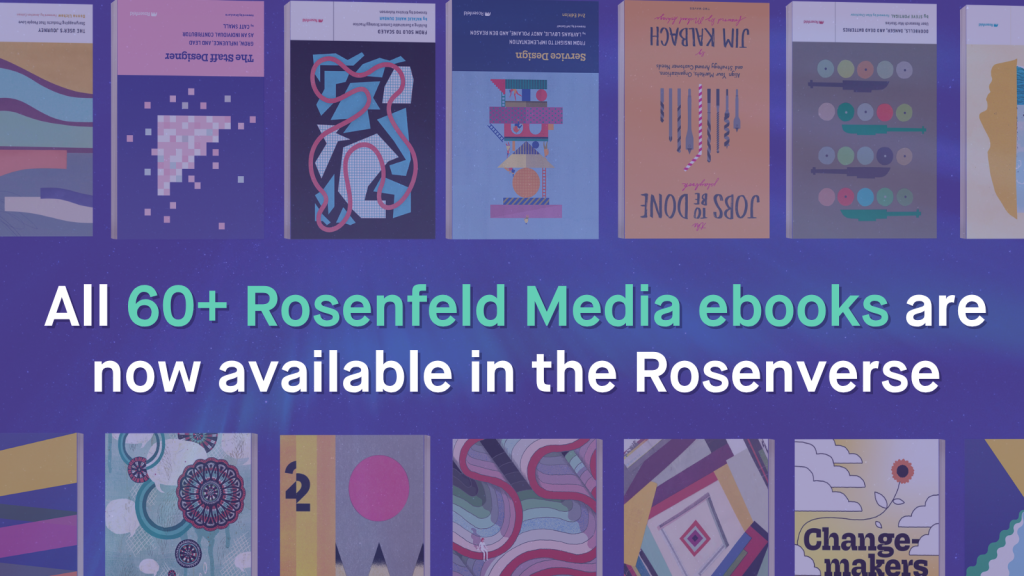
The Rosenverse has expanded! All 60+ Rosenfeld Media ebooks are available in the Rosenverse, exclusively to Gold subscribers, starting right now.
This new feature means you can go to the Books tab in the Rosenverse to peruse new and old favorites such as The User Experience Team of One (2nd edition), Research That Scales, The Staff Designer, and more!
We’re always striving to make the Rosenverse the best it can be, and we’re so excited about this new update!
Are you ready to start reading? Sign up for a Rosenverse Gold subscription today to get access to all of these books—and more!
Rosenverse Live: 7 Insights on Sharing Power in Co-Design with Samuel Martin
Co-design is more than a methodology. It is a commitment to fundamentally rethinking who holds power in the design process and what it actually looks like to share it. In a recent Rosenverse Live session, Samuel Martin, founder of SDMC and the Co-Design Institute, brought nearly two decades of community engagement experience to a conversation that went well beyond surface-level participation frameworks. Drawing on real projects and hard-won lessons, Samuel unpacked the gap between symbolic inclusion and genuine ownership, examining how institutional norms can quietly reinforce inequality even when lived experts are present at the table. From recognizing tokenism in its earliest stages to navigating moments when organizational priorities clash with community needs, the session gave practitioners, advocates, and system designers practical footing for the uncomfortable but necessary work of building processes where lived experts don’t just have a voice but actually drive change.
We pulled seven of the most pressing themes from the session and framed them as questions worth sitting with in your own work.
View the full session for free »
Q: How do you know if you’re tokenizing community members in your design process?
A: One of the clearest signs you’ve slipped into tokenism is when community feedback is collected but never actually used. Asking for input while having no real intention of incorporating it into the work is a hallmark of what’s called the “placate” phase of engagement. It looks like participation on the surface, but the community’s voice isn’t meaningfully shaping outcomes.
Q: Should you compensate lived experience experts for their time in co-design?
A: Compensation for lived experience experts isn’t optional — it’s a baseline expectation. Too often, organizations overvalue academic or professional credentials while undervaluing the expertise that comes from direct lived experience. Paying people fairly for their time and knowledge is one of the most concrete ways to signal that their participation is genuinely valued, not just symbolic.
Q: Will community members make unrealistic recommendations in the design process?
A: A common fear going into co-design is that community members will make demands that are impossible to act on. In practice, the opposite tends to be true. People with direct lived experience typically bring grounded, practical, and even surprisingly empathetic solutions — often toward the very systems that have caused them harm.
Q: What barriers should you remove to make co-design participation equitable?
A: Participation in co-design isn’t just about showing up to a meeting. For many community members, there are real logistical obstacles standing in the way. Supporting people through things like food insecurity, internet access, or childcare needs isn’t going above and beyond. It’s a necessary part of making sure people can show up as their full selves and contribute meaningfully to the process.
Q: Why aren’t surveys always the best tool for community engagement?
A: Surveys tend to be impersonal by nature. They create distance, they’re one-directional, and they don’t approximate real human interaction. Focus groups and direct one-on-one conversations tend to yield richer, more honest feedback because they give people the space to actually be heard rather than just responding to a predetermined set of questions.
Q: How do you engage a community you don’t already have relationships with?
A: When you’re new to a community, the most important first step is identifying who already has trust there. Rather than trying to reach people directly, working with established community partners to understand the landscape, share your goals, and distribute information through channels people already trust is far more effective than cold outreach. The relationship your partners have built is something you can’t manufacture quickly, and trying to shortcut it often does more harm than good.
Q: How do you make sure community feedback isn’t misrepresented when working through intermediaries?
A: The key is building a feedback loop. Whatever information is gathered from community members should always be taken back to that community for verification before it becomes a recommendation or a report. This applies not just to direct quotes but to interpretation. The people whose experiences are being represented should have the opportunity to confirm that what’s being said actually reflects what they meant.
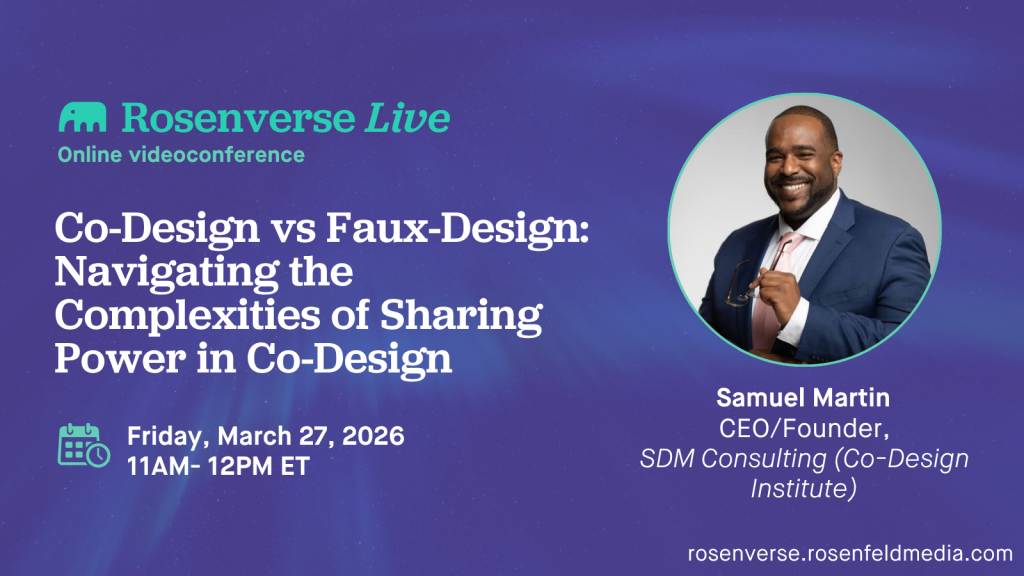
About Samuel Martin
CEO of SDMC, Samuel has 15 years of community engagement experience, advocating with government, corporations, and non-profits to develop positive legislation and policies. He has worked on legislative agenda setting and advocacy with organizations including Casey Family Programs, Foster Club, CCAI, and FCAA. Samuel is an experienced lobbyist, trainer, and public speaker, featured for organizations like Treehouse, Community for Youth, and City Year. He is committed to empowering those impacted by policy to use their voices to advocate and lead. Samuel holds a BA in Political Science from the University of Washington – Seattle Campus and a Master’s in Public Administration from Seattle University.
Meet the speakers for Designing with AI 2026
If you’re thinking about what AI tools to use and how to use them responsibly, Designing with AI 2026 is the place to work through those questions. Taking place virtually June 9-10, our speaker lineup brings together practitioners who are actually doing this work, not just theorizing about it.
Together, we will explore:
- Case studies from UX practitioners on how they validated AI tools before putting them to work in their practice.
- Sessions exploring entirely new design steps that AI makes possible, ones that expand the craft rather than replace it.
- First-hand accounts from teams navigating the shifting ownership of tasks like coding, prototyping, and wireframing as role boundaries continue to blur.
- Honest reflections on AI failures, and the lessons that came out of them.
Our speakers include Beth Chappell (Articulate), Anil Dash (antitech), Claire Dhoosche (Criteo), Paul Ford (Aboard), Shambhavi Gupta (Incedoinc), Joy KendiMwiti (Dalberg Design), Allan Lowson (Arity), Snehal Pendharkar (JPMorgan Chase & Co), Kritika Sony (PromptPath AI), and Vaidehi Supatkar (Philips).
Podcast: Rethinking Design Careers in a Broken System with Jen van der Meer
Podcast Overview
Jen van der Meer’s career path is anything but linear—spanning comparative religion, working on Wall Street, internet startups, and design education. In this thoughtful and timely conversation, Jen shares how her liberal arts background shaped her global perspective, eventually leading her to leadership roles at Frog Design, startups, and now Parsons School of Design, where she co-directs the MFA in Transdisciplinary Design.
Jen challenges designers to go beyond the narrow scope of their titles or craft. Instead of trying to “convince” other industries of design’s value, she argues that designers must step outside their professional comfort zones, learn new languages—especially finance—and see themselves as co-conspirators in systemic change.
With today’s precarious job market and the erosion of traditional design roles, Jen offers a compelling vision for designers to build collective practices, join interdisciplinary communities, and find purpose in transforming complex systems like health, energy, and finance. Her advice to students and early-career professionals? Focus on a system that needs fixing and start connecting with others who care.
What You’ll Learn from this Episode:
- Why a degree in comparative religion gave Jen an edge in global finance
- How working on Wall Street pushed her toward systems-level design work
- Why design can’t change the world without engaging with business
- The importance of shifting from a role-based professional identity to a personal design practice
- How to build a resilient career by focusing on systems, not job titles
- Why transdisciplinary design programs may offer a model for the future of education
Quick Reference Guide:
0:15 – Meet Jen van der Meer
3:17 – Escaping finance for design
7:35 – Why designers should learn finance
11:44 – The challenges of blurred roles and learning the language of your sector and practice
14:33 – Jen’s job advice for students
19:57 – 5 reasons to use the Rosenverse
22:18 – Transdisciplinary design trends
29:11 – Possibilities within Jen’s Parsons program
32:33 – The realities of higher education today and scaling the transdisciplinary model of education
36:12 – Jen’s gift for listeners
Resources and Links from the Episode:
Parsons Studio https://www.newschool.edu/parsons/faculty/jen-van-der-meer/
Jen van der Meer’s website https://jenvandermeer.org
Rosenverse https://rosenverse.rosenfeldmedia.com/
Quotes:
“Comparative religion is a fantastic entry point to navigating the world.”
“That’s what I’ve been working on for the last 10 years. How can I see finance as design territory?”
“We’re not here to convert people. We’re here to work together with other people to transform the systems that we’re in.”
“I think design pedagogy, studio practice, surveys, all of it is the answer to university education.”
Tickets now available for Designing with AI 2026!
We are thrilled to announce tickets are now on sale for Designing with AI 2026, a premier conference exploring the intersection of artificial intelligence and design. This year’s event will take place June 9-10, 2026, bringing together designers, researchers, and innovators to redefine the role of AI in shaping the future of user experience (UX).
What to Expect at Designing with AI 2026
The conference will feature a dynamic lineup of keynotes, panels, and case studies aimed at equipping attendees with insights into how AI is transforming UX processes—and how we can keep those processes human. Whether you’re a seasoned professional or a curious newcomer, this event promises to provide actionable knowledge and inspiration.
Key Themes
- The new AI-augmented design process: How AI is reshaping the traditional design process—introducing new steps, skills, and strategies for both leaders and individual contributors.
- Managing AI-augmented product design work: How to structure and support teams, update infrastructure, and pitch and justify your work in an evolving, AI-augmented design environment.
Why You Should Attend
AI is more than a tool. It is transforming the world of design. At Designing with AI 2026, you will gain:
- Insight into AI’s potential to reshape design
- Practical strategies to integrate AI into your workflow
- New perspectives on ethical considerations in AI use
- Opportunities to connect with leaders shaping the future of design
Register by April 21 to take advantage of early bird pricing. More announcements coming soon!
A Recap of Advancing Research 2026
The Advancing Research 2026 conference, curated by industry veteran Jemma Ahmed, took place virtually on March 10-12, 2026. This event marked a pivotal moment for the UX research community, bringing together diverse voices and perspectives to explore how the discipline is evolving.
If you’d like to explore more from the conference, you can:
- Explore the full program
- Learn more about our speakers
- Buy the recordings (available through June 9)
Key highlights from the conference
Several themes emerged, reflecting how UX research is evolving in response to new technologies, growing complexity, and increasing expectations for impact.
1. Research is becoming an influence discipline
Research is more than just generating insights. It’s about ensuring those insights drive decisions.
Dana Chisnell framed sensemaking as a “superpower,” while a panel with Tala Tayebi, Kelly Goto, and Jared Spool explored how researchers can stay influential even in increasingly noisy, data-saturated environments.
Dr. Feyikemi Akinwolemiwa offered another perspective on influence, focusing on how curiosity and experimentation can make insights more engaging and actionable. Her work shows how research can move beyond reporting findings to actively shaping how teams think, collaborate, and innovate.
These sessions show how influence plays out in practice, from how insights are shared to how they shape decisions.
2. Rethinking Research in the Age of AI
AI is opening new possibilities for research while raising questions about depth, quality, and human judgement.
Several speakers explored how AI can expand research capacity without sacrificing the nuance that makes qualitative work valuable. Tara Tressel discussed how AI-moderated interviews can help teams balance depth and efficiency, while preserving the empathy and context that often get lost at scale.
At the same time, questions about the limits of AI were front and center. Laura Klein examined where AI-driven synthesis falls short, showing how surface-level insights and misleading patterns still require careful human interpretation.
Other sessions pointed to emerging middle grounds. Vitorio Milano shared how quantitative ethnography can translate qualitative data into structured insights, opening new ways for teams to work with complexity. Mujtaba Hameed focused on how AI can support in-person research by reducing time-intensive tasks, giving researchers more space to focus on deeper engagement and richer fieldwork.
The conversations left many with a more thoughtful and less reactive perspective on how AI fits into research practice.
For more Rosenfeld content about AI in UX, explore our virtual workshop series starting this April.
3. Strategies for navigating the evolving research tools landscape
A new third day of the program focused on tools and infrastructure, with sessions open to both paid attendees and free viewers. Together, they highlighted how quickly the research tools landscape is changing and how teams are adapting.
A session on testing and experimentation, led by Erin Weigel and Petra Rajkov, showed how these tools are becoming central to ongoing product decisions, not just validation.
Caroline Jarrett, Aleksandra Korczynska, and Justyna Parmee explored how survey tools are evolving to better support UX research, especially when paired with qualitative methods.
Maria Rosala and Shivanja M. focused on the future of research repositories, while Kate Towsey, Basel Fakhoury, Oren Friedman, and Graham Gardener examined how recruitment tools are improving both speed and research quality.
With so many tools available, our third-day sessions helped clarify how teams can evaluate and choose what’s right for them.
Looking Ahead
As we move into 2026, the insights from Advancing Research 2026 will undoubtedly shape the future of the discipline. The conference set a high standard for collaboration, innovation, and thought leadership, leaving participants inspired to push boundaries in their work.
Missed out? Don’t worry—recordings and resources are available for purchase and viewing through June 9, 2026. Following that, all #AR2026 materials will be available in the Rosenverse exclusively to Gold members. Stay tuned for updates on future editions of Advancing Research!


