
Empower Users with Christopher Noessel’s Newest Release, Designing Assistant Technology: AI That Makes People Smarter
Artificial intelligence is rapidly becoming part of how we work, create, and make decisions. But when it’s designed poorly, it doesn’t empower people, it erodes their skills. Instead of making users more capable, it can leave them overly dependent on systems they don’t fully understand.
Better understand your business’s challenges and how AI can help

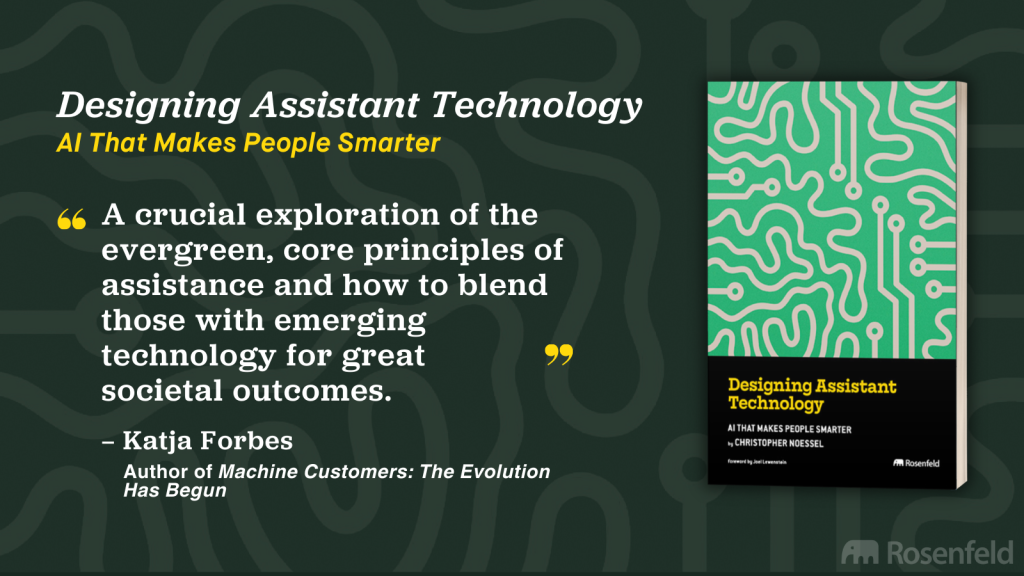
In Designing Assistant Technology, Christopher Noessel provides a practical and timely framework for designing AI that truly supports people. Rather than replacing human judgment, this book shows how to build assistant technologies that enhance it, helping users stay skilled, confident, and in control.
In Noessel’s recent interview on The Rosenfeld Review podcast, he offers a compelling case for why designers are crucial in shaping responsible AI, and how a well-designed assistant can help without dumbing us down. He stresses that “dependence and over-reliance is a major risk with any assistant, but AI makes it more significant and troubling.”
Who should read Designing Assistant Technology?
This book is for the people building and guiding AI systems, including product leaders, designers, researchers, and anyone carefully considering how AI should fit into their work. It’s also for readers who want a more grounded perspective on AI’s impact, beyond hype or fear.
You’ll find practical guidance on how to approach AI design with intention: how to decide when AI should step in, how to keep users in control, and how to avoid the common pitfalls that lead to overreliance or poor outcomes. Along the way, Noessel offers patterns and frameworks you can apply immediately, whether you’re building something new or refining an existing product.
What readers are saying about Designing Assistant Technology
Josh Clark, Big Medium principal and co-author of Sentient Design, says, “An urgent wake-up call to design assistants that amplify judgement instead of replacing it—an unapologetic blend of pragmatism, optimism, politics, and conscience.”
Sheryl Cababa, Founder, Optimistic Design and Author of Closing the Loop: Systems Thinking for Designers, says, “Noessel’s book is a beacon of light: a practical primer with clear frameworks and enlightening examples to guide you in designing AI experiences.”
Meet the author: Christopher Noessel
 Christopher Noessel has shaped interaction design for 30+ years, designing products and services across diverse domains. Back in the dot-com days, he directed information design at marchFIRST, establishing their interaction design Center of Excellence. Christopher’s publications include Make It So: Interaction Design Lessons from Science Fiction (2012, with Nathan Shedroff); the 4th Edition of About Face: The Essentials of Interaction Design (2014); Pair Design (2016, with Gretchen Anderson); and Designing Agentive Technology: AI That Works for People (2017).
Program announced for Advancing Research 2026!
Let’s advance the state of UX research…together.
In a constantly evolving world, it can be hard to keep up. But this March 10-11 at Advancing Research 2026, we’ll tackle it all.We’ll explore two themes at #AR2026:
- Advancing the Work (if not the Role): Discover how UX researchers are pivoting from research doer to enabler while ensuring that the research itself stays true to our shared principles of quality, ethics, and trustworthiness.
- Advancing Research Tools and Methods: Learn how people tackling UX research are achieving what was once unimaginable using state-of-the-art tools, approaches, and expertise.
And get this: The conference program has been announced!
The Game Development Strategy Guide: Read the first chapter
We Need to Talk…About Conflict in the Workplace
Conflict in the workplace is inevitable. Whether it’s a disagreement over project priorities, misunderstandings between colleagues, or personality clashes, tension often simmers beneath the surface of even the most harmonious teams. Yet, despite its ubiquity, many of us are unprepared for difficult conversations at work. We avoid speaking up, hope issues resolve themselves, or worse, let resentment fester until it becomes unavoidable.
But what if there’s a better way to address conflict? What if, instead of seeing disagreements as threats, we reframed them as opportunities for growth, understanding, and better collaboration?
The Cost of Avoiding Workplace Conflict
It’s easy to convince ourselves that workplace conflict is best ignored. After all, who wants to rock the boat? But the cost of avoidance can be high:
- Decreased morale: Unresolved issues can create a toxic environment where employees feel undervalued or misunderstood.
- Lost productivity: Teams bogged down by miscommunication spend more time navigating interpersonal landmines than working toward shared goals.
- High turnover: Talented employees are likely to look elsewhere if they feel trapped in a dysfunctional culture.
Why We Find It So Hard to Talk
Joshua Graves, in his compelling book We Need to Talk, suggests that our reluctance to engage with conflict stems from deeper fears—of being misunderstood, rejected, or losing control. We cling to the illusion that silence equals peace, but in reality, it often means lost opportunities to build trust and clarity.
Facing Difficult Conversations with Courage
Drawing on real-life stories and a spirit of compassion, Graves provides practical guidance for navigating tough conversations at work:
- Listen with empathy: Instead of preparing your rebuttal, try to genuinely understand the other person’s perspective.
- Speak honestly and directly: Clear, respectful language helps prevent misunderstandings.
- Seek common ground: Often, conflicts arise from differing (yet equally valid) viewpoints. Find the shared goals beneath the surface.
Turning Conflict into Catalyst
Embracing workplace conflict as an avenue for growth doesn’t mean seeking it out or relishing drama. Instead, it’s about shifting our mindset. Every difficult conversation is an opportunity for transformation—of individuals, teams, and workplaces.
If you want to become more confident in facing tough conversations and fostering a healthier workplace, check out Joshua Graves’s We Need to Talk: A Survival Guide for Tough Conversations. His wisdom and practical strategies will not only help you navigate conflict at work but also transform the way you communicate in every aspect of life.
Introducing the (new and improved) Rosenverse
Hello friends,
Lou Rosenfeld here, founder and publisher at Rosenfeld Media. If you know me, you know I’m always chasing the next big idea—sometimes to the point of driving my team a little nuts. But today, I’m thrilled to announce something that’s been a long time coming: the launch of the Rosenverse.
So what’s the Rosenverse?
It’s our all-in-one platform that brings together everything Rosenfeld Media has to offer: books, conference recordings, podcasts, live events, discounts, and more. It’s designed for UX and product professionals who want on-demand access to the best resources, events, and people in our field—all in one place.
We’ve listened to your feedback, pored over your suggestions, tore up the beta version, and rebuilt the Rosenverse from the ground up. Here’s what you’ll find:
- A unified experience: All our content—live, recorded, and published—is now accessible from a single, easy-to-use platform. Whether you’re looking for the latest book, a past conference session, or a community call, it’s all right here.
- Rosenbot—the best little chatbot in UX: Meet your new AI-powered research assistant. Rosenbot is trained only on the high-quality content you’ve come to expect from us: our latest books (we publish 8-10 new titles annually), around 1,000 conference and community sessions, and more. The Rosenbot is ready to help you find answers, spark ideas, and support your professional development.
- Fresh content, all the time: We’re adding new community call recordings every month and producing four conferences a year. Gold subscribers get access to all past conference content—including session recordings, notes, sketchnotes, and decks—plus automatic access to new conference content 90 days after each event.
- Community at the core: Join our 14K+ member Slack workspace to connect with peers, get support, and share feedback. We’ve made it easier than ever to collaborate, learn, and grow together.
- Exclusive perks: Gold members enjoy substantial discounts on Rosenfeld books, conferences, and workshops. If you’re serious about your UX journey, this is the best way to stay ahead.
Great content is only as valuable as the conversations it sparks and the community it supports. The new Rosenverse isn’t just about access—it’s about engagement, collaboration, and building a space where UX and product professionals can learn from each other and push our industry forward.
We’re not stopping here. Your feedback will continue to shape the Rosenverse. Join our Slack channels, attend our events, and let us know what you want to see next. We’re committed to making this the best resource for UX and product people—because that’s what you deserve.
Ready to dive in?
If you’ve been with us before, you’ll need to create a new account to access the new Rosenverse—even if you already have a Rosenfeld Media account. Don’t worry: your previously purchased ebooks are still yours to keep.
Thank you for being part of this journey. Let’s keep building, learning, and growing—together.
See you in the Rosenverse,
Lou
P.S. Keep an eye on your inbox for the Rosenfeld Report, our biweekly newsletter, for the latest updates, new releases, and curated UX insights from around the web.
AI is the future of UX. Here’s how to prepare.
As 2025 continues, it’s clear that artificial intelligence (AI) has become more than just another buzzword. It’s reshaping the landscape of user experience (UX) design. In fact, there are many exciting opportunities arising in the UX field because of advancements made with AI. But how do we navigate this shift toward an AI-oriented future while also being mindful of its shortcomings? We’ve got you covered with this quick rundown on the state of AI, UX, and how we can best prepare for the future.
The AI Revolution in UX Design
AI is transforming the way we approach UX design—that much is clear. Let’s explore a couple of ways in which we can harness its potential while staying mindful of its limitations.
Personalization and Predictive Analytics
AI’s ability to analyze vast amounts of data is revolutionizing personalization in UX design. By leveraging user behavior, preferences, and past interactions, we can create hyper-relevant experiences that drive engagement and conversions. AI-powered predictive analytics can anticipate user needs, allowing us to design smoother and more intuitive user journeys.
That being said, we must be cautious of the potential for bias in AI systems. The training data used by large language models can perpetuate stereotypes and reinforce prejudices, leading to skewed results and poor decision-making. It’s essential that we evaluate AI-generated insights through a critical lens and ensure diverse perspectives are considered in our design processes.
Automation and Efficiency
One of the most exciting aspects of AI in UX design is its potential to automate repetitive tasks, freeing up our time to focus on more strategic and creative aspects of design. AI-powered tools can help with tasks like data analysis, layout generation, and color scheme creation, streamlining our workflow and improving productivity. Just think of the amount of tools and resources that are now cropping up to help us with just that!
Challenges and Ethical Considerations
There’s lots of excitement surrounding AI, but as with any technological advancement, there are potential drawbacks we must stay on top of.
Privacy and Data Security
The use of AI in personalizing user experiences, especially in terms of how these models are trained, raises important privacy concerns. Handling user data responsibly and obtaining proper consent is more important than ever. Striking a balance between personalization and data protection will be an ongoing challenge as AI becomes more integrated into our processes.
Emotional Intelligence and Human Touch
While AI excels at data analysis and pattern recognition, it still struggles to fully understand human emotions and cultural nuances. This limitation can lead to designs that lack empathy and fail to connect with users on an emotional level. It’s the human touch that’s so crucial in creating meaningful user experiences. UX designers, we can’t let AI take this away.
Overreliance and Critical Thinking
As AI tools evolve, we run the risk of becoming too reliant on artificial intelligence. We’ve seen examples in other fields, like healthcare, where excessive trust in AI recommendations has led to errors and concerns about reliability. In fact, you may have seen recent study by Microsoft about how reliance on artificial intelligence raises concerns of reduced critical thinking and creative problem solving. It’s crucial that we maintain our critical thinking skills and use AI as a tool to augment our decision-making, not replace it entirely.
Preparing for the AI-Powered Future of UX
To thrive in this AI-driven landscape, here are some steps we can take:
- Embrace continuous learning: Stay updated on AI advancements and their applications in UX design. Attend events like Designing with AI 2025 to keep yourself in the loop and uplevel your AI know-how.
- Develop a critical eye: Learn to evaluate AI-generated outputs critically. Understand the limitations of AI tools and when human intervention is necessary.
- Focus on ethical design: As AI becomes more prevalent, prioritize ethical considerations in your design process. Be mindful of privacy, bias, and inclusivity.
- Collaborate and share knowledge: Engage with the UX community to share experiences and best practices for integrating AI into design workflows. Our network of over 14,000+ user experience designers is a good place to start.
As we navigate this AI-powered future, it’s essential to approach it with both excitement and caution. By leveraging AI’s strengths while being mindful of its limitations, we can create more innovative, efficient, and user-centered designs. The future of UX is here, and it’s up to us to shape it responsibly.
P.S. Don’t forget to check out Rosenfeld Media’s second annual Designing with AI 2025 conference. It’s going to be an awesome opportunity to learn, network, and get inspired about the future of UX and AI. See you there!
5 Hands-on virtual workshops to level up your UX Research skills
Are you ready to revolutionize your UX research skills in 2025?
The Advancing Research conference is back with an exciting lineup of 5 hands-on virtual workshops that will transform your approach to user experience research. Starting in mid-March, world-leading UX research (UXR) experts will guide you through cutting-edge methodologies, innovative techniques, and practical strategies to elevate your research game.
These workshops dive into crucial topics that are shaping the future of UX research. Whether you’re looking to master trauma-informed research, explore quantitative methods for qualitative researchers, or harness the power of AI in your UX research workflow, there’s a workshop tailored to your professional growth.
Don’t miss this chance to enhance your skills, network with fellow researchers, and stay ahead in the rapidly evolving field of UX research. Secure your spot at one (or more!) of our workshops and equip yourself with the knowledge and tools to drive impactful research in the years to come.
Experience our hands-on virtual workshops
 Trauma-Informed Research: Caring for You and Preventing Secondary Trauma
with Carol Scott and Melissa Eggleston
8 hours over 2 segments: March 17 & 19, 2025
In this workshop, learn about secondary trauma and how you can protect yourself and your team. Carol and Melissa will explore practical tips, discuss ways to continue your journey toward becoming trauma-informed, and help you thrive in a long career that is mutually supportive, equitable, and healing for all.
 Quantitative Methods for Qualitative UX Researchers: Triangulate Your Way to Holistic Insights and Stronger Storytelling
with Subhasree Chatterjee and Archana Shah
8 hours over 2 segments: March 18-19, 2025
Many UX researchers often rely on familiar qualitative methods such as interviews and usability testing, overlooking the potential benefits of combining these with quantitative methods through triangulation. Depending solely on one set of tools can result in blind spots, limiting researchers’ ability to provide comprehensive insights. This workshop aims to address these challenges.
 Radical Participatory Research
with Victor Udoewa
8 hours over 2 segments: March 20-21, 2025
This workshop will start with a short, general introduction to Participatory Research methodologies, and then specifically introduce a type of relational research called Radical Participatory Research (RPR), a meta-methodology. We will explore ways to transition to RPR, team recruitment, bias awareness, transitional facilitation, intersectional research, asset-based methodologies, compensation, evaluation, and RPR advocacy.
 AI for UX Researchers
with Llewyn Paine
8 hours over 2 segments: March 25 & 27, 2025
As researchers begin to adopt LLMs, it can be hard to determine where AI makes research better, where it falls short, and where the human researcher provides unique value. In this workshop, learn a framework for understanding AI’s capabilities within the context of user research and workshop opportunities for AI to evolve the role of research, making the researcher even more valuable in this new world.
 Listening Deeply
with Indi Young
8 hours over 4 segments: March 18, 21, 25, 28, 2025
Listening is the foundation for inclusivity, for new opportunities to support more people, and also for powerful team efficiency. Having clear techniques for understanding a person’s interior cognition–for developing cognitive empathy–allows professionals the foundation for later finding patterns that will reveal gaps and inclusive, intentional direction for your solutions. This workshop will teach you how to pay rapt attention. And when and why to do it.
Advancing Research 2025: A Conference for the Future of Research
Exciting news for the research community! We’ve just unveiled the program for Advancing Research 2025, and it’s set to be a game-changer. This year’s conference takes a bold new approach to addressing the evolving user experience research (UXR) landscape—one that we can’t wait to dive into with you.
A Fresh Perspective on Program Design

Jemma Ahmed, with her extensive background in mixed methodology insight roles, has crafted a program that we couldn’t be more excited about. Instead of the traditional method of soliciting ideas and retrofitting them into a loose structure, this year’s conference features an integrated program shaped around overarching themes and community needs.
Addressing the Researcher’s Dilemma

The research field is at a crossroads. With democratization and automation challenging the lower end of the practice, and the constant pressure to “be more strategic” without clear guidance, researchers are seeking a roadmap for their future. And don’t even get us started on the emphasis on artificial intelligence integration. Advancing Research 2025 aims to provide clear guidance for researchers on how to move into the future of UXR.
A Framework for the Future
The conference is structured around three powerful themes, each occupying a full day of the three-day event:
- Day 1: Reconceiving the Purpose of Research (facilitated by Jemma Ahmed)
- Day 2: Redefining the Research Toolkit (facilitated by Megan Blocker)
- Day 3: Reclaiming our Value as Researchers (facilitated by Eduardo Ortiz)
This framework, developed through community workshops and discussions, thoroughly explores the future of research. Where do you see your future as a researcher five years from now, in 2030? Let’s find out together.
A Packed Program with Impressive Speakers

We have three jam-packed with carefully-curated sessions that cater to the themes of #AR2025. Whether that means attending sessions about AI or introducing new methodologies into your practice, our team has its finger on the pulse of all the most critical and emerging topics in the world of UX research. Plus, our speakers represent some of the most impressive minds in the field, hailing from companies like Google, Meta, Hinge, Dalberg Design, and more!
Why Attend Advancing Research 2025?
- Envision Your Future: Gain insights to future-proof your career in the rapidly evolving research landscape. UX researchers have to understand, speak, and even reframe their work in research terms in order to make an impact. Whether you’re moving into a research role, or looking to be a better partner with research peers, Advancing Research will prepare you for success in research-centric organizations.
- Tailored Experience: Enjoy a conference program created by researchers for researchers, addressing the real challenges faced by UX practitioners. Want a sneak peek of the conversations to come? Check out our community workshop series—a collection of Rosenverse sessions that feature some of this year’s speakers talking about topics we’ll explore in the program at #AR2025.
- Networking Opportunities: Connect with peers and leaders in the field, fostering collaborations and sharing insights. We have a dedicated Slack channel for all conference-goers, buzzing with lively conversation over the course of the three-day conference! Also, every conference ticket comes with the opportunity to sign up for our famed attendee cohorts program—the opportunity to meet up with others in a facilitated environment throughout the conference to mingle and discuss each day’s sessions.

Advancing Research 2025 promises to be more than just a conference—it’s a roadmap for researchers navigating the complexities of their field in the years to come. Don’t miss this opportunity to shape the future of research!
Why the DesignOps Summit 2024 is a Must-Attend Event for Design Operations Professionals
Are you ready to be part of the forefront of design operations? The DesignOps Summit 2024 virtual conference is just around the corner, and it’s shaping up to be an unmissable event for anyone invested in the future of design. This year, we’ve packed our three-day summit with three compelling themes: resilience, impact, and innovation. If you’re wondering what DesignOps Summit 2024 is all about, you’re in the right place. We’re here to give you a sneak peek of what to expect on September 23-25 and why you cannot afford to miss it.
A Glimpse into the Eighth DesignOps Summit
The DesignOps Summit has come a long way since its inception. As we gear up for our eighth summit, we’re excited about the maturation of design operations as a crucial field—one that molds the infrastructure, organizations, and operations supporting design at its core.
Resilience in the Face of Challenges
In recent times, design organizations have faced numerous challenges including significant layoffs. The key to overcoming these challenges lies in resilient operations. The “Resilience” theme on Day 1 will delve into how well-structured design operations can make organizations not just survive but thrive. It’s about ensuring your design organization remains relevant, impactful, and efficient.
The Importance of Maturing Infrastructures and Organizations
Design operations need to keep pace with the ever-evolving demands of the industry. Mature infrastructures and organizations are not just beneficial but essential for driving impactful results. This year’s Day 2 theme of “Impact” underscores the significance of meaningful contributions made by design operations professionals. By leaning into this theme, we aim to showcase the impactful work being done and set a roadmap for future endeavors.
Innovation Leading the Way
Innovation is the lifeblood of any forward-thinking design organization. Day 3’s “Innovation” theme focuses on the continuous improvement of design operations, leveraging the latest technology and an enhanced understanding of human interaction with design. The goal is to foster an environment where design teams are always at the cutting edge. This theme will discuss the role of design ops professionals in driving innovation and ensuring the design processes adapt to new technological advancements and evolving consumer behaviors.
Invest in Your Future – Don’t Miss Out!
The DesignOps Summit 2024 is not just an event; it’s an investment in yourself and your organization. The knowledge, connections, and insights you gain here will be pivotal for your career and your organization’s growth. Now is the time to focus on the future of design operations—don’t let this opportunity pass you by!
Join us in embracing the future of design operations with a roadmap for impact, resilience to withstand challenges, and innovation to stay ahead. Register for the DesignOps Summit 2024 and get ready to be a part of something transformative.
By attending the DesignOps Summit 2024, you’re taking a significant step towards enhancing your professional skills and contributing to your organization’s success. We can’t wait to see you there!
Apply to speak at Advancing Service Design, a new conference from Rosenfeld
We’re so excited to announce the launch of a new virtual conference: Advancing Service Design 2024! The conference will take place virtually December 3-4; it is curated by Patrick Quattlebaum and Ben Reason, and produced by Rosenfeld Media.
Why do we need a new conference on service design? Because, as a methodology that helps us connect and communicate designed experiences at a systems level, service design is clearly more relevant and important than ever before.
But we feel there’s a dire need to demonstrate service design’s value in new contexts: how its toolkit can support other practices, like product management, and how it can make a difference even broader, more complex settings that are often inter, not intra-organizational.
Whether you identify as a service designer, systems thinker, or something else entirely different, we encourage you to submit a proposal (see form below) to speak at the inaugural Advancing Service Design. Specifically, we’re seeking case studies that demonstrate how service design:
- Integrates with and supports other practices—like product management, agile processes, and corporate strategy—within an organizational system.
- Engages with wider systems that go beyond individual organizations, as required for impact in such areas as healthcare, the green transition, or with advanced technology.
We anticipate that these presentations will run 20-25 minutes (not including Q&A).
Do you have a rich story to tell, or even a formal case study? Then please submit a proposal to speak by completing the form below. Submissions are due by EOD Monday, August 19.
Important notes for prospective presenters:
- Let’s Advance Service Design together. We’re looking for stories in which Service Design is not the hero; rather, it should be a critical ingredient in a cross-disciplinary partnership.
- This is not your grandfather’s presentation preparation process: Our speakers prepare their presentations over the course of 2-3 months in a highly iterative, collaborative process. You’ll be part of a speaker cohort, getting and providing feedback to your fellow presenters with the aid of our curators and a speaker coach. It’s work that requires your commitment (and if it’s not honored, we’ll remove you from the program). But it also offers a unique opportunity to delve into your idea with lots of support and the benefit of time. You’ll ultimately be positioned to give a great presentation, maybe your best yet—whether you’re new to speaking or a seasoned presenter.
- Diverse perspectives are required, not a nice-to-have: You don’t advance a field by recycling the same voices and perspectives again and again. So we employ our CFP to uncover people from underrepresented groups and others who, for various reasons, haven’t presented frequently. Whether or not you intend to make a proposal here, please also encourage others who might not ordinarily consider speaking to submit a proposal.
- Our CFP asks a lot. We appreciate your spending time to seriously communicate your case study: its context, problem statement, and outcomes. Also note that we request DEI information as part of your proposal, and employ a double-blind review process–so please don’t include personally identifying information in your submission except where we request it.
- What happens next. If your proposal is accepted, you’ll receive a complimentary ticket to the conference and a small honorarium after completing your presentation (and remember, it’s virtual, so no travel required). We’ll also promote you and your case study, and help you develop it. If your proposal is not accepted, we’ll let you know by mid-September.
Reminder that the deadline to submit is EOD Monday, August 19. Contact the Rosenfeld team ([email protected]) with questions.


