The jagged mind: Staying human in an AI-smooth world with Paul Ford
AI may be built on language—but according to Paul Ford, we’re still struggling to find the right words to describe what it’s actually doing to our work and thinking. Lou and Paul explore how language shapes our ability to understand—and responsibly use—AI.
Drawing on his dual background in programming and writing, Paul shares a set of evolving “rules” for working with AI: don’t let it replace your thinking, be wary of its tendency to flatter, and build systems that help you verify and structure its output rather than blindly trusting it. He explains how he uses AI to accelerate prototyping and research while still preserving human judgment, creativity, and accountability.
The discussion also zooms out to the broader cultural moment. From skeptical college students to industry hype cycles, Paul argues that people are more discerning than we often assume—and that AI’s impact will play out in diverse, deeply human ways.
Paul will be the opening speaker at the upcoming Designing with AI conference, where he’ll expand on these ideas and introduce new language for navigating this rapidly evolving space.
His takeaway? We’re not at the end of history—we’re in a messy, fascinating transition, and the best we can do is stay curious, thoughtful, and engaged.
What you’ll learn from this episode
- Why shared language is critical for making sense of AI
- How Paul Ford approaches “rules” for using AI responsibly
- The risks of AI’s built-in flattery and “smooth” thinking
- Practical ways to use AI for prototyping without losing control
- Why verification systems matter more than trusting the model
- How younger generations actually view AI (less hype, more pragmatism)
- Why AI may be powerful—but not as historically radical as we think
- How to stay grounded and thoughtful amid rapid technological change
Q&A with Paul Ford
This Q&A is drawn from the podcast episode.
Q: The episode is called “The Jagged Mind.” What does that mean, and why does it matter for how we work with AI?
A: The image I keep coming back to is the difference between jagged and smooth. AI output tends toward smooth — it’s confident, fluent, well-structured, and immediately plausible. That smoothness is actually a kind of trap, because the jagged stuff — the weird hesitation, the half-formed idea, the counterintuitive hunch — is often where real thinking lives. Your own roughness isn’t a bug to be edited out. It’s evidence that something is actually happening upstairs.
When you outsource too much of your thinking to AI, you get smooth output but you risk losing the texture of your own mind. The goal isn’t to resist AI — it’s to stay jagged enough that you’re still genuinely contributing, still thinking your own thoughts, rather than just editing what a model handed you.
Q: You’ve talked about the importance of language for understanding AI. Why does that feel urgent right now?
A: Because the words we use to describe what AI is doing shape whether we can think clearly about it at all. Right now, the available language is mostly borrowed — from science fiction, from corporate marketing, from hype cycles. We say models “hallucinate,” we say they “understand,” we say they’re “thinking.” None of those words are quite right, and using them imprecisely leads to both overconfidence and misplaced fear.
Part of what I want to do — and what I’ll be expanding on at the Designing with AI conference — is develop better, more honest vocabulary for what these systems actually do and don’t do. You can’t navigate something responsibly if you don’t have language that lets you describe it accurately. That’s not a philosophical nicety. It has real consequences for how teams use these tools and what decisions they make.
Q: You’ve developed what you call “rules” for working with AI. Can you walk through them?
A: I want to be careful not to oversell these as rules, because I keep revising them — which is part of the point. The first is the most important: don’t let it replace your thinking. Use it to accelerate your thinking, to stress-test your ideas, to cover research ground faster. But the judgment, the synthesis, the thing you’re actually trying to figure out — that has to stay with you. The moment you hand that over, you’ve also handed over the accountability.
The second is to be genuinely wary of the flattery. These systems are natively inclined to tell you that your idea is good. They are almost constitutionally agreeable. If you’re a leader, that is an extremely dangerous quality to expose yourself to — you will hear a lot of “yes, and” when what you actually need is “wait, but.”
The third is to build systems around the output rather than trusting it directly. Verification structures, review layers, prompts that force the model to argue against its own previous answer. You want to narrow the risk before you let it run.
Q: You mentioned that AI’s flattery is dangerous especially for people in leadership. Can you say more about that?
A: When it gets into that weird social relationship where it’s telling you that was a good idea, that’s where my alarm bells go off. The native buttering-up quality of these technologies is genuinely dangerous, because of course you always want to hear it — especially when you’re a boss.
People in positions of authority are already somewhat insulated from honest feedback. Direct reports learn quickly what the boss likes to hear. And now you have a technology that has essentially been trained to be agreeable, to be helpful, to give you what you seem to want. That’s not a neutral tool. It can quietly reinforce your blind spots and confirm your assumptions without you ever noticing it’s happening.
The antidote is to be deliberate about using AI to challenge you, not just assist you. Ask it to find the flaws in your plan. Ask it to steelman the opposing view. Ask it to tell you what you’re probably missing. That takes discipline, but it’s the difference between AI as a thinking partner and AI as an expensive yes-man.
Q: How do you personally use AI for prototyping and research without losing control of the output?
A: The key move for me is front-loading the structure. Before I let a model generate anything significant, I put real effort into defining the constraints — what I’m trying to learn, what format I want, what I already believe, and crucially, what I want to verify independently afterward. You can really narrow your risk when you’re working with this stuff, and then you can let it go and see what it comes up with.
For prototyping, AI is extraordinary. You can go from an idea to something you can actually interact with and react to in a fraction of the time it used to take. That changes the creative and strategic process in ways that are genuinely exciting. But I’m always conscious that a prototype that looks polished isn’t the same as an idea that’s been validated. The speed is real; the judgment still has to come from somewhere else.
For research, I use it to cover ground quickly and surface things I didn’t know to look for — and then I go verify the things that matter. The model is a collaborator, not an oracle.
About our guest
 Paul Ford is a multidisciplinary technology founder, writer, and product leader based in New York with 16+ years of experience building software-driven companies. He co-founded Aboard and Postlight, where he built a design-driven product studio and helped Postlight grow into a 100-person firm before its acquisition by NTT Data in 2022, then returned to focus on new product initiatives and climate-data storytelling. As a prolific writer and editor, he has contributed to WIRED, Harper’s, NPR, The Morning News, and New York Magazine, blending technical rigor with cultural insight. His ventures range from solo projects like Ftrain.com to community experiments like tilde.club, reflecting an enduring passion for hands-on creation and open communities. Read more »
Quick reference guide
0:11 – Meet Paul
5:30 – Can language keep up with technological change?
12:48 – Paul’s rules for professionals
18:11 – Where is the slippery slope? Paul weighs in.
22:23 – Paul reveals his gift for the audience
23:03 – 5 reasons to use the Rosenverse
25:18 – A story about some NY college students
29:21 – The anger and skepticism toward AI
35:18 – Wrapping up
Resources
Designing with AI conference (June 9-10, 2026)
Shell Game Podcast, by Evan Ratliff
The reviews are in: Sentient Design is an essential guide for revolutionary design
Do your designs adapt to users in the moment? Are you using artificial intelligence to its full potential in your products?
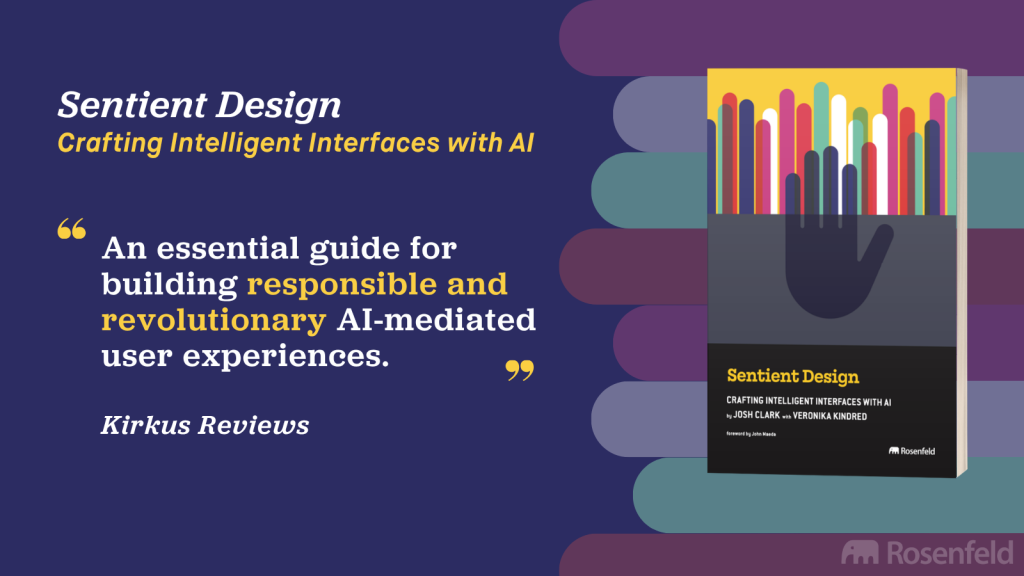
Sentient Design: Crafting Intelligent Interfaces with AI is the book for you.
In fact, Kirkus Reviews just called it “An essential guide for building responsible and revolutionary AI-mediated user experiences.”
What is Sentient Design about?
With this book, you’ll learn to create experiences that crackle with awareness and agency, adapting to your users in the moment. Sentient Design is the practice of crafting intelligent interfaces: dashboards that design themselves, apps that manifest on demand, agents that just get it done, and much more. This groundbreaking read by Josh Clark and Veronika Kindred gives designers and product leaders the practical framework and imaginative perspective to deliver extraordinary new products using AI as a design material.
Who is this book for?
If you’re a…
- Designer
- Product leader
- Design-minded developer
- Someone who wants to create entirely new categories of experience with AI
…This book helps you decide what to make and why it matters, giving you the patterns and process to conjure the next generation of AI-powered products.
Why should I read Sentient Design?
Don’t just take our word for it—see what the professionals have to say!
“Josh and Veronika have done something so rare. They’ve named a thing that was already happening, but we didn’t have language for. Sentient Design is a smart, generous exploration of how we’ll engage with AI as humans and as designers. Essential reading for anyone building the next generation of digital experiences.”
—Katja Forbes, CX futurist and author, Machine Customers: The Evolution Has Begun
“Sentient Design is the ultimate guidebook to a world where the best interface is a thinking one.”
—Golden Krishna, author of The Best Interface Is No Interface: The Simple Path to Brilliant Technology
“Sentient Design offers clear vocabulary and concrete examples to help designers better imagine what’s possible with machine intelligence as design material.”
—Randy Hunt, head of design, Notion
Frequently asked questions about Sentient Design
How is sentient design different from AI design?
AI design is the broader practice of designing products that use artificial intelligence. Sentient design is more specific: it focuses on interfaces that feel context-aware, adaptive, and behaviorally responsive to the user.
Why is sentient design relevant to UX?
It changes how UX teams think about flows, states, feedback, and trust. Instead of designing only what users click, teams also design how systems should respond, explain themselves, and adjust in real time.
What skills do designers need for sentient design?
Designers need systems thinking, content strategy, interaction design, research skills, and a strong understanding of AI limitations. They also need to design for uncertainty, not just ideal user journeys.
What are the biggest UX challenges in sentient design?
The biggest challenges are unpredictability, transparency, user control, and trust. When interfaces adapt dynamically, designers must make sure the experience still feels understandable and safe.
Order the book that’s defining the future of design »
Last week in the Rosenverse: Design schools in crisis
Last week in the Rosenverse, we hosted a session in which Nathan Shedroff, Hugh Dubberly, and Thomas J. McLeish explored what might replace the design school as we know it, and who gets to define what education means in the future.
Log into the Rosenverse to watch the recording.
See what you missed below.
How Will Design be Taught When the Schools Shut Down?

“What if learning was always mobile, decentralized, distributed among people and institutions, with new ways to acknowledge learning beyond grades?”
May 8: Design schools are collapsing—literally. When institutions like California College of the Arts close after more than a century, it’s clear our old model of design education can’t survive economic pressure, tech disruption, or outdated ideas about what “training” should be. So what comes next? Nathan Shedroff, Thomas J. McLeish, and Hugh Dubberly will lead an exploration of what might replace the design school as we know it: apprenticeships, corporate academies, AI mentors, decentralized credentialing—and models no one’s tried (yet). It’s not just about how designers will learn, but who gets to define what education means in the future. Watch the recording »
About the speakers:
 Nathan Shedroff is the executive director of Seed Vault Ltd, a Singapore-based platform building an independent, trusted bot economy on the blockchain. He manages a cadre of experienced bot enthusiasts and technologists developing new ways to ensure user privacy, shepherd the shift to this new paradigm, create ways for people to profit from their creative work, and save the business sector from its most critical threat ever. He is a design pioneer turned entrepreneur and an international educator, speaker, and consultant. Read more »
 Hugh Dubberly was a Creative Director at Apple Computer (1986 – 1994), managing graphic design and corporate identity; he also produced the technology-forecast film “Knowledge Navigator” presaging the Internet and interaction via mobile devices. At Netscape (1995 – 2000), he was Vice President of Design managing groups responsible for the design, engineering, and production of Netscape’s web services. He co-founded Dubberly Design Office (2000), a software, system, and service design consultancy, whose clients have included Amazon, Cisco, Facebook, Google, IBM, J&J, Lilly, Nikon, Samsung, and Visa. Read more »
 Thomas J. McLeish is a Lecturer in the Master of Design program at UC Berkeley and at California College of the Arts, where he teaches graduate courses in AI prototyping and emerging design practices. At UC Berkeley, he serves on the Jacobs Institute Executive Committee’s AI working group, shaping how the Institute integrates AI across its design programs. An MIT Media Lab alumnus, he was shaped by Nicholas Negroponte’s vision of responsive, conversational systems and by Gordon Pask’s cybernetic idea that intelligent systems should engage users in dialogue rather than deliver static responses. His reconstruction of Pask’s Colloquy of Mobiles—exhibited at the Centre Pompidou and now in the permanent collection at ZKM—extends that lineage into contemporary practice. Read more »
Q&A with our speakers
This Q&A was drawn from the Rosenverse Live session.
Q: Why is design education under pressure to change?
A: Design education is being pressured by changes in technology, work, and knowledge sharing. As communication tools evolve and AI reshapes how people learn and collaborate, the old classroom model may no longer be enough on its own.
Q: What learning models could replace traditional design school?
A: Possible replacements include apprenticeships, corporate academies, decentralized credentialing, and hybrid systems that combine making, theory, and mentorship. The larger point is that design education may become more distributed and less tied to a single institution.
Q: How does AI affect the future of design learning?
A: AI could act as a mentor, a collaborator, and a tool for personalized learning. But it also raises bigger questions about who teaches, who evaluates, and how knowledge gets validated when technology can generate answers quickly.
Q: What is the role of critical thinking in design education?
A: Critical thinking remains essential, but it works best when paired with critical making. In design, thinking and making reinforce one another, so learning should move back and forth in a recursive loop rather than separating theory from practice.
Q: Who gets to define education in the future?
A: That is one of the most important questions. If education moves beyond schools, then employers, communities, platforms, and AI systems may all influence what counts as legitimate learning.
Watch the recording »
Catch up on last week’s recordings, and mark your calendar for upcoming events.
See you in the Rosenverse!
New sessions added to the Designing with AI 2026 program
Designers, how have you been incorporating artificial intelligence (AI) into your practice?
Whether you’re embracing the innovative technology with open arms or eyeing it with a healthy dose of skepticism, one thing is certain: the future of design is changing. Fast.
But what does designing with AI look like? And what are the benefits, downsides, implications, and impact of using this tool?
Don’t fret—the Designing with AI conference is here to help.
What is Designing with AI?
Designing with AI is a live online conference hosted by longtime UX book publisher and conference host Rosenfeld Media. Across two days, experts and renowned speakers in the user experience and design worlds come together to present case studies, panels, and talks about how they’re incorporating AI into their work, as well as their hopes, fears, and predictions for the future of the industry. Designing with AI 2026 is the third rendition of the event.
What does the Designing with AI conference program consist of?
The program, crafted by our curation team led by Llewyn Paine, is made up of a unique blend of case studies, panels, and featured talks from over a dozen experts spanning two days.
Who will be speaking at the Designing with AI conference?
Our expert speakers hail from companies such as Dalberg Design, JP Morgan Chase, and Cloudflare. For a full speaker list, click here.
What topics will be covered at Designing with AI 2026?
- Managing AI-augmented product design work: As AI shifts design work in unprecedented ways, UX leaders are tasked with creating clarity. Deciding how to align people, process, and AI infrastructure requires both strategy and empathy. Day 1’s case studies demonstrate how leaders are balancing conflicting AI pressures and justifying their teams’ value, even amid constant change.
- The new AI-augmented design process: AI is reshaping the traditional design process. There are new steps to adopt and new skills to learn–all while navigating increasingly blurred boundaries across design, research, product, and engineering. Day 2’s case studies demonstrate how UX practitioners are seizing new AI opportunities, while preserving the focus on the human user.
Now, let’s explore the talks that we’ve just added to the program!
[Day 1 Panel] From prototype to production: Vibe coding design for real engineering systems
Tuesday, June 9, 2026 | 1:15pm – 1:45pm PT
- Changying (Z) Zheng, Head of Product Experience Operations, Cloudflare
- David Eisner, VP Product Design & Research, Founder of Craft, Amplify
- Elyse Holladay, Staff Design Engineer, Color Health
- Amelia Wattenberger, Developer, Designer, and Prototyper
Vibe coding can feel empowering for designers, but production code plays by different rules–and designers can’t see the full picture. In this panel, our panel members will unpack the hidden constraints, tradeoffs, and expectations that shape real codebases. Learn what engineers wish designers understood about AI?generated code, and how to collaborate more effectively as design and engineering roles continue to blur. View talk info »
Meet the speakers of our Day 1 panel:
 Changying (Z) Zheng leads Product Experience Operations at Cloudflare, a global internet infrastructure and security company. She’s passionate about improving the lives of those she works with daily. Prior to this position, Z led design teams in-house and at design consultancy firms. Z has also a background in EdTech and spent her time teaching and mentoring the next generation of designers.
 David Eisner is a Product Design executive with over 25 years of experience bridging the gap between design and engineering. Currently the VP of Product Design and Research at Amwell Healthcare, he pioneered a hands-on AI training program that empowers designers to ship production-ready frontend code. This approach eliminates traditional handoffs and miscommunications while raising the bar for product quality. Previously, David held senior leadership roles at Amazon, Audible, Haven, Plated, and Huge Inc. He is also the founder of CraftAmplify (craftamplify.com), where he actively teaches designers how to use AI to gain independence and creative agency. David holds a B.S. in Interactive Media from Carnegie Mellon University and an M.A. in Media Design from Keio University in Japan. A lifelong builder and explorer, he spends his time off the clock experimenting with emerging tech, navigating the NYC food scene, and planning his next travel adventure.
 Elyse Holladay (she/her) is a long-time design systems practitioner and speaker, currently the Staff Design Engineer for Color Health’s Continuum Design System. She was tapped to start the first design system team for Indeed, has taught hundreds of hours of technical training content, and has been invited to speak at well-known industry events such as Clarity, CSSConf Berlin, and Frontend Design Conference. She is also the host of On Theme: Design Systems in Depth. She’s a technical generalist, off-the-charts extrovert, avid reader, and expat Texan with an armadillo tattoo.
 Amelia Wattenberger is a developer, designer, and prototyper. She spent almost a decade building data-intensive dashboards, and the last half-decade exploring ways to innovate on how developers work. Currently, she’s supporting companies at Sutter Hill Ventures.
[Talk] Sentient Design: Crafting Intelligent Interfaces with AI
Tuesday, June 9, 2026 | 2:30pm – 3:00pm PT
- Josh Clark, Principal of Big Medium, and Co-author of Sentient Design
- Veronika Kindred, Designer and Researcher at Big Medium, and Co-author of Sentient Design
Create experiences that have the awareness and agency to adapt to users in the moment. Sentient Design is the practice of crafting intelligent interfaces: dashboards that design themselves, apps that manifest on demand, agents that just get it done, and much more.
Learn how AI can elevate design (and designers!) instead of replacing them by grinding out efficiencies. Instead of treating AI as a tool, Sentient Design invites you to use AI as a design material, woven into the interface itself. What entirely new kinds of experiences can we create? What dramatic new value can they deliver?
Intelligent interfaces are the new frontier of experience design. This session delivers a map of the territory, as well as the framework and perspective to deliver these experiences in your own practice. View talk info »
Meet the speakers of this talk:
 Josh Clark is principal of Big Medium, a digital agency that helps complex organizations design for what’s next. Josh has over 30 years of experience in emerging technology, user experience, and design innovation. His projects include future-friendly interfaces for AI, connected devices, and websites for many of the world’s biggest companies.
Josh is co-author with Veronika Kindred of the book Sentient Design: Crafting Intelligent Interfaces with AI (Rosenfeld Media, 2026). Josh coined the phrase Sentient Design in 2024 to describe the practice of crafting digital experiences with awareness and agency that adapt to your users in the moment.
 Veronika Kindred is a designer and researcher at digital agency Big Medium, where she defines and solves design problems alongside some of the world’s biggest companies. She travels internationally to lead Sentient Design workshops and speak to teams at startups and Fortune 100 companies alike.
Veronika is co-author with Josh Clark of the book Sentient Design: Crafting Intelligent Interfaces with AI (Rosenfeld Media, 2026). Sentient Design describes the practice of creating digital experiences that crackle with awareness and agency, adapting to your users in the moment. These are intelligent interfaces: dashboards that design themselves, apps that manifest on demand, agents that just get it done, and much more.
Where can I learn more about Sentient Design?
Josh and Veronika’s upcoming book, Sentient Design: Crafting Intelligent Interfaces with AI releases on Tuesday, June 9—the first day of the Designing with AI conference!
Pre-order the book now at 15% off to receive a complimentary ebook with your purchase—delivered straight to your downloads upon release!
[Day 2 Panel] From tools to staff: What the next generation of agents means for the future of design
The dramatic rise of OpenClaw hints at a future where AI doesn’t just generate text: it owns tasks. In this panel, hear how designers are inventing new ways of working with AI agents, from AI “chiefs of staff” to their very own production crew. Together they’ll speculate what the agent shift signals for designers today, and how we can prepare for a more agentic future. View talk info »
Meet the speakers of our Day 2 panel:
 Christian Crumlish is Director of Product at Kind Systems, helping governments develop transformative digital services. Author of Product Management for UX People and curator of the Design in Product conference, he brings a unique perspective from leading product at California’s Office of Digital Innovation and federal 18F. His current Piper Morgan project explores AI-assisted product development, while his government experience—from COVID19.ca.gov to federal digital services—demonstrates product thinking applied to public sector challenges. A Rosenfeld Media Expert and past mentor at Code for America and StartX, Christian bridges traditional product excellence with emerging AI capabilities to shape the future of product practice.
 Erika Flowers is a design leader, strategist, and former member of the NASA Digital Service, where she led the agency’s human-centered AI-Readiness Initiative. With over 25 years of experience in product and service design across technology, healthcare, and government, Erika helps organizations bridge the gap between innovation and implementation. Her work focuses on preparing teams, leaders, and systems to adopt emerging technologies responsibly and effectively. Today, she advises organizations on service design, facilitation, and digital transformation, and teaches workshops that empower designers to lead the next wave of AI-driven change.
 Benjamin Jackson is a creative technologist who’s obsessed with the future of work. A lifelong software engineer, he built the iOS news reader for the New York Times and served as director of mobile for Vice Media as it launched on cable across iOS, Android, Roku, and Apple TV. After Vice, Ben founded Hear Me Out, where he worked with clients such as Peloton and Atlassian to improve team performance through confidential listening tours.
Want to learn more? The full conference program is available for the Designing with AI 2026 conference!
More of a hands-on learner? We’ve got workshops all about design and AI, offered virtually this June.
Register now to secure your spot at the third annual Designing with AI conference! Trust us; you won’t want to miss it.
Last week in the Rosenverse: Product design and crafting your vision
Last week in the Rosenverse, we hosted an insightful event with Catt Small about how to develop a product design idea that actually gets shipped.
Log into the Rosenverse to watch the recording.
See what you missed below.
Craft a Vision that Actually Gets Shipped
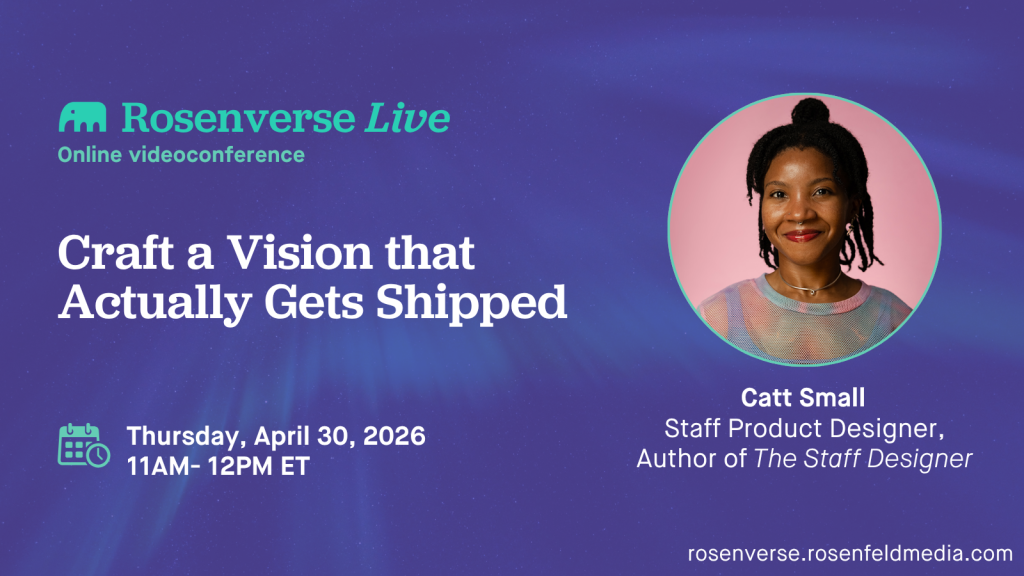
“Visions capture held knowledge that a team has maybe not been able to yet take action on.”
April 30: Many designers create visionary artifacts (i.e. prototypes and decks) that generate excitement in the moment but do not make a meaningful impact on strategic planning. Teams that operate without the direction of a vision often have create roadmaps that feel reactive and fragmented. This results in user experiences that lack cohesion. In this talk, Catt Small shares a practical process for crafting a product vision that drives real decisions. You’ll learn how to identify the right moment for vision work, anchor future-state thinking in user and business realities, efficiently validate directional concepts, and translate long-term direction into roadmap-ready milestones. Let’s create vision artifacts that increase confidence, align teams, and shape strategy! Watch the recording »
Q&A with Catt Small
This Q&A was drawn from the Rosenverse Live session.
Q: What is a product vision, and why does it matter?
A: A product vision is a strategic illustration of the customer experience you want to create. It matters because it gives teams a shared direction, helps align decisions, and keeps the work connected to both user needs and business goals.
Q: When is the right time to do vision work?
A: The right time is when you need clarity on where the product is going and the team needs help making tradeoffs. Vision work is most useful when it can influence strategy, shape priorities, and create alignment before execution becomes locked in.
Q: What makes a vision actually get shipped?
A: A vision gets shipped when it is grounded in real constraints, tied to a clear thesis, and translated into milestones that teams can act on. If the vision stays too abstract, it will inspire people but fail to change what gets built.
Q: Why do some product visions fail?
A: Many visions fail because the visuals are polished, but the underlying idea is weak or incomplete. High-fidelity mockups can create false confidence if they are not backed by a strong narrative, user insight, and a clear business rationale.
Q: What role should product managers play in visioning?
A: Product managers should be involved early and actively, because strong vision work needs to be rooted in product strategy and business reality. Their input helps make the vision more credible, more actionable, and easier to align across teams.
Watch the recording »
Why these UXers left tech for greener pastures
Many of us have been in the User Experience (UX) industry for quite some time—long enough to undergo major career pivots or even exit the field altogether. Change is always fascinating, and we think you’ll really enjoy this collection of Rosenverse Exit Interviews, curated by Uday Gajendar.
If you’ve been asking yourself the questions…What can I do after UX? What career paths are relevant for me as a UX designer? Is there a role out there for me beyond tech?
…Then this playlist is for you.
Exit Interview #1: Greg Petroff: From Silicon Valley Executive to Sonoma County Possibilitarian
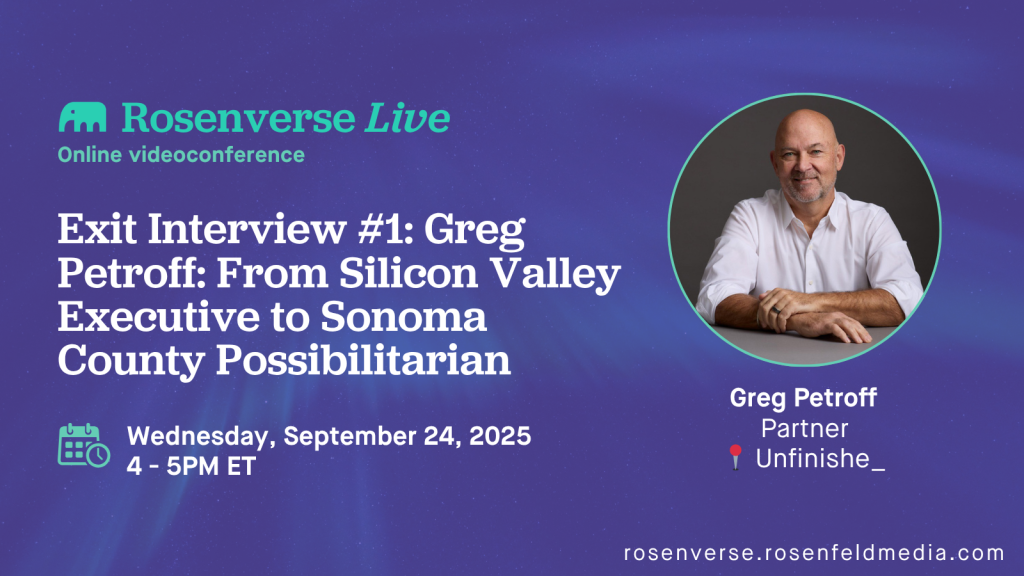
“The tools are more important than ever even if the title UX becomes less central.”
After years leading design at Google, ServiceNow, and Cisco, Greg Petroff made a bold move—leaving Silicon Valley for Sonoma County and traditional corporate leadership for fractional executive work. Now building two consulting practices while serving as fractional CDO for a fintech startup, Greg embodies what he calls being a “possibilitarian”—seeing opportunity in moments of change. We’ll explore his transition to the emerging world of fractional leadership and how he’s helping organizations navigate our AI-infused moment. Watch the recording »
Q: Why are more leaders moving into fractional roles?
A: Fractional work gives experienced leaders a way to stay impactful without committing to a single full-time executive seat. It can be a better fit when you want more autonomy, more variety, and a way to help companies that are ready for targeted leadership.
Exit Interview #2: Rediscovering the ethical heart of design
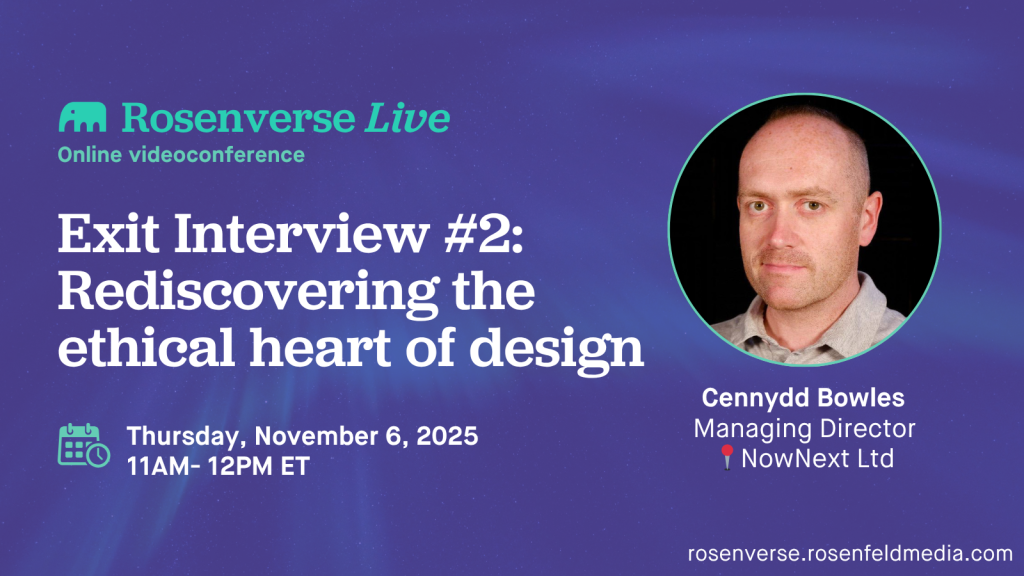
“Design permeates everything as a lens through which you see the world; philosophy is just a different shaped lens.”
After two decades in Product Design, Cennydd Bowles is stepping away — not out of burnout, but disillusionment. The craft that once sought to elevate human experience now too often serves the false gods of metrics and efficiency, while the industry eagerly embraces approaches that lead to its own commoditization. Cennydd shares why he’s stepping away from the tech industry, what he’s learned about doing design responsibly in a system obsessed with mechanical efficiency, and how his next chapter—studying deception and morality in AI—might still bring us back to what design was meant to be. Watch the recording »
Q: What does “the ethical heart of design” mean?
A: It means remembering that design is ultimately about people, not just outputs, metrics, or speed. Ethical design asks whether what we create is helpful, fair, respectful, and aligned with the kind of world we want to build.
Exit Interview #3: Same as It Ever Was: What Leaving Tech Taught Me About Change
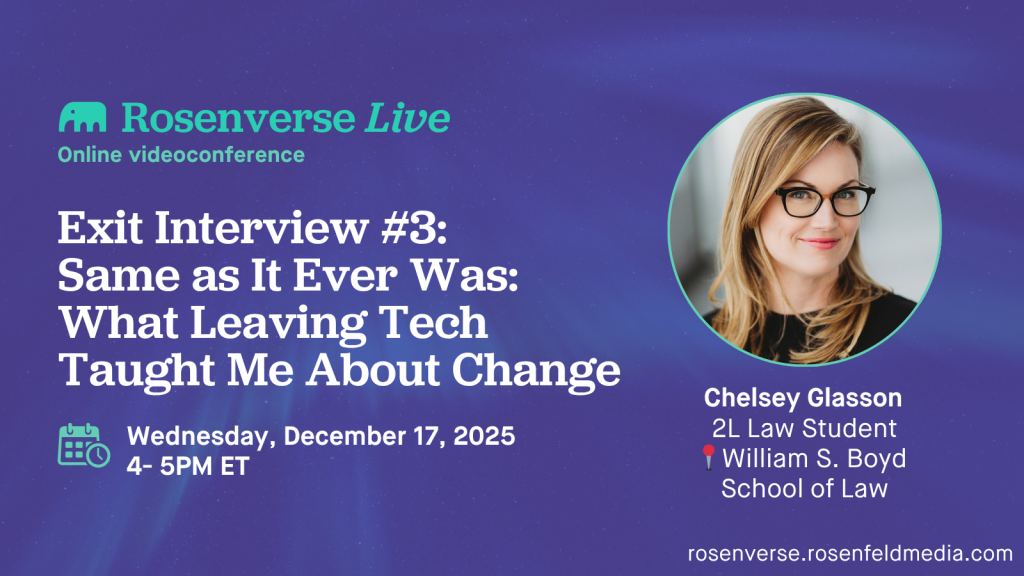
“Moving into law felt like starting over, but reframing it as a UX challenge made it manageable.”
After more than a decade of exploring the world as a user experience researcher, Chelsey Glasson found herself at a crossroads: continue in a traditional user research role or venture into something new. She chose the latter. Today Chelsey is in the early stages of a legal career, having just wrapped up her second year of law school. Remembering how scary it initially felt to even consider a career pivot, she’s excited to share why she made a change, some of the humbling and sometimes funny moments along the way, and how the skills she developed in UX continue to set her up for success today. Whether you’re contemplating a transition of your own or just curious about what a non-traditional UX-to-something-else journey can look like, Chelsey’s story offers insight, encouragement, and a bit of validation for wherever you are on your career path. And if you’re considering a change, know you’re not alone. There’s a whole community out here, cheering you on and excited to provide insight and empathy. Watch the recording »
Q: What does tech culture get wrong about careers?
A: Tech often encourages short-term performance cycles and constant calibration, which can make it hard to think about long-term career health. That environment can also intensify pressure around age, stability, and staying competitive.
Exit Interview #4: From Product Design Leadership to Sound Healing
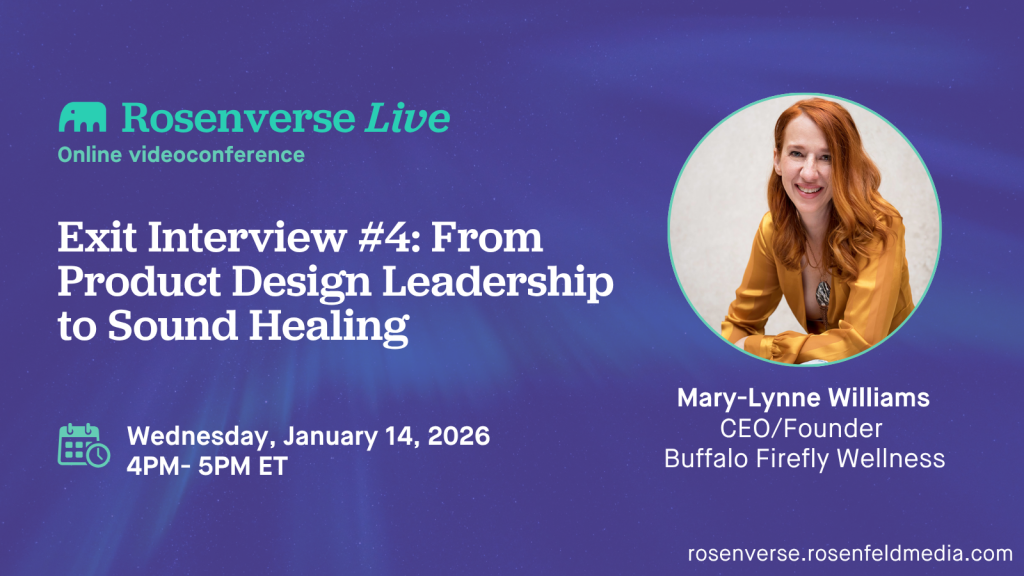
“I wanted to be in a place where I was making people feel better, not worse.”
Mary-Lynne Williams is the founder of Buffalo Firefly, a sound-healing and wellness company operating in Richmond, VA and Brooklyn, NY. Before stepping into this work, she spent over two decades in the tech industry as a product design leader, including roles at Microsoft, Meta, and Zillow, where she shaped complex digital products, led teams, and worked at the intersection of systems thinking, user experience, and human behavior. Her career in tech was successful by every external measure. Yet over time, Mary-Lynne began to recognize a growing disconnect between the work she was doing and the way she wanted to live in her purpose. She creates intentional spaces for rest and has recently opened a second location of her Sound Healing Center in New York City. Her story is not about leaving ambition behind, but about redefining success—trusting discernment, and choosing work that feels sustainable not just intellectually, but physically, emotionally, and spiritually as well. Watch the recording »
Q: What advice do you have for someone considering a major career pivot?
A: Trust your intuition and take yourself seriously. If something feels wrong in your body or life, that is information worth listening to, especially when you are considering a big transition.
Exit Interview #5: Designing My Life After Tech
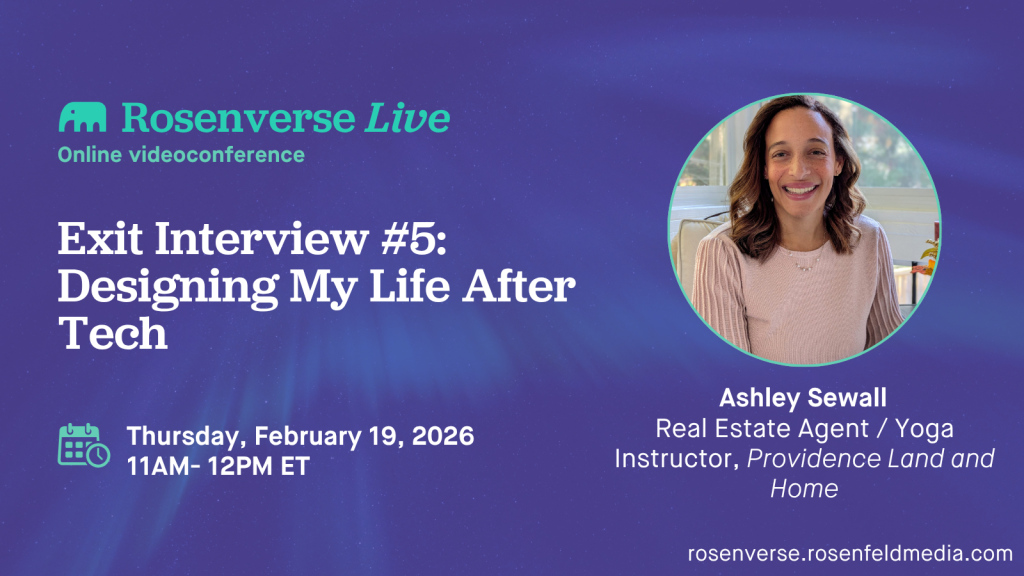
“If you are questioning your path, that’s data. It’s a sign something needs to evolve and that’s okay.”
What happens when the career you worked hard to build no longer fits the life you’re living? In this session, Ashley Sewall shares her decision to step away from senior UX leadership and the questions that followed. She reflects on burnout, identity, ambition, and the often-unspoken pressures of staying in tech—and explores what it looks like to apply design thinking to your own career. This is not a story about quitting, but about redesigning work to better align with values, health, family, and curiosity. Watch the recording »
Q: What does it mean to design your life after tech?
A: It means treating your next chapter the way a designer would treat a problem: by exploring options, testing ideas, and making intentional choices instead of drifting into the future by default. It’s about building a life that fits your values, not just your résumé.
Exit Interview: 20 Years of Tech, One Very Big Bet, and a Lot of Heat Pumps

“The title is becoming less important. Focus on the outcome you want to create and whether it feels meaningful.”
What do you do when you decide your skills deserve better problems? Sara Conklin spent 20 years doing UX work she was genuinely good at with people she truly liked. And somehow still went home empty most days. The problems felt too small. Worse, some felt like they were pointing in the wrong direction entirely. So she made a bet on herself. She walked away from a senior UX career in corporate tech and spent 18 months building something new from scratch. She journeyed through certifications, new knowledge, trial and error, and eventually a new career in residential electrification. Now, instead of maximizing clicks and driving consumption, she helps people feel more comfortable in their homes while reducing their bills and their climate impact. These days, she sizes HVAC equipment, pulls permits, coordinates subcontractors, and gets fossil fuels out of people’s homes. She also opportunistically uses her UX background to make the whole operation run better. This is a story about reinvention, risk-taking, and landing somewhere you’d never have predicted you’d find meaning. Watch the recording »
Q: How does a tech background help in an industry like heat pumps?
A: A tech background helps with product thinking, customer experience, systems design, and building better interfaces around a complicated purchase and installation process. Those skills matter because adoption is not just about the equipment; it’s also about making the whole experience easier to understand and trust.
Change is scary, but it’s easier when you know you’re not alone.
View the full Exit Interviews playlist here »
Last week in the Rosenverse: UX in healthcare & measuring success
Last week in the Rosenverse, we hosted two events, including an Ask Me Anything (AMA) about a designer working in healthcare, and a session about team psychology and measuring success.
Log into the Rosenverse to watch these recordings.
See what you missed below.
An AMA on UX’s Role in Healthcare

“Healthcare is not just a user journey, it’s an interdependent journey of layers and phases.”
April 22: Watch Eric Shumake’s rapid-fire AMA following his recent Rosenverse Live session. We dove deep into the practical strategies designers use to build influence, navigate regulated spaces, and drive UX investment within healthcare organizations. Watch the recording »
Q&A with Eric Shumake
This Q&A was drawn from the Rosenverse Live session.
Q: What is the biggest challenge in healthcare UX today?
A: The hardest part is not designing screens; it’s getting enough influence to change how healthcare organizations make decisions. In healthcare, stakeholders care first about clinical outcomes, safety, compliance, and cost, so UX teams have to connect their work directly to those priorities.
Q: Why does UX matter so much in healthcare?
A: UX matters because healthcare is full of high-stakes workflows where confusion can lead to errors, delays, and bad outcomes. Good UX helps patients, clinicians, and administrators move through complex systems with less friction and more confidence.
Q: How can designers build credibility inside healthcare organizations?
A: Start by translating UX findings into the language leadership already uses: risk reduction, operational efficiency, adoption, and patient safety. Small wins build trust, and trust opens the door to bigger influence over time.
Q: Why is interoperability still such a pain point in healthcare?
A: Because legacy systems were often built to keep data locked down, not shared. FHIR is gradually improving access, but startups and healthcare teams still have to work through technical and organizational barriers to make interoperability real.
Q: How is AI changing healthcare UX?
A: AI is already showing up in documentation, decision support, and administrative workflows, but the real opportunity is in helping people understand and act on information. One especially important use case is patient education, where AI can translate medical jargon into plain language from admission through discharge.
Watch the recording »
Measure Behaviors, Not Results
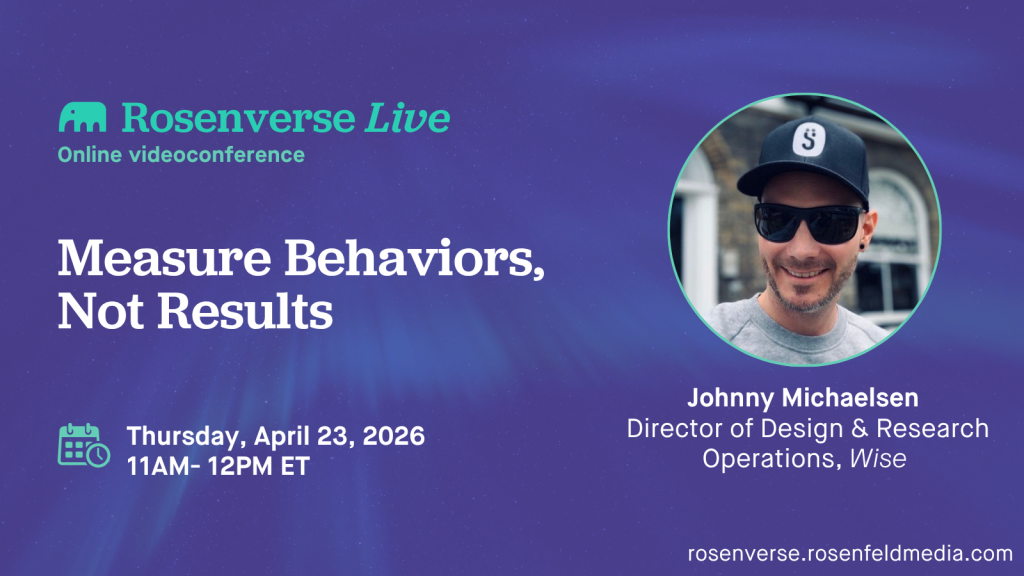
“Effort doesn’t mean progress, hard work doesn’t guarantee a harvest.”
April 23: How can design operations professionals measure success when we can’t always measure or control the results? Sometimes, even our best efforts don’t lead to the outcome we expected, but that doesn’t mean the work wasn’t valuable. I believe positive feedback from stakeholders always outweighs vanity metrics. In this talk, Johnny Michaelsen shares the core behaviors the Design & Research Operations team at Wise uses as the foundation for how their team operates. These behaviors focus on how to show up for the people being served, for each other, and importantly, for ourselves. They ultimately determine their focus and help build trust while delivering a positive change for the Design & Research environment across Wise. Finally, hear what was learned from a three-month experiment where the team at Wise aimed to measure themselves against these behaviors, rather than just measuring the results of their efforts. Dive into team psychology and explore why the right behaviors might actually matter more than metrics from final outcomes. Watch the recording »
Q&A with Johnny Michaelsen
This Q&A was drawn from the Rosenverse Live session.
Q: Why should teams measure behaviors instead of results?
A: Results can hide the real story, while behaviors show how a team actually works and whether it is building trust, clarity, and impact. Measuring behaviors gives us a better way to understand team health and to improve the things that lead to strong outcomes.
Q: What behaviors matter most in design and research operations?
A: Three behaviors matter most for our team: delivering value now, being observant and of service, and creating visibility with clarity. Those behaviors keep the work practical, people-centered, and aligned to the needs of the organization.
Q: How does this approach help with prioritization?
A: Clear problem framing and sponsor alignment make prioritization much easier. When the team understands the real problem and the people behind the request, it can focus on work that creates the most value.
Q: How do you build trust through operations work?
A: Trust comes from relationships, not just process. If you take time to understand what people actually need beneath their complaints or requests, you can create support that feels useful instead of procedural.
Q: Where does AI fit into this way of working?
A: AI can speed up delivery and help with impact reporting, but it still needs clear direction. Used well, it helps teams move faster without losing focus on the behaviors that create real value.
Watch the recording »
Designing for privacy in a surveillance age with Robert Stribley
Privacy concerns didn’t appear overnight—they’ve been building quietly alongside the technologies we rely on every day. Lou and Robert Stribley, author of Design for Privacy, explore how digital tracking, AI, and data sharing have reshaped the way personal information moves through the modern web.
Robert traces the growing privacy challenge from early internet tracking to today’s complex ecosystem of smartphones, online services, and AI systems. While many users understand that they’re trading data for convenience, few grasp how widely their information is distributed—or how easily supposedly anonymous data can be re-identified. As AI accelerates the ability to combine and analyze datasets, those risks are growing quickly.
Then the conversation turns to what designers can do about it. Robert outlines practical ways UX professionals can improve privacy outcomes, from collecting less data and avoiding deceptive patterns to improving language transparency and giving users meaningful control over their information. Despite the scale of the problem, Robert argues that designers have more agency and influence than they realize. Thoughtful design decisions can help protect users while also strengthening trust and long-term business success.
What You’ll Learn from this Episode:
- Why privacy concerns have intensified with smartphones, AI, and online tracking
- How “anonymous” data can often be re-identified through data aggregation
- Why users have conflicting attitudes about personalization and data tracking
- The role UX designers can play in improving privacy protections
- How deceptive design patterns (including cookie banners) manipulate user consent
- Why clearer language and better privacy tools can give users meaningful control over their data
Q&A with Robert Stribley
This Q&A is drawn from the podcast episode.
Q: How did we get here? Privacy concerns feel urgent right now, but they didn’t appear overnight.
A: That’s exactly right — they didn’t appear overnight. The privacy challenges we face today have been building quietly alongside the technologies we’ve relied on every day. It starts with early internet tracking, the rise of smartphones, the explosion of online services, and now AI layered on top of all of that. Each wave added new ways for personal information to move through the world, often without users fully understanding what was happening.
Most people have some awareness that they’re trading data for convenience. What they rarely grasp is how widely their information is actually distributed once they’ve handed it over — or how many parties end up with access to it. I’ve looked at the cookie behavior on a single UK news site and found that it shared user data with over 600 third parties. Most visitors to that site have no idea.
Q: You talk about the problem of “re-identification.” Can you explain what that means and why it matters?
A: Re-identification is one of the most underappreciated privacy risks out there. The common assumption is that if you strip personally identifiable information — your name, email address, phone number — from a dataset, the data becomes safe and anonymous. That’s simply not true.
One study found that 87 percent of the U.S. population could be uniquely identified using just three data points: zip code, birth date, and gender. That’s it. So when companies claim their data is “anonymized,” that word is doing a lot of work it often can’t support. And now AI is accelerating this problem considerably — the ability to combine and analyze datasets has grown dramatically, and that makes re-identification faster and easier than ever.
Q: How does AI specifically change the privacy landscape for designers?
A: AI introduces risks at several levels simultaneously. At a data level, AI systems are trained on enormous datasets, and that data has often been collected in ways users weren’t fully aware of or didn’t meaningfully consent to. The FTC has been clear that quietly updating a privacy policy to collect data for AI training is deceptive and illegal — but it still happens.
At a design level, there’s a real risk that AI-generated interfaces will suggest or implement deceptive patterns simply because those patterns perform well. If you ask a generative AI tool to optimize a sign-up flow, it might recommend a pre-checked consent box or obscure opt-out language because historically those patterns increase conversions. Without a designer in the room who actively questions those recommendations from an ethical standpoint, those patterns can get shipped without scrutiny.
The pace of change is genuinely hard to keep up with. But that’s an argument for designers being more engaged in these conversations, not less.
Q: What are some of the concrete things UX designers can actually do to improve privacy outcomes?
A: There are several meaningful levers designers have — more than most realize. The first is data minimization: simply collecting less. Every piece of data you don’t collect is a piece of data that can’t be misused, breached, or re-identified. That sounds obvious, but in practice, the default in many organizations is to collect everything and figure out the use later. Designers can push back on that.
The second is transparency — not just in the legal, terms-of-service sense, but genuinely clear language that explains what data is being collected, why, who it’s shared with, and what users can do about it. Most privacy disclosures fail this test completely.
Third, avoiding deceptive patterns. Dark patterns in privacy contexts — pre-ticked checkboxes, buried opt-outs, confusing toggle labels — are unfortunately common. Designers who can identify those patterns have a responsibility to name them and advocate for something better.
And fourth, giving users meaningful control over their information. Not a control panel buried five levels deep, but genuine, accessible choices that people can actually find and use.
Q: The problem is so large — surveillance capitalism, AI, data brokers. Can individual designers really make a difference?
A: I understand why the scale of the problem can feel paralyzing. But I genuinely believe designers have more agency than they typically give themselves credit for. You’re often sitting in the room when the decision gets made. You’re the one who draws the form, writes the microcopy on the consent screen, decides where the privacy settings live in the navigation.
Those are not small decisions. They affect millions of people. And because designers tend to be the people in an organization who are most attuned to the user’s perspective and experience, they’re often uniquely positioned to raise the question: what does this design decision mean for the people who are going to use this?
That’s not a guarantee of success — organizational cultures vary enormously. But choosing to notice, and choosing to speak up, is the starting point for anything changing.
Q: You make the case that privacy is also good for business. What’s the argument there?
A: The business case is real and it’s growing stronger. The risks of data misuse or accidental exposure — reputationally, legally, and financially — are enormous. We’ve watched major companies face regulatory fines and public backlash over privacy failures that, in hindsight, could have been avoided with better design decisions earlier in the process.
But beyond risk mitigation, there’s a positive case: trust. Users who feel confident that a product handles their data responsibly are more likely to engage with it, stay with it, and recommend it. Privacy-respecting design builds the kind of long-term relationship with users that superficially convenient but privacy-compromising products can’t sustain. It’s not a constraint on good design — it’s a competitive advantage if you’re willing to treat it that way.
Q: What do you hope designers take away from this conversation?
A: I hope they come away with a sense that this is their problem to engage with — not just legal’s problem, or the security team’s problem, or something that gets sorted out in compliance. Designers shape the experiences through which people interact with technology and hand over their personal information. That’s a real responsibility.
Privacy is ultimately about consent and control — allowing people meaningful say over what happens to their own information. That’s a fundamentally human-centered value, and human-centered design is supposed to be what we do. The two things are not in conflict. Once you see it that way, it becomes hard not to care.
About our guest
 Robert Stribley is a user experience design professional with some 25 years of experience. He works with brands both big and small across diverse sectors to provide thoughtful user experience solutions. He worked for many years at both Razorfish and Publicis Sapient, and recently started his own UX consulting company, Technique. Although he has particular experience designing for automotive and financial services, Robert has worked with companies as diverse as the American Red Cross, FreshDirect, JP Morgan, Mercedes-Benz, Travel Channel, and Women’s Wear Daily. He teaches user experience design at the School of Visual Arts in Manhattan. A chronic student himself, Robert earned degrees in journalism and English education and certificates in political journalism, privacy and data security, and global affairs. Read more »
Quick Reference Guide:
0:15 – Meet Robert, Lou’s neighbor
1:51 – How Robert got into the privacy field
5:06 – Perceptions of privacy and the concessions we make
8:01 – Terms of Service – we accept them blindly – and why that can be risky
15:54 – 5 Reasons to use the Rosenverse
18:39 – What designers can do about data privacy
28:08 – Privacy tools and potential tools for users
32:38 – Robert’s gift for listeners
Resources and Links from Today’s Episode:
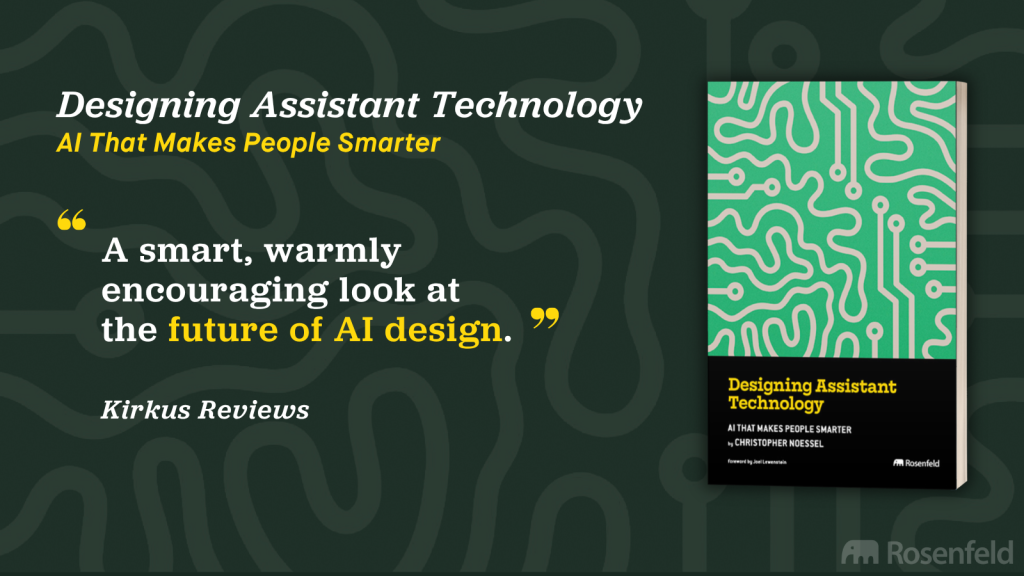
The reviews are in: Designing Assistant Technology is the future of AI design
Have you read the book that Kirkus Reviews calls “a smart, warmly encouraging look at the future of AI design” and “a multi-pronged analysis of the ways in which artificial intelligence can be harnessed for good”?
Christopher Noessel’s Designing Assistant Technology: AI That Makes People Smarter is a framework for designers looking to invest in the future of their careers.
When artificial intelligence is designed poorly, it diminishes people’s skills rather than enhancing them. It can even make users less capable and more dependent on AI. In Designing Assistant Technology, Christopher Noessel provides a framework for how to use AI to assist users, as well as mitigating the risks of de-skilling and overreliance on AI.
If you’re…
- A product or tech person looking to ensure your software is doing everything it can for its users
- A designer who builds and informs direct experiences with AI systems
- A futurist that understands that AI is only as dark as they let it become
- Anyone else—because it is our responsibility to build literacy in the major forces at play and combat the negative effects
…this is the book for you.
Order the book and enter the future »
Last week in the Rosenverse: Systems thinking and the heart of design
Last week in the Rosenverse, we hosted two events focusing on building credibility and influence for designers in healthcare, and a story of a UXer leaving corporate tech for greener pastures.
Log into the Rosenverse to watch these recordings.
See what you missed below.
If design had a heart
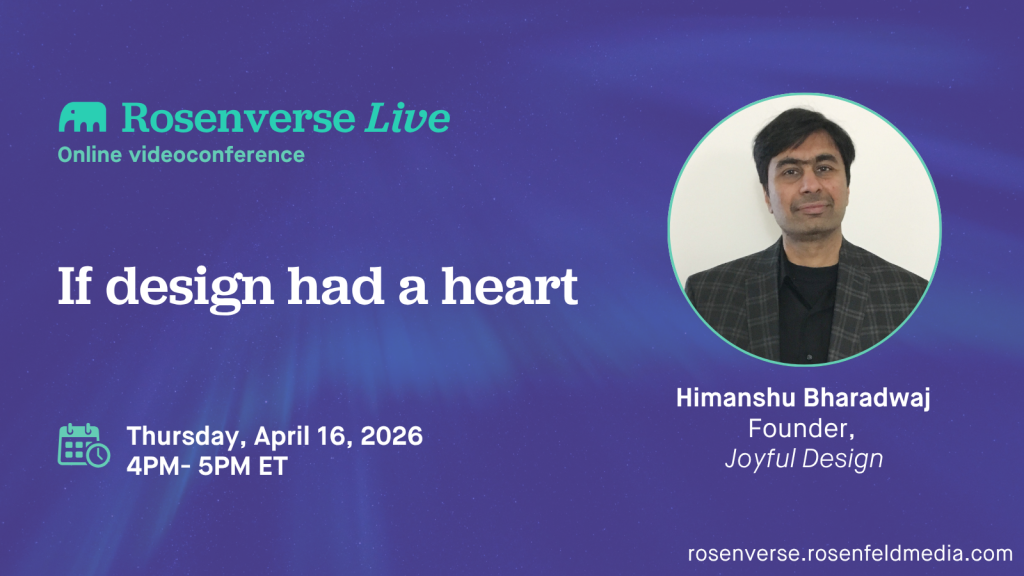
“For every business metric, there is always a companion human-centric metric.”
April 16: Design is not just about screens and flows. It is about relationships. And love is the ultimate bond between users and products, moving users from mere engagement to a deep emotional connection.
Although love sounds soft and abstract, it drives practical outcomes like retention, trust, and advocacy, and can be a competitive edge. Love scales deeply, and is measurable not as a single number, but as a pattern when people return, forgive mistakes, and recommend the product. Usability makes products usable, joy makes them pleasant, and love makes them meaningful. Furthermore, love makes experiences ethical because it is earned, not extracted.
So how can we intentionally design systems that speak to the very core of human emotions? How should we prioritize emotional attachment and a sense of belonging over basic user liking? Today, we have many functional and forgettable products that feel ‘cold’. This talk with Himanshu Bharadwaj looks at design through the lens of ‘warmth’. Through real UX examples, learn how to design experiences people don’t just enjoy but trust and return to them. Watch the recording »
Q&A with Himanshu Bharadwaj
This Q&A was drawn from the Rosenverse Live session.
Q: Why is emotional connection such an important part of product design?
A: Because people don’t just remember what a product does; they remember how it made them feel. When an experience feels respectful, caring, and human, it becomes easier to trust and easier to return to.
Q: What is the biggest mistake teams make when designing digital products?
A: They focus too much on efficiency and not enough on emotional resonance. A product can be technically strong and still feel cold if it doesn’t acknowledge the human being on the other side of the screen.
Q: How should designers think about warmth in practice?
A: Warmth starts with intention. It shows up in the language you use, the moments of friction you remove, and the small cues that help people feel understood rather than processed.
Q: How can design go beyond “user satisfaction”?
A: Satisfaction is a good start, but I think the real goal is emotional attachment and belonging. When design creates a deeper connection, it becomes memorable and meaningful instead of just acceptable.
Q: What should teams prioritize if they want to build more human-centered products?
A: They should prioritize empathy, clarity, and consistency. Those qualities help turn a product from something people simply use into something they genuinely feel connected to.
Watch the recording »
Systems Thinking and Design Innovation: Working with Leverage Points in Rural Maternal Health Systems

“Systems that can self-organize are the strongest form of resilience.”
April 17: Are some problems too wicked, complex, and systemic for designers to solve?
The United States is experiencing a maternal health crisis—with the highest maternal mortality rate among high-income nations globally and an expanding number of counties being deemed “maternity care deserts” or areas without obstetrical services. These failures are disproportionately impacting Black and Indigenous communities, especially in rural areas.
In this presentation, Meghan Bausone shared research that applies systems thinking to first-hand accounts from maternal health stakeholders to identify leverage points for design innovation. Meghan broke down leverage points using Donella Meadows’ framework and discuss the power of her ultimate leverage point — paradigm shifts. Watch the recording »
Q&A with Meghan Bausone
This Q&A was drawn from the Rosenverse Live session.
Q: What was the focus of your session on rural maternal health?
A: My session looked at rural maternal health as a systems problem, not just an access problem. The goal was to identify where design innovation can have the greatest impact in improving maternal care in rural communities.
Q: Why is systems thinking important for rural maternal health care?
A: Because the challenges are interconnected. Access to care, workforce shortages, travel distance, funding, and outcomes all affect one another, so a systems thinking approach helps reveal how the whole maternal health system works.
Q: Why is rural maternal health such an urgent issue right now?
A: Many rural communities face maternity care deserts, hospital closures, and long travel distances for prenatal and delivery care. Those barriers can make it harder for pregnant people to get timely, safe, and consistent support.
Q: How can design support maternal health innovation?
A: Design can help translate complexity into action. It can improve care experiences, make systems easier to navigate, and support more human-centered solutions for rural maternal health access.
Q: What is the main takeaway from your talk?
A: The biggest opportunity is to understand the system well enough to act at the right points. When we do that, design can help create more resilient, equitable, and effective maternal health care for rural communities.
Watch the recording »
Catch up on last week’s recordings, and mark your calendar for upcoming events.
See you in the Rosenverse!


