
The reviews are in: Sentient Design is an essential guide for revolutionary design
05/13/2026Do your designs adapt to users in the moment? Are you using artificial intelligence to its full potential in your products?
Sentient Design: Crafting Intelligent Interfaces with AI is the book for you.
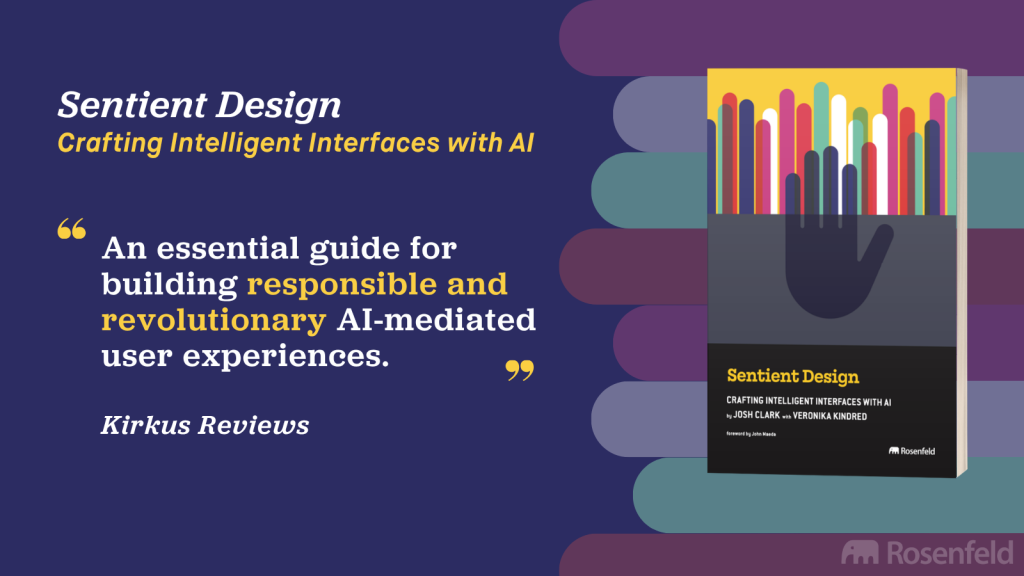
In fact, Kirkus Reviews just called it “An essential guide for building responsible and revolutionary AI-mediated user experiences.”
What is Sentient Design about?
With this book, you’ll learn to create experiences that crackle with awareness and agency, adapting to your users in the moment. Sentient Design is the practice of crafting intelligent interfaces: dashboards that design themselves, apps that manifest on demand, agents that just get it done, and much more. This groundbreaking read by Josh Clark and Veronika Kindred gives designers and product leaders the practical framework and imaginative perspective to deliver extraordinary new products using AI as a design material.
Who is this book for?
If you’re a…
- Designer
- Product leader
- Design-minded developer
- Someone who wants to create entirely new categories of experience with AI
…This book helps you decide what to make and why it matters, giving you the patterns and process to conjure the next generation of AI-powered products.
Why should I read Sentient Design?
Don’t just take our word for it—see what the professionals have to say!
“Josh and Veronika have done something so rare. They’ve named a thing that was already happening, but we didn’t have language for. Sentient Design is a smart, generous exploration of how we’ll engage with AI as humans and as designers. Essential reading for anyone building the next generation of digital experiences.”
—Katja Forbes, CX futurist and author, Machine Customers: The Evolution Has Begun
“Sentient Design is the ultimate guidebook to a world where the best interface is a thinking one.”
—Golden Krishna, author of The Best Interface Is No Interface: The Simple Path to Brilliant Technology
“Sentient Design offers clear vocabulary and concrete examples to help designers better imagine what’s possible with machine intelligence as design material.”
—Randy Hunt, head of design, Notion
Frequently asked questions about Sentient Design
How is sentient design different from AI design?
AI design is the broader practice of designing products that use artificial intelligence. Sentient design is more specific: it focuses on interfaces that feel context-aware, adaptive, and behaviorally responsive to the user.
Why is sentient design relevant to UX?
It changes how UX teams think about flows, states, feedback, and trust. Instead of designing only what users click, teams also design how systems should respond, explain themselves, and adjust in real time.
What skills do designers need for sentient design?
Designers need systems thinking, content strategy, interaction design, research skills, and a strong understanding of AI limitations. They also need to design for uncertainty, not just ideal user journeys.
What are the biggest UX challenges in sentient design?
The biggest challenges are unpredictability, transparency, user control, and trust. When interfaces adapt dynamically, designers must make sure the experience still feels understandable and safe.


