
Unlock new user insights with Body Talk
08/21/2026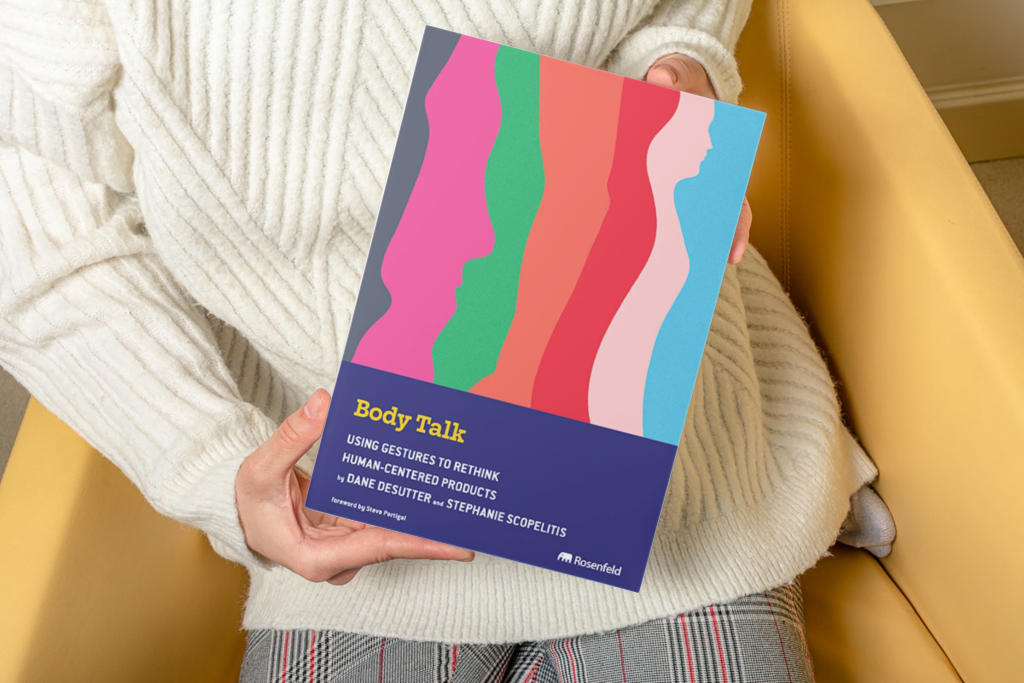
Ever shipped a product or feature that tested well, seemed obviously right, and then just… didn’t land? There’s a decent chance the missing signal wasn’t in anything anyone said. It was in the room — in a shrug, a leaned-in posture, a hand that traced a shape nobody wrote down. A new book from Rosenfeld Media makes the case that this overlooked layer of communication deserves a seat at the table in human-centered design, and it’s now open for pre-order.
Body Talk: Using Gestures to Rethink Human-Centered Products, by Dane DeSutter and Stephanie Scopelitis, is available to pre-order now through October 20, 2026 at 15% off. Here’s what it covers and why it matters.
What does “body talk” actually mean?
People think, communicate, and coordinate with more than words. Gestures — hand movements, posture, gaze, the way someone orients toward or away from another person — carry meaning that speech alone can’t capture. DeSutter and Scopelitis walk through the entire product lifecycle showing how tuning into gesture, both the user’s and your own, deepens research, sharpens ideation, strengthens design validation, and makes it easier to ground fast-moving technology in real human experience.
Is gesture just about the hands?
No, and this is one of the book’s core reframes. A gesture can be a hand movement, sure, but it’s also a shifted posture, a held gaze, a turned shoulder, a lifted chin, or a raised eyebrow in context. The book treats gesture as any visible bodily action that helps people make meaning while they think, talk, and work together. If you’ve only been watching what users say and click, you’ve been missing a whole channel of data.
Who should read this book?
If you talk to users or customers, shape product design or strategy, or lead the people who do, this book is likely speaking directly to you — whether your title is researcher, designer, engineer, or product manager. It’s also built for leaders, educators, healthcare professionals, and facilitators whose work depends on reading people accurately and getting things done together.
If you’ve ever wondered why a promising idea fizzled in the room, the answer may have been sitting in gestures nobody was trained to notice.
What will I actually be able to do after reading it?
The book is hands-on, not just conceptual. You’ll come away able to:
- Recognize how gestures reveal people’s mental models and help them think.
- Read the meaning in gestures that words leave out entirely.
- Understand how the thinking, communicating, and coordinating body work as one system.
- Actually spot the gestures that matter, instead of missing them.
- Evaluate and analyze gestures for their communicative impact.
- Use gesture to build trust and belonging within teams, and collaborate more richly as a result.
- Read gesture in context — tied to your goals, your relationships, and how ideas move through a group.
- Prototype and build the right thing, together, faster.
- Analyze and interpret gestures captured on video.
- Use AI and software to search video at scale and locate movement patterns.
What’s inside, chapter by chapter?
The book moves from foundational theory into applied practice across eight chapters — starting with why gesture-awareness matters, into how to actually “see” it, how to analyze gesture data, and finally how to build stronger teams and design better products by paying attention to what bodies are already telling you.
What are people saying about it?
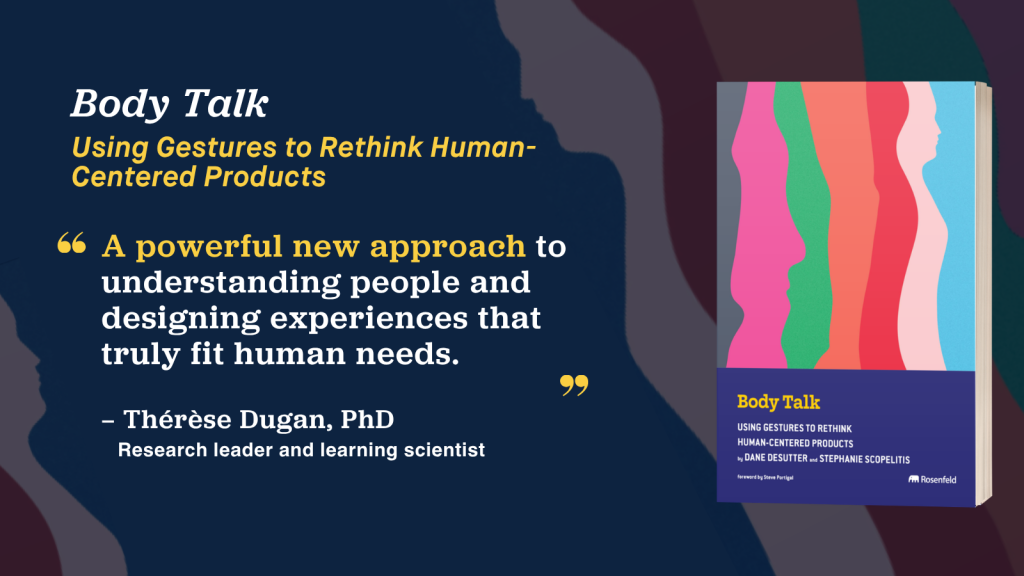
Early readers across design, research, and academia are calling it a genuine shift in perspective — from design leaders praising its focus on understanding human needs beyond words, to researchers highlighting how it grounds gesture in real practice, to reviewers noting that even in an AI-saturated moment, human-centered products still start with old-fashioned human observation.
Order a copy before October 20 to save 15%.
About the authors
 Dane DeSutter is an embodiment and gesture scientist who has spent over a decade studying how the body externalizes and supports complex cognition and putting those insights to work in product development. He uses spontaneous co-speech gestures to probe the fine details of people’s mental models across domains as varied as spatial reasoning in science, physician-patient dynamics in clinical environments, wearables, developer experience, and human-AI interaction. He is currently a Senior Product Researcher at Microsoft. Read more »
 Stephanie Scopelitis is an educator, learning scientist, and qualitative researcher. Her life as a professional dancer carried her into a deeper study of human interaction and the body. She has built her work on a fundamental belief: we understand and navigate the world through our bodies. Read more »


