
Sample Chapter: Game Development Strategy Guide
This is a sample chapter from Cheryl Platz‘s book The Game Development Strategy Guide: Crafting Modern Video Games That Thrive. 2025, Rosenfeld Media.
Chapter 1
What Makes Us Play
Why do players choose to keep playing your game? If you can’t answer that question, stop everything you’re doing. You can’t afford to waste millions of dollars chasing a complex software project that might not actually excite players. But before you dive too deeply into what motivates players to play games, you should understand the rules of the game-making game. How do you define a “game”? Merriam-Webster defines game as “a physical or mental competition conducted according to rules with the participants in direct opposition to one another.” But what about single-player games, where you’re only competing against yourself? This definition makes several assumptions that aren’t true of all games: that games are competition, and that players are in direct competition with one another.
If you’ve ever played a collaborative game like Overcooked! (Figure 1.1) where players team up to complete goals on their local device, those video games challenge both of those assumptions. The rules of the game provide goals, so that the only competition the players experience is against their own performance. And under normal circumstances, players are also cooperating, not competing. However, what keeps players coming back to gaming is often much more than a relentless pursuit of growth or mastery. Thriving games satisfy a wide variety of human psychological needs. These motivators will be at the core of everything else discussed in this book.
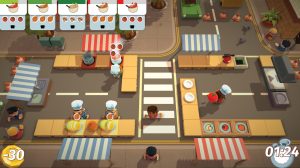
Figure 1
Overcooked! is a popular multiplayer game that requires two to four people to work together to complete food orders. It is virtually impossible for a single player to complete any order alone.
Defining Games
When I teach video game design and development, I give two definitions of games: games as contextual challenges, and games as a sort of user experience puzzle—friction with intent. The definition of game is in the eye of the beholder. If you’re looking to build a commercial video game, it doesn’t actually matter what academic definition you choose your players will be the arbiters of whether or not you got it right. It’s your job to sift through the options and choose a definition that resonates most with your instincts, training, and lived experience; that’s part of the art. (And sometimes that art imitates life, as in Figure 1.2.)

Figure 2
Game Dev Tycoon is a Steam PC game that turns the complex process of developing games into a game by simplifying difficult decisions into repeatable patterns with opportunities for creative expression.
Games as Contextual Challenge
Games are sets of rules, challenges, narratives, or patterns to explore that are set in an interactive context that makes them compelling or enjoyable to the player. I add “to the player” because I would like to avoid normalizing situations like The Hunger Games and Squid Game where participants are exploited for the benefit of someone else.
Games as Friction with Intent
Games are user interfaces that use intentional friction to give players the satisfaction of surmounting obstacles in an enjoyable context, while ideally minimizing friction that does not serve the game’s core purpose. That second clause is where many games trip up—they provide plenty of challenges to master, but they forget to remove the unfun aspects of their game like awkward inventory management. “Fast travel” is a great example of removing unnecessary friction.
What is Game Design?
To start with, ponder the semantic questions: What is game design and who designs games? If you just define game designer as “a person who designs systems, content, or artifacts for games,” there are a wide variety of folks from different disciplines who qualify, from game design to UX design and even environmental artists. Think of it this way: Many people design for games, and some specially trained people practice the specific craft of game design.
During my time as Director of UX for the Player Platform at Riot Games, “design” was an overarching discipline, and within it were the cousin crafts of game design and user experience design. Within those crafts, there were some optional specialist roles, like narrative designer and technical designer that you will learn about in Chapter 3. What I loved about this model was that it encouraged both sides to communicate openly during our biweekly design shares. In video game development, there is often a blurry line between where one type of design ends and another begins. At the core of any game designer is a desire to understand and shape for human motivation in service of specific gaming outcomes. Delivering game designs that support a wide variety of nuanced player motivations is one of the most satisfying parts of video game development, as I discovered during my time on Disney Friends DS.
Case Study
Disney Friends DS Player Motivation
One of my proudest game development accomplishments was shipping Disney Friends, a Nintendo DS–exclusive original title where players could focus on their relationship with four key Disney characters as their caretakers (Stitch, Simba, Dory, and Winnie the Pooh). As lead producer on Disney Friends DS, I was very passionate about creating a game that created an immersive environment and placed the focus on those characters, rather than the UI. To avoid distractions, we chose to render 3D on two screens using a hardware hack (Figure 1.3), and we eliminated almost all UI from the “Interaction Mode”—leaving just the Friend themself.
During playtesting, this immersive environment that allowed players to interact with a Friend—via positive or negative touch or voice commands—resonated deeply with young girls in a way that few other games at the time were achieving (likely due to the gameplay motivator of companionship). But somehow, our young male players in playtesting (around 7–10 years old) reported that they “didn’t get it.” This felt like a huge failure, because Stitch is like catnip for kids raised in United States male social norms. After the test, I sat with my lead designer Amy Kalson (Player 7 throughout this book), and we pondered the feedback until we realized that the phrasing was key. The boys didn’t know what to do. We’d stripped away so much that there was no clear path to mastery—and mastery is widely recognized as one of the most common motivators of play. Girls didn’t struggle with this as much because they were more likely to have been taught the intrinsic value of positive social interaction. On a hunch, we made three relatively minor changes:
- Positive interactions would generate “friendship points.”
- When “friendship points” were generated, a sparkle effect could be seen around the character.
- A single daily “friendship point” meter was added to the screen, providing a daily goal for positive interaction.
We rebuilt and retested the game with only this change, and the change in the results was the best possible scenario. Girls still loved the game and reported they could play it for hours. But now, the boys were super engaged as well. We’d given them a path to mastery, while still allowing the girls to pursue the motivator of companionship in parallel.
Well-designed games can adapt to multiple motivators of play simultaneously, increasing your market and broadening the appeal.
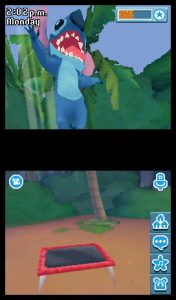
Figure 1.3
The final Disney Friends Interaction Mode UI contained a “friendship points” goal meter, which was created as a result of playtesting feedback from players seeking a path to mastery.
A Theory of Fun
Raph Koster’s A Theory of Fun for Game Design revolutionized the gaming industry when it came out in 2004, applying a series of existing behavioral science and cognitive psychology insights in novel ways to explain why games succeed. As Raph pointed out in the 20th anniversary keynote celebrating his book at GDC (Game Developers Conference) 2024, in the ensuing decades some of the theories upon What Makes Us Play which his work was based were disproven—and yet, the theories still seem to be relevant for entirely different reasons. Koster defines a broader category of “enjoyment,” which he segments into four phenomena: aesthetic appreciation, visceral reactions, social status maneuvers, and fun. Here are a few things Koster has to say about fun:
- Fun is the act of mastering a problem emotionally.
- Fun is about learning in a context where there is no pressure.
- There are multiple styles of learning, so different games will appeal to different people.
- It is the act of solving puzzles that makes games fun. In other words, with games, learning is the drug.
Fun starts for many players with the pursuit of comprehension and mastery. Not all players play for this reason. But the pursuit of mastery is a deeply intrinsic behavior, partially because humans have learned to learn their whole life and are typically rewarded positively for successful learning. It is the act of solving puzzles that makes games fun for these players, in many cases, because learning is how humans survive—and their brains will reward them handsomely for displaying their adeptness at learning in any context.
People play games to make their life better in some way. But what better looks like, and why, varies greatly based on the individual and their context. “Fun” is subjective. Ralph’s take is just one take on fun: For example, designer Nicole Lazzaro has proposed a different framework called “4 Keys 2 Fun” framework that proposes “Hard Fun” (triumph over adversity), “Easy Fun” (curiosity), “Serious Fun” (relaxation and excitement), and “People Fun” (amusement). Nicole’s model looks at fun as an umbrella, and beneath that umbrella are other forms of motivation.
Raph Koster and Nicole Lazzaro explore some core motivators of play like fun and mastery—reasons that players are drawn to play games, drawn from observation and study of the body of cognitive psychology and gaming research. In my class “What Makes Us Play: The Craft of Video Games” at Carnegie Mellon’s Master of Entertainment Industry Management (MEIM) program in Hollywood, we’ve added a few modern takes to this evolving list. You’ve encountered a few of the motivators already in the case study earlier in this chapter. Now, let’s explore what makes humans play.
Motivators of Play
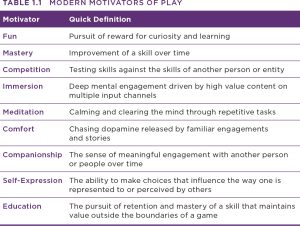
A motivator of play is one of the core psychological needs that a player seeks to satisfy when choosing to play a game of any kind. Players may consciously or unconsciously pursue these motivators, and players may pursue more than one motivator at once within any specific game. From the wide variety of takes on potential play motivators, I define six core motivators of play in my class: fun, mastery, competition, immersion, meditation, and comfort. I also define three modern motivators of play made possible by internet gaming: connection, self-expression, and education.
Fun
Players are motivated by fun when they believe there is new content to learn. This content could be the simple joy of discovery as a story is revealed based on continued gameplay, or it could be the act of mastering the gameplay itself that is the learning. The continued desire to engage with something fun is typically influenced by dopamine, a critical neurotransmitter in the brain that is intrinsically tied to motivation and rewards in addition to other core systems often utilized in games like attention and memory.
Dopamine transmits a good feeling, and it motivates you to continue pleasurable activities. For example, you may have heard people casually referring in the vernacular to a “dopamine hit” when scrolling social media to see their likes. Seeing that a post has been liked generates positive feelings and motivates people to refresh their feeds in search of another “hit” of that positive feeling. When a game successfully creates a positive feeling, if it’s clear to a player how to achieve that feeling again, they may be motivated to continue seeking that elusive fun.
Mastery
Mastery, a sense of skill or superiority in a subject, is one of the most common motivators of play. In the Disney Friends DS story at the beginning of this chapter, you saw that the lack of a clear path to mastery caused some players to feel lost and unmotivated until we launched a simple fix aimed at satisfying this need. Achievements came into popularity with the Xbox, but they are a key element of effective “gamification” that gives players tangible goals to strive for on their path to mastery. Players are so hungry for the feeling of mastery that they’ll even retrofit old games with achievements. While researching this book, I discovered a website where players had reverse-engineered digital copies of out-of-print games I’d designed or produced 20 years ago (like 2006’s Pirates of the Caribbean: Dead Man’s Chest for the Game Boy Advance), in order to retrofit them with a modern system to award achievements based on the original gameplay—an interesting symptom of changing player expectations over time.
Competition
Competition is more than mastery—it is the chance to best other humans in a unique combination of connection and skill, which can take many forms. The most traditional is head-to-head gameplay, but you may also see leaderboard-style gameplay where players complete single-player modes in an attempt to score the highest, go the fastest, or finish first. Not every game has competition, and not every player will enjoy it or find it rewarding. (That won’t always stop game executives from trying to force competition into the game. Just ask the exec who suggested we add a “pwned” list to The Sims.)
There are also different levels of competition. Many players are more comfortable competing against friends, but a minority of game players will be drawn to “ranked” play, which tends to elicit the type of vulnerability, intense language, and harsh behavior that runs counter to many peoples’ primary reasons for gaming: fun, escape, relaxation, or a feeling of mastery. To maximize your market and chances for success, even highly competitive games should consider providing multiple ways to play and compete.
Immersion
Immersion speaks to a state of deep mental engagement that transports you from stressful daily surroundings to another world, often using a combination of storytelling, art, and sensory stimulation. When players are immersed, the intensity of engagement in an activity often increases. Beat Saber is an immersive rhythm game for the virtual reality Oculus system: Unlike more traditional games like Just Dance, the use of the virtual reality affordances completely surrounds players with a new way to experience the music with their entire body. This full immersion often leads to enthusiastic dance interactivity: Many people use Beat Saber as an exercise tool.
Meditation
Meditation as a motivator of play refers to the ability to calm and clear the mind. Repetitive but dynamic experiences like Candy Crush Saga give players a way to “shut off their brains,” focusing on the game in a similar fashion to yogis having students focus on breathing. Researchers at the University of Oxford in 2009 conducted a study that indicated that playing Tetris in the 20 minutes after a traumatic event actually reduced the number of flashbacks to the traumatic scenes the next week. This is evidence of a meditative state that helps to clear the mind and prevent permanent memory retention of unwanted stimuli, which is a powerful finding for gaming in general.
A 2021 pandemic-era university study found that the physiological effects of casual gaming in short bursts is comparable to meditation techniques like body scanning: “Overall, our data show that playing a casual video game such as Flower (Figure 1.4, from thatgamecompany) for a short duration can be nearly as effective in reducing stress among undergraduate students as participating in a body scan session for the same duration. There was a statistically significant decrease across all four stress measures (PSM-9, heart rate, systolic blood pressure, diastolic blood pressure) pre- to post-intervention.” In short, some forms of gaming can present the same physical and mental benefits as mindfulness and meditation.
Comfort
Comfort in this context refers to the power of familiarity, nostalgia, repetition, and dopamine to take the edge off the day. Comfort is subjective and often factors into the replay of existing games, or for the play of casual games with which you were familiarized as children, like Solitaire. In recent decades, the comfort motivator is often associated with so-called “cozy games,” as first popularized by games like Harvest Moon (1996) and famously succeeded by the Animal Crossing and Stardew Valley franchises. Disney Dreamlight Valley creative director Joshua Labelle described their take on the cozy genre for a literally playful article in Reuters: “One of the core fantasies of a cozy game is getting to live in a community where, maybe there is friction sometimes, but ultimately everybody kind of pulls together and holds together.”

Figure 1.4
Flower, a casual nature-themed game from thatgamecompany, has been shown by researchers to provide meditative physiological effects.
Note on Mindfulness
If you’re having trouble differentiating comfort from meditation, focus on the mindfulness. Meditation is largely about the support of a mindful state “in the moment” without seeking a specific outcome, while comfort is often found by using stimuli to elicit specific familiar emotions and feelings, like finding a plush toy to hug.
Three Modern Motivators of Play
Clear trends that have become normalized in recent years with the prevalence of social gaming, family gaming, and the internet have led to the emergence of three motivators that weren’t moving the needle in the industry decades prior:
companionship, self-expression, and education.
Companionship
Companionship can speak to the social element of gaming, from World of Warcraft guilds to Jackbox parties. Sometimes people keep playing a game for connection long after the fun has waned. In other cases, a game can provide the sense of companionship when social connections are not present. This is seen in Nintendo’s Animal Crossing series of games, where players recruit new residents for their towns, write letters to nonplayer characters, and work toward the shared good of their village, even when no humans are living there.
Self-Expression
One of my first assignments as an intern on the last expansion pack for The Sims (2000), The Sims Makin’ Magic, was to investigate and document the fan community. This was long before “user-generated content” (UGC) became an industry buzzword. But even in 2003, with dial-up and basic pre-CSS websites, fans were not only posting stories built from screenshots of their Sim families, but they were even authoring their own furniture, appliances, and decor to mod the game for the community. This was an incredibly powerful movement, and you can see it replicated today; open creator worlds like Roblox and Minecraft mix self-expression, companionship, and mastery in an endless loop. In other games, the simple act of self-expression through cosmetics/character “skins” is enough to fund entire live-service games, as is seen with Riot Games and their tentpole games League of Legends and VALORANT.
Note: Defining Cosmetics in a Gaming Context
Cosmetics and Skins: Aesthetic customizations for in-game characters, avatars, weapons, or other elements that typically have no bearing on gameplay outcomes.
This movement is backed by research. In May 2024, Variety reported on findings from Fandom’s annual “Inside Gaming” survey where 46% of players indicated “creation, imagination, and self-expression” were one of their main motivators for playing video games. That’s a 10% increase from the 2023 survey, and a strong signal in an industry that once viewed self-expression as a niche interest.
Education
In A Theory of Fun for Game Design, Koster talks about practice as a fundamental human behavior and learning as a critical part of fun—but he also talks about learning in a sandbox. In most cases, the skills and information learned while gaming are only useful in that context. Certain games go beyond traditional mastery to provide players with permanent improvements in their knowledge that can be applied outside the game world. The popular language learning game Duolingo has all of the trappings of a game—leaderboards, experience points, characters, health and energy, and beyond—but at its core it is driving players down a permanent mastery track toward acquiring a life skill.
Manifesting the Motivators
Are all of these motivators shown in Table 1.1 created equal? No. The collective drive of the player community shifts with cultural norms and current events. In the “Fandom Inside Gaming 2024” survey, which surveyed 5,000 gamers, players responded to a question about their top motivation for gaming with results that map to all nine of the modern motivators.
The results from this Fandom study in 2024 map loosely to many of these motivators, but in ways that challenge previously held assumptions:
- 54% of players said stress relief is a primary motivator for play, a combination of comfort and meditation.
- 46% cited creation, imagination and self-expression.
- 40% of players cited achievement and rank, and 33% cited challenge—both mastery-oriented motivations for play.
- 39% of players cited social connection and community, which map to companionship.
- 37% of players cited “to escape” and 31% of players cited “exploration,” both of which map to immersion.
- 20% of players cited intellectual stimulation, which maps to education.
- 18% of players cited competition as a primary motivation for play.
It may be shocking to view competition so low on the list when so many of the most successful games are competitive, like Call of Duty and Apex Legends. Keep in mind that competition is inherently social. In a way, these results may imply that social connections have become more important to many players than the competition. This may also be an indication that the competitive market is oversaturated, and that there is plenty of untapped space for noncompetitive social games where social expression and collaboration rule the day. The success of collaborative user-generated content platforms like Minecraft and Roblox could be seen as evidence in line with that hypothesis.
Note: Bartle’s Player Types
An alternative way to look at player motivation has been proposed by Richard A. Bartle, creator of the original “Multi-User Dungeon.” Bartle’s simpler taxonomy divides players into four archetypes who are defined by the binaries of (1) player vs. game focus and (2) interacting with something vs. changing/acting on something:
- Achievers who are interested in acting on (or mastering) the game
- Explorers seeking surprise by interacting with the game
- Socializers who focus on interacting with other players
- Killers who seek to act on other players
These archetypes manifest several of the motivators of play like mastery, competition, companionship, immersion, and self- expression. Bartle defines these player types as a sort of system: In his experience, games require a stable (nonequal) balance of the four archetypes.
Mechanics of Motivation
When you talk to a cognitive psychologist about motivation, they probably won’t mention the motivators of play. Those are a heuristic built from observation of a specific industry. Psychologists take a more general view of motivation, defining two primary types of motivation: intrinsic motivations driven by internal frameworks or concepts and extrinsic motivations driven by external stimuli that send signals about desirable vs. undesirable behavior.
Intrinsic Motivation
Although this may seem surprising to observers of an industry seemingly driven by concepts like achievements and gamerscores, it’s actually fairly common for players to play games without an extrinsic reward. After all, the classic business model for gaming: a player purchases a cartridge or CD… and then what? Before there were achievements, players just played the games they bought. There have been many proposed frameworks for understanding intrinsic motivation, but for the purposes of this book, let’s focus on a perspective from inside the industry.
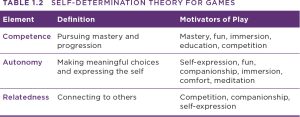
You don’t necessarily need multiplayer mechanics to address the need for connectedness. The farming simulator Stardew Valley was both lauded and criticized for its rich nonplayer character gameplay that allowed players to engage in meaningful relationships, making what might have been a repetitive farming game transformational. Years after the original release, outlets like CBR are still talking about these relationships: “The social and romantic aspect of the game is one of Stardew Valley‘s most compelling features…. Dating, unlocking heart events, and getting married are undoubtedly some of the most rewarding and fun activities in Stardew Valley.
Extrinsic Motivation
Extrinsic or external motivation is classically associated with early video games. Think about point-based arcade games or pinball machines.
- If one action scores less points than another, what does that do to your motivation?
- What happens if there is an action or circumstance that doesn’t score any points at all?
Games reward all kinds of things to capitalize on motivation by extrinsic motivation. Points are a classic example, but you should also consider achievements, currency grants, collectibles, loot drops, and beyond. Some teachers will reward good behaviors in schoolchildren with stickers or other prizes: A common tool is a chart upon which kids can place “gold stars” or other desirable stickers in zones that indicate what positive behavior they displayed.
The Balancing Act
The problem with extrinsic rewards is that once players grow to expect them, the absence of those rewards causes an immediate loss of motivation. Extrinsic motivation is a bit like a motivational crutch: Use it too much, and you will atrophy the core important intrinsic motivation muscle that was driving those interactions. I have seen this play out in situations where highly engaged players stop playing at the end of a battle pass, for example. That said, almost every game loop you see will involve some kind of action—reward pairing.
This may seem to indicate that extrinsic motivation is too dangerous for use in gaming but look to Edward Deci’s work for some important nuances. In his research, Deci found that money as an incentive in particular caused this atrophy of intrinsic motivation. “In short, money may work to ‘buy off’ one’s intrinsic motivation for an activity. And this decreased motivation appears (from the results of the field experiment) to be more than just a temporary phenomenon.” Since many games inherently reward players with forms of currency, the same mechanics can be applied. (In general, other forms of extrinsic motivation like social approval did not have a demotivating effect.) When rewarding players with money, virtual or physical, you are literally assigning a value to player time and effort. When that is not honored consistently, players may disengage. The popularity of using gaming tropes like achievements comes at a known
psychological cost: The later absence of those motivators will render people less likely to engage than they would have been without the extrinsic motivators.
Extrinsic rewards are fine if used sparingly and intentionally, but they are a one-way street. Once you implement extrinsic rewards, your players are unlikely to play without them. If you don’t full What Makes Us Play understand the role that extrinsic rewards play in your gaming systems, you will be at risk of losing even highly engaged players when those rewards cease. Good game designers will typically balance intrinsic and extrinsic motivational methods to ensure that their games stand the test of time.
The Motivational Mindset
Dungeons and Dragons game masters know that motivation takes many forms. Within a gaming party, each individual has a character sheet with a unique set of statistics, like constitution, wisdom, charisma, and strength. These characters also have skill points in specific skills like lockpicking and acrobatics. The character sheet for each character becomes a powerful motivator of a player’s choices in gameplay. A character high in charisma is going to be motivated to talk to lots of nonplayer characters. A character high in strength may be more likely to break down doors than wait for their lockpicking counterparts to finish.
As a game master, you must decide: Will your campaign provide a wide variety of experiences so that each unique character build gets to explore what drives them? Or will you make a choice to lean into a specific type of gameplay, like a campaign that relies heavily on verbal interaction and thus charisma checks to get by? Different players will likely come away with different levels of satisfaction with a campaign, depending on how well that campaign lets them satisfy their own individual goals for their character—even if the overall campaign was a success for the group.
Motivators of play work similarly. Each human is built differently, and the character sheet for a living human is just as complicated as a Dungeons and Dragons character sheet. Some players will choose play styles that emphasize domination and destruction; others will choose play styles that emphasize connection and exploration. It’s up to the game master to decide how and what in this spectrum should be accommodated.
Some of the general truths about the motivators of play:
- Not all players will have the same set of motivations, even when playing the same game.
- One player might have different motivations for playing different games.
- It’s rare for one game to adequately serve every motivator of play; typically, they specialize in a few of them.
- A game’s ability to satisfy a motivator of play is often a subjective topic.
Prepare for the Boss Battle
Boss battles in video games refer to the climactic final showdowns at the end of major levels or entire games. They typically require players to demonstrate mastery of the variety of skills they’ve picked up earlier in the level or game. To conquer this chapter’s boss, prepare yourself to use the motivators of play in your work:
- READY: Figure out what the definition of game means to you in a way that resonates with your work.
- SET: Memorize the nine motivators of play covered here (Koster’s six: fun, mastery, competition, immersion, meditation, comfort—and our extended three: companionship, self-expression, and education) and map the appropriate motivators to any game or feature you’re working with.
- GO: Learn the difference between intrinsic (self-driven) and extrinsic (motivated by external stimuli) motivation and look for ways to honor both in your game designs.


