Read the first chapter of What Your Machines Should Do by Stefanie Hutka
10/08/2026AI is just automation’s latest chapter—yet too many organizations chase fully automated futures untethered from readiness and customer value. What Your Machines Should Do closes that Automation Strategy Gap. Stef Hutka draws on decades of lessons from human factors, HCI, cognitive science, and systems thinking to help you automate with intention: setting deliberate direction, sequencing rollout, and making grounded day-to-day decisions.
Read chapter one for free below!
Chapter 1
Dreams of Automated Futures
Close your eyes and picture “the future.” (Go ahead, I’ll wait.) What did you see? Robots folding your laundry? An AI agent answering all your emails? Skies filled with delivery drones? Chances are your vision of the future included machines doing more for us than they do today.
If so, you’re not alone. Society’s cultural imagination has long equated the future with automation. Sometimes, the vision is dystopian, like Karel ?apek’s 1920 play, Rossum’s Universal Robots: robots built to free humans from labor ultimately revolted, driving humanity to the brink of extinction. Other times, it’s utopian, like the 1960s cartoon The Jetsons, with flying cars zipping between skyscrapers and Rosie the robot keeping the family home spotless.
NOTE: FROM FICTION TO ROADMAP
The role of automation within fiction doesn’t just influence cultural imagination. It also plays a role in shaping the technologies we build. For instance:
- The word robot comes from ?apek’s play, and is based on the Czech word robota, meaning forced labor. ?apek’s robots were synthetic beings created to do unwanted work, foreshadowing today’s debates about machines replacing human labor.
- Rosie from The Jetsons would go on to inspire the invention of the Roomba, the autonomous robotic vacuum cleaner. Colin Angle, CEO of iRobot, the company that created the Roomba, has said Rosie sparked their initial interest in building cleaning robots.
Why the Future Never Quite Arrives
It should come as no surprise that visions of automated futures also serve as a North Star for business executives. Take General Motors chairman and CEO Roger B. Smith. In the early 1980s, General Motors was in trouble. They were facing mounting financial losses and growing competition from Japanese automakers. Smith, looking to revitalize the company, turned to aggressive automation to transform manufacturing efforts, inspired after touring a Toyota plant. His vision was a “lights-out” factory of the future: a robot-led operation with so few humans that the lights could be turned off.
General Motors was set to scale from just 302 robots in 1980 to a projected 14,000 by the end of the decade. A plant in Saginaw, Michigan, was to be the crown jewel of this operation: a robot-run facility that would boost productivity by 300%. However, there was a gap between Smith’s vision of full automation and the reality of execution: the robots couldn’t reliably distinguish between car models. They attached the wrong parts. They painted each other instead of the vehicles. With costs exceeding those of traditional unionized plants, the Saginaw factory eventually closed in 1992. All said, these automation efforts were (conservatively) estimated to have cost General Motors around $40 billion, equivalent to about $95 billion in 2026.
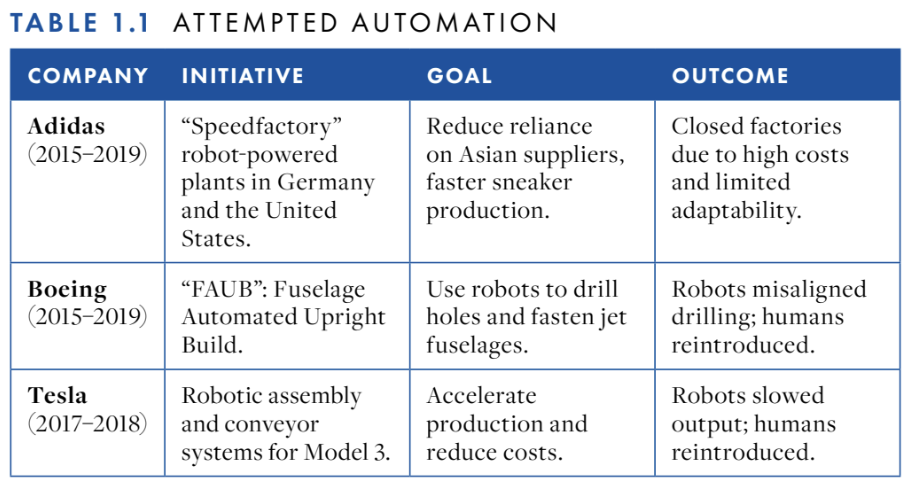
Surely, the General Motors case study would serve as a cautionary taleagainst defaulting to a fully automated vision of the future. Except you don’t need to look far to see this pattern repeat with several other high-profile companies, such as Adidas, Boeing, and Tesla (Table 1.1). Ambitious attempts at doing away with humans gave way to costly failures, and often, bringing back the very humans the machines were supposed to replace.
Just when you thought this was a book about the challenges of automating manufacturing with robots, you get the story of Klarna, Swedish fintech company, and their attempt to automate customer service with AI. In 2023, Klarna’s CEO Sebastian Siemiatkowski decided to embrace an “AI-first strategy,” integrating ChatGPT into its customer service operations. By February 2024, they had launched an AI assistant that, within its first month, fielded about two-thirds of customer chats—some 2.3 million conversations. That same year, Klarna imposed a hiring freeze, added on top of a nearly 40% workforce reduction since December 2022.
Klarna touted their AI assistant as a breakthrough, claiming it could replace the work of 700 human agents. Yet, by May 2025, Siemiatkowski announced Klarna would start rehiring staff because customer service quality was plummeting. Customers were getting stuck in long back-and-forth conversations with a chatbot and receiving unempathetic responses to sensitive questions about payment issues. Sometimes, the responses were flat-out incorrect. Despite a different use case, technology, and decade, the Klarna example fits the pattern: bold visions of full automation collapsing under real-world complexity. This pattern is modeled in the Automation Strategy Gap.
The Automation Strategy Gap
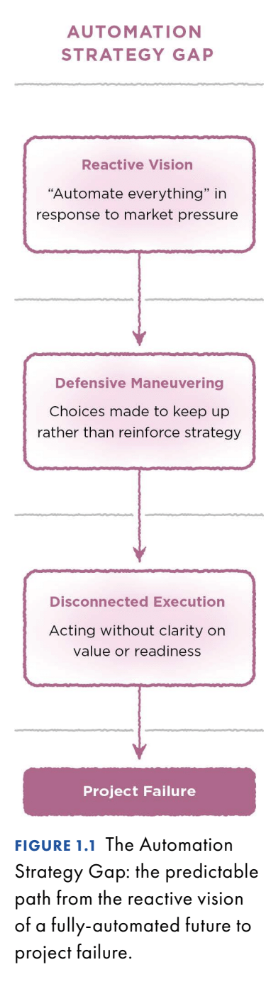
The Automation Strategy Gap is the misalignment between an organization’s automation aspirations and the realities of what is required for successful implementation (Figure 1.1). This gap results from a predictable pattern that begins with a reactive vision of full automation in response to market pressures. This initial reactivity sparks a chain reaction that results in execution that is detached from automation value and the organization’s ability to move from automation idea to implementation (organizational readiness). The result is that the promised future of machines replacing their costly human counterparts never arrives, leaving organizations with losses and pun-laden headlines (see the 2024 New York Times’“260 McNuggets? McDonald’s Ends A.I. Drive-Through Tests Amid Errors”).2
From Market Pressures to Reactive Visions of Full Automation
The vision of a fully automated future is hard to resist. It’s a story written into our cultural imagination from science fiction, offering the promise of lower costs, higher productivity, and competitive advantage. These promises feel closer than ever as automation-enabling technologies advance at an unprecedented pace and scale. At present, this push is largely driven by generative AI development.
2. Hank Sanders, “260 McNuggets? McDonald’s Ends A.I. Drive-Through Tests Amid Errors,”New York Times,June 21, 2026.
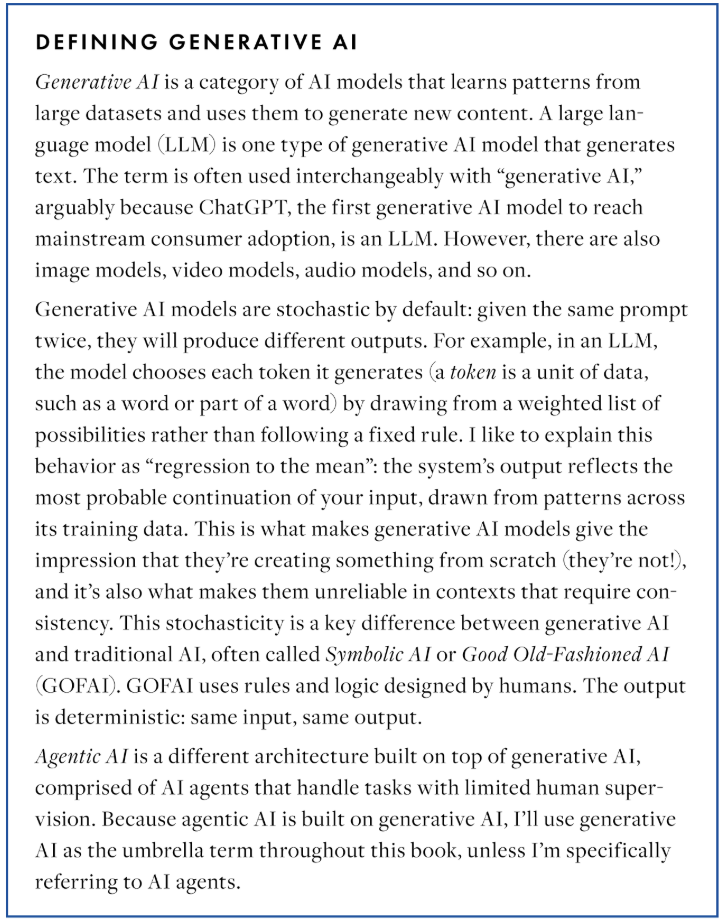
Generative AI systems are increasingly able to perform tasks that were once considered exclusive to humans. With a few natural language inputs, generative models create everything from high-fidelity prototypes, to working code, to your headshot in the style of Studio Ghibli. These systems are only getting better—potentially, a lot better.
There is widespread consensus across the technology industry that artificial general intelligence (AGI), systems that match human capabilities across all cognitive tasks, is inevitable. Most surveys of AI researchers and experts indicate a 50% probability of achieving AGI between 2040 and 2061.3 Regardless of your views on the merits of the AGI mission, you can agree that investment is staggering. UC Berkeley professor Stuart J. Russell estimates that projected AGI funding, adjusted for inflation, has already reached 10 times the cost of the Manhattan Project as of 2024. On the current investment trajectory, Russell expects that number to rise to 25 times in the coming years.4 Because of this, it feels like there is no technical ceiling to what you can automate. What seems impossible today may soon become feasible with enough data, computing power, and new methods. Furthermore, AGI isn’t even the end goal. At the time of writing, several frontier AI companies, such as OpenAI and Meta, have already shifted their ambitions past AGI toward artificial superintelligence (ASI), systems that surpass human capabilities across domains.
Beneath this momentum is a rarely examined assumption: human thinking is a process that can be separated from the thinker and reproduced by a machine. If that assumption is true, then full automation is just an engineering problem on a timeline. If it isn’t (decades of cognitive neuroscience research suggest it isn’t, see Chapter 11), then the destination of “automate everything” needs rethinking.
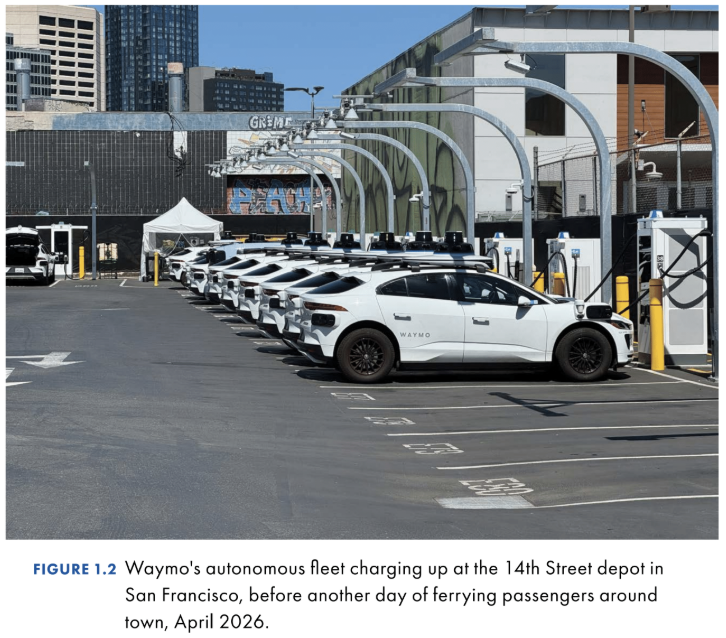
AI’s momentum is also no longer confined to software or knowledge work; it’s rapidly taking physical form. Stroll down any street in San Francisco, and there’s a good chance you’ll see more than one autonomous vehicle shuttling its passengers to their destination (Figure 1.2). Companies like Figure AI, valued at $40 billion in 2025, are designing humanoid robots for both industrial and domestic tasks. At the same time, Fei-Fei Li’s World Labs is building “spatial intelligence,” the capacity for AI systems to perceive and interact with the three-dimensional world, much like LLMs interpret and generate text. Meanwhile, companies such as ElliQ are creating AI companions to support aging populations.
3. Cem Dilmegani and Sila Ermut, “AGI/Singularity: 9,800 Predictions Analyzed,” AI MultipleResearch, May 2026, https://research.aimultiple.com/artificial-general-intelligence-singularity-timing
4. Tharin Pillay, “Stuart Russell,” Time100 AI 2025,Time, August 25, 2025, https://time.com/collections/time100-ai-2025/7305869/stuart-russell/
From Reactive Vision to Defensive Maneuvering
In this reactive state, visions of a fully automated future often collapse into defensive maneuvering (Figure 1.1), sometimes labeled as strategy but lacking in substance. True strategy is about the choices you make about where in the market to compete and how you succeed in that niche. What, then, does it mean when an organization declares it’s taking an “AI-first strategy”? Take Duolingo: CEO Luis von Ahn sought to transform the language-learning company into an AI-first operation by phasing out contractors where AI could replace them, while restricting new hires to work that couldn’t be automated. The move drew backlash from both employees and customers.
Imagine replacing “AI” with any less flashy technology in a sentence. Am I a Word-Document-first author? Will you hire hammer-first contractors for your next home renovation? These are nonsensical declarations, prioritizing signaling your use of a technology tool over the purpose it is meant to serve. Technology is the means to an end, rather than an end in itself. Automation choices are strategy choices that reinforce where you’ll play and how you’ll win in the market,5 and intentional choices are better than reactive ones (see “The Automation Choice Check Activity,” Chapter 6).
From Defensive Maneuvering to Disconnected Execution
When strategy starts with technology, execution is disconnected from the value that it should deliver to customers and the organization’s capacity to deliver it (Figure 1.1). The disconnect often stems from leadership and teams operating from two different pictures of reality. Leadership tends to overestimate what the technology can do and underestimate the effort required to implement it well, communicating in big picture business goals and outcomes. Teams closer to the work see the technology’s shortcomings up close and feel gaps in organizational readiness. Both sides lack feedback loops and shared language that would keep each other grounded in what the other is learning. This often shows up as leaders who are pushing teams to use AI where it doesn’t create differentiating value, underestimating the time and training required to make a model work in the real world, or teams burning cycles trying to interpret what leadership wants instead of innovating.
5. This is a nod to A.G. Lafley and Roger L. Martin, Playing to Win: How Strategy Really Works (Harvard Business Review Press, 2013).
TIP: KEEPING TECH DISCUSSIONS GROUNDED
Does this disconnect feel familiar? Here are three questions you can ask in your next meeting to ground the conversation:
- What’s the unique value here?: How does using this technology create an advantage over what people do today? What does this technology (say, generative AI) do that other technologies (say, discriminative machine learning models) cannot?
- How are we testing feasibility? Do we have evidence, such as benchmark data or a pilot study, that supports that the tech can deliver what we think it can deliver? Do we have a plan to collect that evidence?
- Are we resourced for this? Have we scoped the data and training time required to make this work at scale? Do we have the in-house expertise to pull this off or will we need to bring in vendors or consultants?
When leaders issue mandates like “use AI to personalize all marketing emails,” they often underestimate what’s required. Effective personalization requires clean (and consented!) customer data, integration across fragmented systems, and careful review to avoid generic or off-brand copy. While off-the-shelf tools can handle basic segmentation, scaling true one-to-one personalization usually demands significant resources in data engineering, orchestration, and oversight.
Sometimes, teams spot the risks but lack the language to translate them into business terms. Other times, even seasoned engineers are surprised, because building intuition for what today’s fast-moving systems can and can’t reliably do requires regular hands-on experimentation. Without clear feedback loops between leadership and teams, organizations keep executing against flawed assumptions, defaulting to vanity metrics like open rates, or send volume instead of outcomes, like customer satisfaction and successful request resolution. The result is an illusion of progress, even as customer experience suffers. Dropping support ticket resolution times from eleven minutes to two minutes means nothing if your customer is rage-quitting because they were trapped in an infinite loop with an unhelpful AI agent.
Outcomes
The outcomes of projects that succumb to the Automation Strategy Gap are predictable: underwhelming results or outright project failure. A 2024 Rand Institute study estimated that over 80% of AI projects fail, which is nearly double the failure rate of traditional IT efforts. In IBM’s 2025 study of 2,000 CEOs, 64% of CEOs reported that fear of falling behind drove them to invest in new tools before fully grasping their value. In that same study, only 25% of AI initiatives have delivered their expected ROI, with just 16% scaling enterprise wide. The National Bureau of Economic Research’s 2026 working paper on AI adoption surveyed nearly 6,000 business executives across the U.S., UK, Germany, and Australia, finding that while 69% of firms used some form of AI, 90% of executives reported that AI had no impact on their firm’s employment or productivity over the last three years.
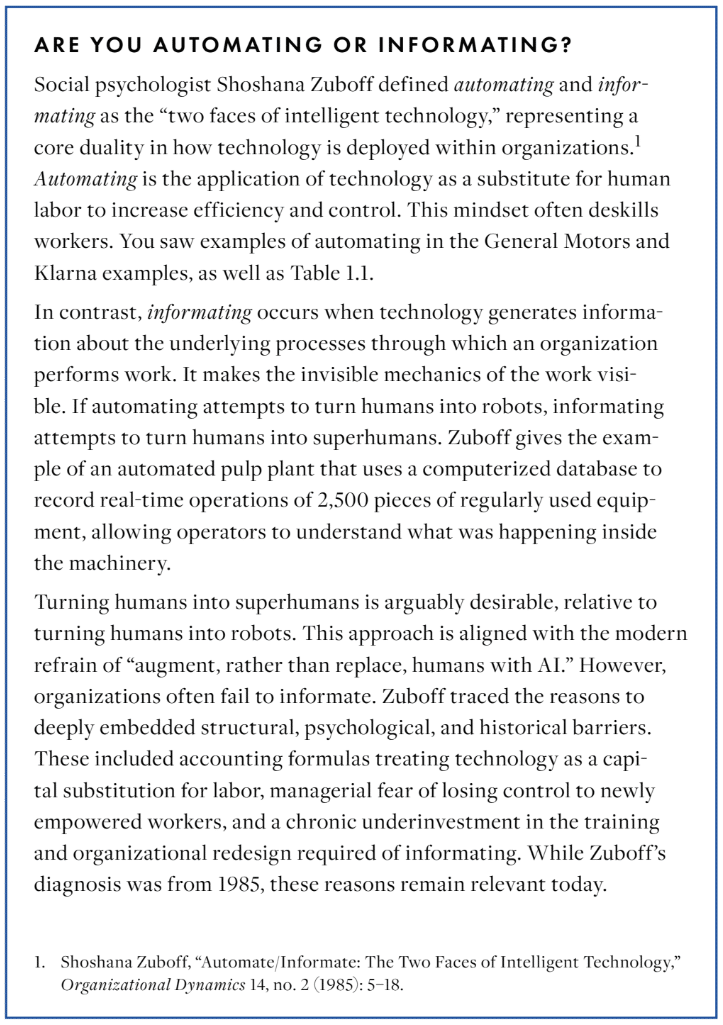
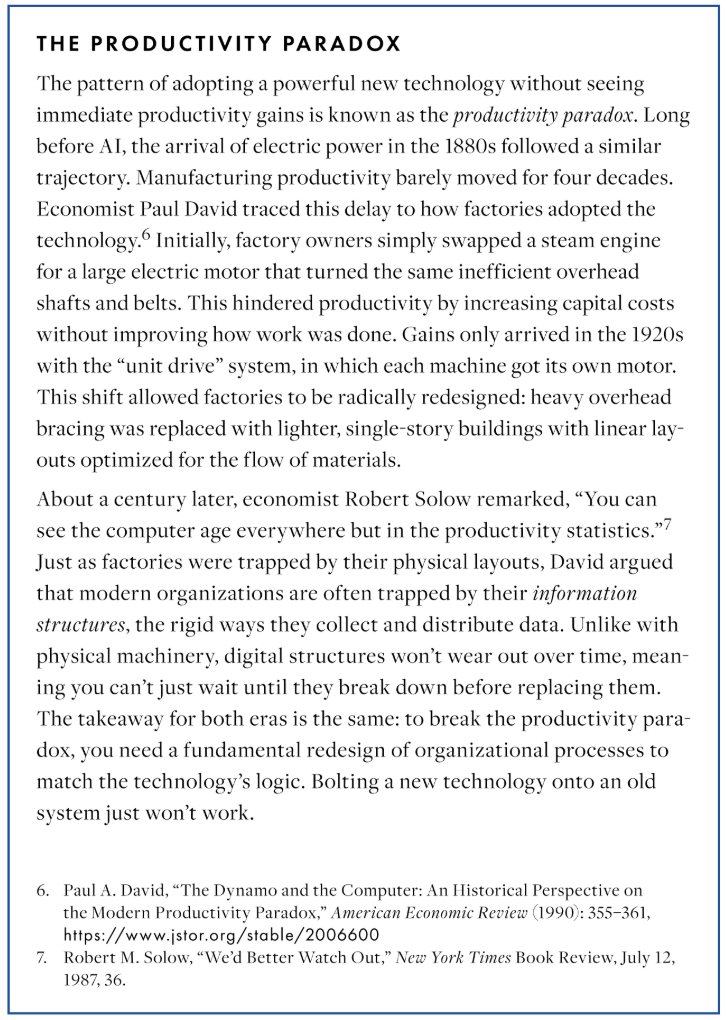
By now, you might be thinking the Automation Strategy Gap is impossible to close. Organizations seem cursed to repeat the patterns of Zuboff’s “automating” instead of “informating” (see Chapter 5 for a detailed explanation 0f why this occurs). Don’t give up hope yet. There are companies that have closed the gap through an intentional approach to automation.
Automating with Intention
Sometimes, automation really does deliver. FANUC, a Japanese robotics company, has been running a lights-out factory near Mount Fuji since 2001, with the capacity to produce over 11,000 robots a month with minimal human oversight. Ocado, a British grocery technology company, offers another automation success story. Founded in 2000, the company sought to rethink grocery retail through an online-only model coupled with a highly automated warehouse. They steadily scaled their operations to their present-day “Hive” system, where AI-powered robots navigate across a vast 3D grid holding thousands of grocery items. The system can pick and pack a 50-item customer order in five minutes (about six times faster than manual picking). Humans are still in the picture, performing tasks such as system maintenance and loading completed orders onto delivery vehicles. In the digital realm, Boston Consulting Group (BCG) reported that just 4% of companies reported meaningful returns from generative AI as of 2024, but the common thread is the same: they applied the technology to carefully chosen use cases that created value rather than simply cutting costs.
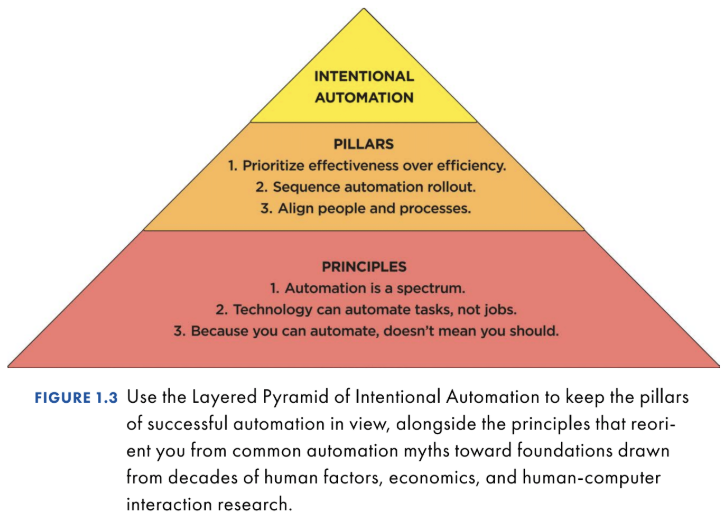
A common approach underlies each of these successes: automation pursued with intention. That approach can be broken down into a pyramid: intentional automation outcomes at the top, three pillars holding it up, and principles forming the base (Figure 1.3).
The Three Pillars of Intentional Automation
The three pillars of intentional automation capture the common patterns behind organizations that succeed with automation. They are the following
- Prioritize effectiveness over efficiency.
- Sequence automation rollout.
- Align people and processes.
Prioritize Effectiveness over Efficiency
Organizations that use automation to transform their core business, rather than merely to cut costs, tend to be successful. FANUC envisioned scaling production and achieved it with robots building robots. Ocado pictured a new way for people to buy groceries, achieved by a combination of e-commerce and advanced automation. In the BCG study, leaders who saw returns on generative AI investment framed the technology as a source of revenue growth, not just cost-saving efficiency. The through line is that these organizations all used automation to become more effective (not just efficient), in a way that actualized their vision for the future. Automation was a means to an end, not an end in itself.
Sequence Automation Rollout
Success comes from narrowing focus to a few high-value opportunities and sequencing them with intention. For instance, Ocado achieved its sophisticated Hive system over several iterative stages. They began with off-the-shelf hardware, such as conveyors and cranes, coupled with proprietary software. Over several years and iterations, they developed the Hive storage and retrieval system, in which robots would grab crates of items and take them to pick stations. AI robotic arms that could pick directly from the crates came later. The BCG example demonstrates the importance of focusing on high-value use cases rather than solely chasing cost-cutting. Here, intention showed up as discipline: organizations resisted the urge to automate everything at once and instead made deliberate choices about where automation would matter most.
Align People and Processes
While building advanced technology is hard, it’s not the hardest part about automation. That would be aligning people and processes with the technology. Successful automation requires organizational change management: stakeholder alignment, workforce preparation, and redesigning workflows alongside automation implementation. The most technically advanced generative AI systems are of little use if you don’t have a coordinated approach to how your organization will learn and use them, and to what end. This misalignment can occur on multiple axes, such as what to automate, how to automate, and when to automate.
A related challenge is the mismatch between the rapid pace of individual adoption and the slower rollout of organizational infrastructure. People use generative AI tools to build things they couldn’t build a year ago, but the systems for sharing, evaluating, and scaling that work often don’t keep pace. Aligning people and processes means investing in building the scaffolding of organizational readiness (more on this in Chapter 3).
The Three Principles of Intentional Automation
If the pillars describe the structure of successful automation, the princi-ples are the foundation beneath them. They are the beliefs that supportintentional practice and help prevent organizations from falling into theAutomation Strategy Gap. No matter what your role is, the following princi-ples are important to internalize:
- Automation is a spectrum.
- Technology can automate tasks, not jobs.
- Because you can automate, doesn’t mean you should.
Automation Is a Spectrum
Automation is the use of machines to do tasks—sometimes just part of the task, sometimes the whole thing—that people used to handle themselves. It’s a spectrum, not a binary switch. At one end, humans handle everything; at the other, machines act entirely on their own. In between are levels of automation where the machine performs increasingly more of the task.
How many levels are there? It depends on who you ask. In a classic human factors paper, “A Model for Types and Levels of Human Interaction with Automation,” there are ten levels. The spectrum starts with “The computer offers no assistance: humans must take all decisions and actions” (level 1), moving through the computer “executes the suggestion if the human approves” (level 5), and ending with “The computer decides everything, acts autonomously, ignoring the human” (level 10).8 In the automotive industry, the National Highway Traffic Safety Administration defines a six-level scale for vehicle autonomy. It runs from level 0, where the human does all the driving, to level 5, where the car handles everything and the human is just a passenger. The in-between steps move from more human involvement to less human involvement. For instance, in level 3, the car drives but a human must be ready to take over.
The exact number of automation levels is secondary to the key point: if you triangulate across autonomy research, autonomy is consistently a spectrum. You have options beyond “people do all the things” and “automate everything, now.” For practical purposes, think of automation as having four levels (Figure 1.4).
8. Raja Parasuraman et al., “A Model for Types and Levels of Human Interaction withAutomation,”IEEE Transactions on Systems, Man, and Cybernetics—Part A: Systems and Humans 30, no. 3 (2000): 286–297, https://doi.org/10.1109/3468.844354. This paper is cited over 5,550 times at the time of writing. The authors must have been onto something!
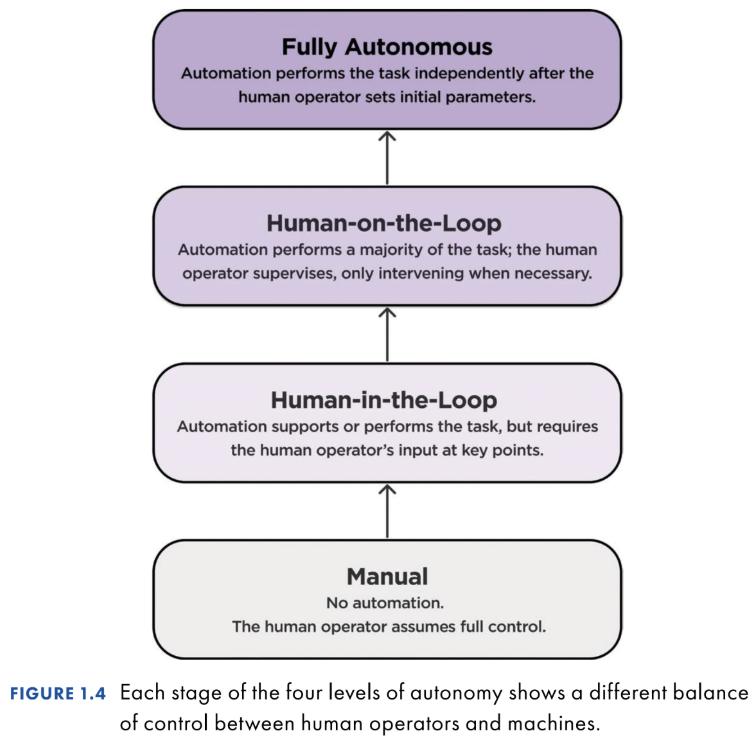
The lowest level of automation is manual mode, where a human operator has full control of the task. Next is human-in-the-loop (HITL), where the human remains the primary decision-maker, while the system carries out the human’s plans. Because the human operator’s input is required during some parts of task completion, they’re more actively evaluating what the system is doing and why it is doing it.
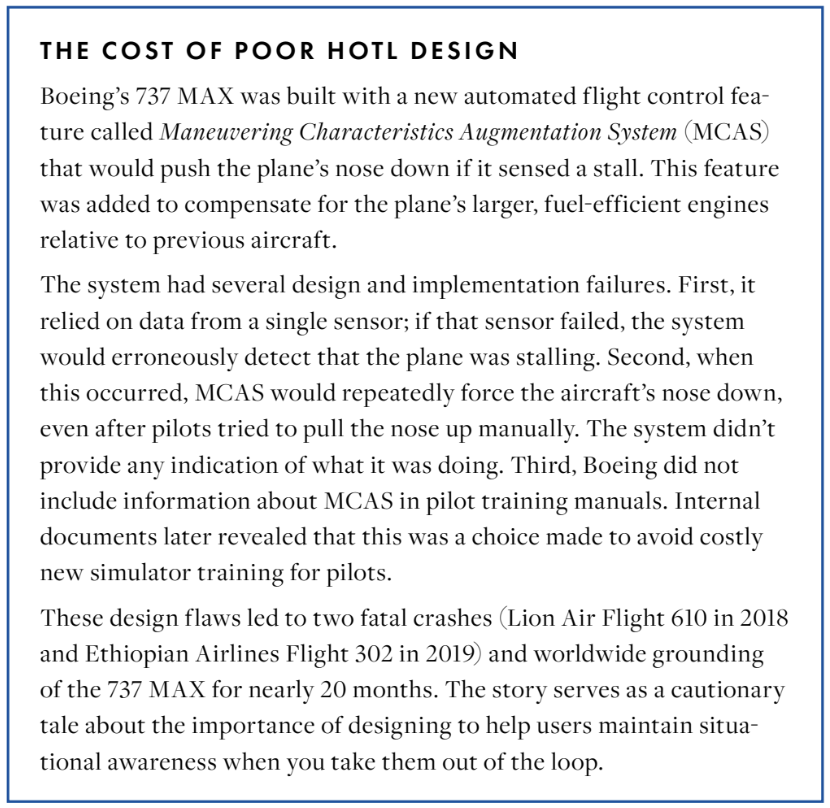
One level up from HITL is human-on-the-loop (HOTL), where a system can make and carry out its own decisions while a human supervises. While no longer the primary decision-maker (unlike in HITL), it’s vital that the system is designed so that the human operator retains situational awareness of what the system is doing (see Chapter 9). After HOTL, you reach fully autonomous systems. Here, the system operates independently after the human operator sets initial parameters. Unlike in HOTL, there is no routine human oversight.
To bring these levels to life, consider the example of flying an airplane. At the manual level, the pilot flies the plane, directly controlling speed, altitude, and direction. With HITL, the pilot sets parameters, such as flight path and altitude. An autopilot system executes these commands while the pilot remains the primary decision-maker.
Moving up in autonomy level to HOTL, the autopilot system can make and carry out its own adjustments, such as detecting turbulence and automatically changing altitude or speed. The pilot supervises to ensure that the system behaves appropriately. Finally, with full autonomy, the pilot inputs only the origin and destination, and the autopilot independently manages the entire flight, including navigation, responses to weather, and landing, without routine oversight.
As the level of autonomy increases, the pilot’s primary role shifts from doing, to deciding, to supervising, to being removed from the operational loop altogether. Delegating more of the task to machines fundamentally changes the pilot’s mental workload. Monitoring tends to be more boring than doing, so it is easy to lose situational awareness of what’s happening unless the system is designed to keep you aware of its status. Hands-on skills also tend to fade once you stop using them. Together, these set up a well-documented paradox in the human factors literature, the “Ironies of Automation”: automating the easy parts of a task can make the remaining hard parts even harder.9 The human operator needs to jump back into complex, high-stakes situations precisely when their situational awareness and skills have eroded. That’s why automation design requires careful judgment about which tasks to allocate to machines, and how to keep humans aware of what the system is doing when they’re no longer in the loop.
9. Lisanne Bainbridge, “Ironies of Automation,” in Analysis, Design and Evaluation of Man–Machine Systems, ed. G. Johannsen and J. E. Rijnsdorp (Pergamon, 1983), 129–135.
Technology Can Automate Tasks, Not Jobs
People perform a wide variety of tasks throughout their day. For instance, a designer might create wireframes in Figma, run a usability test with a participant, and prepare a slide deck about their design work for stakeholders. Each of these activities is a distinct task (with multiple subtasks, see Chapter 4), even though they all fall under the same job title.
When someone claims they can automate (read: replace) the designer—or the factory worker, or the customer service agent—chances are, they don’t have a clear picture of what the potentially replaceable person does all day, and how their actions fit within their broader environmental context. Selecting the right level of automation to extend people’s effectiveness depends on a clear understanding of workflows and the contexts in which tasks unfold.
Jobs can’t be automated in one sweep because they aren’t single, uniform activities. They’re made up of many different tasks: an economics concept called a task framework. Some tasks are structured and repeatable, while others are complex and judgment driven. Production relies on allocating these tasks across humans, machines, or some combination of the two.
This task perspective connects directly to the first principle—automation exists on a spectrum. Assuming the technology is capable, some tasks lend themselves to near-full automation, while others require oversight, and some resist automation altogether. In design work, generating interface variations can be automated through vibe coding, while deciding what concept to prototype requires expert human judgment. But what if technology got really, really capable, such that it could do everything that a human can currently do? Shouldn’t everything be automated?
Because You Can Automate, Doesn’t Mean You Should
Imagine a future where technology could automate nearly every human task. In this hypothetical world of technological abundance, would everything be automated? Economists have long been thinking about this question. One such economist, Daniel Susskind, has argued that even if machines surpass humans at all economically useful tasks, there will still be reasons for people to remain involved. These limits exist because society will still require human participation in three ways:
- General equilibrium limits: Humans may remain relatively better than machines at edge cases. For example, AI can read most medical scans faster and more accurately, but radiologists are still needed to adjudicate rare, ambiguous cases where decisions require more real-world context than machines can access.
- Preference limits: People may prefer human processes even when machines are capable. For instance, some guests will choose a restaurant with human servers over one staffed entirely by robots, valuing the experience of personal interaction.
- Moral limits: Certain decisions demand human accountability. Incriminal justice, even if highly accurate risk assessments were possible,society expects a human judge to decide sentencing, making moral judg-ments that require human accountability.10
Returning to the present day: technology for automation remains imperfect. Organizations therefore face two fundamental questions: could you automate this task and should you? The first is about technical and organizational maturity: can the technology do what you want it to do, and can your organization effectively work together to implement it? The second is about whether the technology solution creates unique value for people—a step-change improvement in how they operate today. When the answers to both questions are “yes,” only then should you consider moving forward with automation.
Takeaways
- Mind the gap. Most failures of automation are the result of the Automation Strategy Gap, a misalignment between an organization’s automation aspirations and the realities of what is required for successful implementation. Market pressures give way to a reactive vision of a fully automated future, which yields defensive maneuvering, disconnected execution, and ultimately, project failure.
- Getting automation right requires intention. FANUC, Ocado, and a handful of generative AI leaders taught us that successful automation requires intention, prioritizing effectiveness even over efficiency, treating automation as a means to reinforce their broader strategy, and investing in organizational readiness.
- Remember the three principles. You don’t need to jump to “full automation”: you have options on the automation spectrum. Think about automation at the task (not job) level. Evaluate automation choices through the lens of “should you,” not just “could you?”
10. Daniel Susskind, What Will Remain for People to Do? (Knight First Amendment Institute,April 2025), http://knightcolumbia.org/content/what-will-remain-for-people-to-do