
Read the first chapter of Body Talk by Dane DeSutter and Stephanie Scopelitis
10/16/2026In Body Talk: Using Gestures to Rethink Human-Centered Products by Dane DeSutter and Stephanie Scopelitis, explore the role of the body in enriching foundational research, supporting collaborative ideation, advancing and validating designs, and facilitating technical conversations to ground nascent technology in complex human experiences.
Read chapter one for free below!
Chapter 1: The Need to Go Deeper
It started with a hand. Sam Farber, creator of OXO Good Grips, watched his wife Betsey struggle with a vegetable peeler. Arthritis had turned a simple kitchen tool into daily frustration.
“This is hard to hold,” she said. As she set the peeler down, she instinctively grasped her wrist, flexing her fingers to stretch out the ache. A team relying solely on the words “hard to hold” could have started crafting a product solution that missed the mark entirely. Maybe they would have proposed changing the grip material or adding some additional texture to the handle. However, these well-intentioned solutions would have overlooked what Betsey really needed.
But Sam looked beyond the words. He saw his wife’s flexed fingers and noticed her massaging her wrist. He then observed the tense, full-fisted grip she had been forced to use. This key observation of the body revealed the real problem: the shape of the handle was forcing her hand into an unnatural posture. That insight, found through observing the body, is in no small part why the iconic, wider Good Grips handle exists today.
This principle that the body reveals needs that words may not reveal is universal. It applies whether you are designing a physical tool like a vegetable peeler or a digital interface. At the end of the day, all human-centered design needs to be grounded in and informed by the body, because every experience is lived through physical actions and reactions.
You Need to Go Deeper
Working in product, design, or UX, you entered this field to create products that genuinely help people, whether to delight them, solve everyday frustrations, or make their lives easier. Fulfilling that mission requires driving at a deeper understanding of what people need.
To achieve this, you may talk to top customers, observe people on the job, or look at analytics to see where people spend their time. You might also read forums, run focus groups, or conduct in-depth interviews. Maybe you’re starting to even leverage AI to parse social media posts and customer support tickets at scale.
You already use this information and apply tools to make sense of it to build a clear path for product development. Product teams rely on an arsenal of tools to understand people, communicate clearly, and collaborate effectively. You’ve probably used many of them: journey maps, personas, wireframes, and even the classic “How Might We” exercise. These tools help teams structure ideas, surface assumptions, and keep miscommunication in check in order to guide roadmap decisions with intention.
But a bias runs through nearly all of these tools: it’s the primacy of language. Written or spoken, words pave the pathway for the product development journey. They carry insights from research, fuel ideation, and frame design choices.
Words are crucial and informative. Yet even with all these well-intentioned tools and processes, products sometimes still miss the mark. The reality is that it’s not always about failing to listen closely to the words; it can also be about failing to listen to the body.
To build human-centered products, you need to understand humans fully, not just through what they say, but also through what they do. The way that people move their hands and bodies, shift their posture, adjust their gaze, and react through facial expressions is part of how they think, communicate, and coordinate their actions. To build products that truly fit people’s needs, you have to look beyond language to the way the body talks. And that applies to everyone in your work: the people you build for, and the people you build with.
NOTE: GESTURES DEFINED
Gestures are part of the spontaneous and intentional physical actions that people make. They include hand movements, body posturing, and shifts in gaze. More than just emotional expressions, gestures are active participants in the thinking, communication, and coordination that drive product development.
Go Beyond Words
To supercharge how you create products for people, you need to supercharge how you understand people holistically. Going beyond language and making use of what the body “says” can help you. 4 Chapter 1
HOW MUCH IS “SAID” NONVERBALLY?
You’re probably familiar with the claim that 80% of human communication is nonverbal. While widely cited, this figure is likely an overgeneralization that stems from psychologist Albert Mehrabian’s “7-38-55 rule.”1 Mehrabian’s research focused on how people interpret feelings and attitudes when verbal and nonverbal cues are incongruent. He found that in cases where words and body language didn’t match, people relied on verbal content only 7% of the time, while tone of voice accounted for 38% and facial expression for 55%. This led to the common estimate that 80-90% of communication is nonverbal, although this interpretation overlooks the specific conditions of his study.
The idea gained traction, particularly in public speaking seminars and communication training. Mehrabian himself later clarified2 that his findings do not mean that words are insignificant; rather, nonverbal cues play a significant role in resolving ambiguity about emotional intent. The research numbers may vary depending on how gestures are utilized. For example, Adam Kendon suggests that gestures account for as much as 50% of the meaning conveyed in conversations.3 What remains true is that gestures are not an adjunct to talk; they are an essential part of it.
1 The so-called “7-38-55 rule” traces back to two experimental studies by Albert Mehrabian and colleagues (1967). These studies looked specifically at how people judge emotional attitudes when verbal and nonverbal cues conflict, producing the well-known weighting of verbal content, vocal tone, and facial expression. The popular summary was later condensed into the 7/38/55 proportions.
2 Mehrabian later emphasized in Silent Messages and subsequent interviews that these findings apply only when interpreting feelings under ambiguous conditions. He cautioned against using the percentages to describe communication more broadly.
3 Adam Kendon’s work (e.g., Gesture: Visible Action as Utterance, 2004) provides a more nuanced view, showing that gestures can contribute substantial semantic content in conversation, particularly when speakers describe spatial layouts, actions, or abstract ideas.
Consider the universal usability test. A user is shown a prototype and clicks through. A researcher or designer asks for feedback on the prototype, and the user says that it was “easy to use.” (That’s what the transcript captured as well!) However, they also noticed a hesitation in the user’s voice that was coupled with a furrowed brow and hesitant mouse movements. Though never articulated in language, the unspoken aspects of this session hinted at a more nuanced interpretation of this user’s experience. The design concept is likely not, as the words state, entirely “easy to use.” There’s more work to do!
Although words are essential in how people share thoughts, communicate ideas, and work together, the words people share don’t always tell the entire story. Relying solely on words might risk overlooking crucial information that is embedded within nonverbal cues. Hand gestures, facial expressions, gaze, and body posture often significantly enhance talk, adding critical meaning and essential understanding when words alone fall short.
The Case for Gestures
Gestures are not just hand waving. They aren’t mere decorations, nervous fidgets, partial fill-ins for words, or simply learned cultural habits. They are something more.
Gestures do more than add kinetic flair. Just as a knife cuts and a wrench tightens, gestures do something. When you are planning out the argument in an essay, and you stack imaginary ideas in the air, you are using your hands to organize your thinking before you write a single word.
When you are planning what to say in a meeting, you might move your hands in front of you as if laying out points in space—placing one idea here, another there, and then circling back to the first. Your hands help you organize the sequence of your thoughts before you say a word. When you raise your arm and lean forward on the sidewalk to hail a cab, your action stops a two-ton vehicle. When you use your finger to stand in for a wood peg and then motion how it joins the back and side of an IKEA bookshelf, you’re explaining how to complete a step in the instructions (and hopefully not fighting with your significant other).
Gestures provide a visceral channel of insight and action and serve as a silent invitation for exchange that propels everyone forward.
GESTURE-LANGUAGE LINK: EVIDENCE FROM APHASIA
The connection between language and movement is deeply rooted in human biology. Research in embodied cognition shows that understanding action-related language engages parts of the motor system, overlapping with the neural circuits used for action execution.4 One striking piece of evidence that established the gesture-language link comes from patients who have suffered strokes. Aphasia, a disorder caused by localized brain damage, can result in selective linguistic deficits depending on the location of the damage. Clinical researchers working with these patients have also extensively documented correlated impacts on gesture production.5 This distinction is particularly clear when comparing Wernicke’s and Broca’s aphasia (see Figure 1.1).
Wernicke’s aphasia (also known as fluent aphasia) occurs when people experience damage to the brain’s language comprehension center. Patients with fluent aphasia are able to produce fluent speech, but often what they say is not coherent. Interestingly, researchers observed that these patients produce gestures that also lack conceptual depth. Rather than producing illustrative or meaningful gestures, they primarily rely on pointing, suggesting a disruption in their ability to encode cohesive ideas into both speech and movement.
Broca’s aphasia (also known as nonfluent aphasia), by contrast, occurs when people experience damage to the brain’s speech production center. While these patients struggle to control the muscles that move the tongue and vocal cords to produce vocalizations, their ability to comprehend language remains intact. Though difficult, these patients can produce speech that is coherent and logically organized. Notably, their gestures remain unaffected, often serving as a compensatory tool to express meaning when words fail.
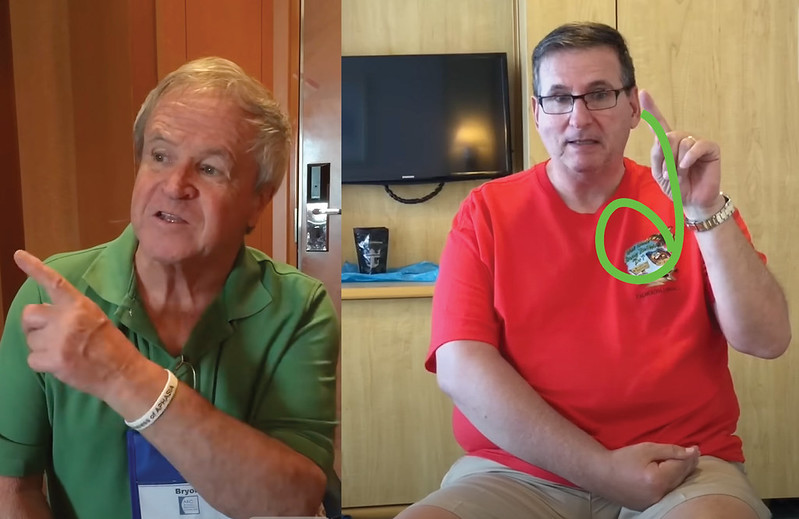
FIGURE 1.1 Patient with Wernicke’s aphasia uses simple pointing gestures that provide little additional meaning to the language (left); patient with Broca’s aphasia struggles to verbalize the number “60” and uses gestures to compensate for missing language (right).
When language comprehension and production are selectively disrupted by damage to the brain, parallel deficits emerge in gesture. The contrast between these two types of aphasia reinforces that gestures and language originate from the same neural system6 and share a deep network for representing meaning across both modes.
4 Gallese and Lakoff (2005) synthesized evidence from neuroscience and cognitive linguistics to argue that conceptual understanding—including abstract concepts— is embodied, relying on distributed sensory, motor, and affective systems rather than abstract symbols.
5 McNeill (1985) reviewed evidence from Broca’s and Wernicke’s aphasia showing that gesture and speech exhibit parallel patterns of impairment and preservation following brain injury. Broca-type patients retain referential words and iconic gestures but lose the ability to combine elements linguistically or gesturally, while Wernicke-type patients preserve fluent sequencing and beat-like gestures but produce few meaningful iconics. McNeill argued that these parallel breakdowns indicate a shared computational stage underlying speech and gesture production.
6 McNeill (1992, 2005) and Goldin-Meadow (2003) argue that gesture and speech are co-expressive components of a unified meaning-making system. Evidence from aphasia supports this view, showing that gesture and language remain fundamentally integrated rather than functioning as separate channels.
When you notice someone pointing left while giving directions and saying, “ . . .then you’ll make a right,” it’s a signal that prompts you to ask for clarification before you get lost. Similarly, if a friend tilts their head while you’re explaining the rules of a new board game, you might recognize the need to backtrack and provide a simpler explanation. When a choreographer points to a spot on the stage during a school play rehearsal, they shift every child’s gaze to the same location, coordinating their action and completing their understanding of the director’s vision.
This seamless interaction between language and gesture elevates human engagement, transcending words alone to build shared understanding. Gestures, along with the words you speak, expand meaning. Gestures in collaboration with the sentences you exchange develop ideas. And gestures partnered with the thoughts you process build understanding. Ignoring the connection between language and gestures can lead to incomplete inquiries, misunderstandings, and inaccurate conclusions.
When thoughtfully employed and perceptively observed, gestures become a powerful resource to
- Support thinking.
- Enhance communication.
- Coordinate people, things, and actions.
Gestures work so well because they are inseparable from the people using them. They are always present, easy to access, and flexible enough to adapt to whatever the moment requires.
How Gestures Support Your Product Journey
The path of product development follows a familiar trajectory, from uncovering a human need to shipping a solution that meets it. It’s a journey that takes you from research and discovery, through definition and ideation, into design and delivery. At every step, gestures can help you.
But this journey isn’t just a series of technical steps, it is a complex social endeavor of designing with people, for people. Products aren’t just objects! They are the outcome of a complex, messy, and sometimes circuitous journey of teams moving together. This process is filled with human interaction, collaboration, and creative sparks.
When you start to attend to gestures as tools for thinking, resources for communication, and a means for coordinating people, things, and actions in your product development journey, you will open up opportunities to do the following:
- Understand users and communicate their needs.
- Create inclusive teams that collaborate effectively.
- Build innovative solutions that center on human experience today and in the future.
But how you make use of gestures depends on where you are in that journey. In the early stages of discovery, gestures help you understand users by revealing what they really think and clarifying their mental models. A hesitant hand movement during a user interview can expose a hidden source of friction far better than words.
As you move to define the problem, gestures help you convey user needs to stakeholders with impact. Re-enacting a user’s struggle by mimicking their posture and frustrated movements creates a visceral, shared understanding that a slide deck would struggle to achieve.
During ideation, gestures help you foster belonging in teams and invite the full participation that unlocks creativity. A quiet designer tracing an idea in the air can be invited to contribute, ensuring their perspective isn’t lost. And as you design and prototype, gestures help you test ideas. The seamless swipe of a finger across a prototype confirms an intuitive design, while a fumbled grasp reveals a flaw long before a user can articulate why it feels wrong.
Each of these moments—from discovery to delivery—is a step on your path. Attending to gestures doesn’t just make each step more effective, but it also ensures that the entire journey carries you toward your North Star: building something human-centered that delights people and makes their lives better.
Gestures Look Back and Forward
Gestures support every stage of the product journey. At their foundation, they are sense-making tools that drive action: they help you understand where you’ve been, where you are, and where you’re going. They link parts of the journey that might otherwise feel separate. Think of them as a bridge.
GESTURES AND THE TRACES THEY LEAVE
For cross-functional product teams who are designing human-centered solutions, pay attention not only to what people do, but what they have done as well. Desire paths—those well-worn shortcuts across the grass, the muddy trails that cut past pristine sidewalks—are everywhere. You’ve probably seen them in parks or on college campuses, quiet but visible signs of how people actually move through a space. These informal paths zigzag around congested spots, shorten distances between locations, or sidestep areas that become treacherous in bad weather. (See Figure 1.2.)
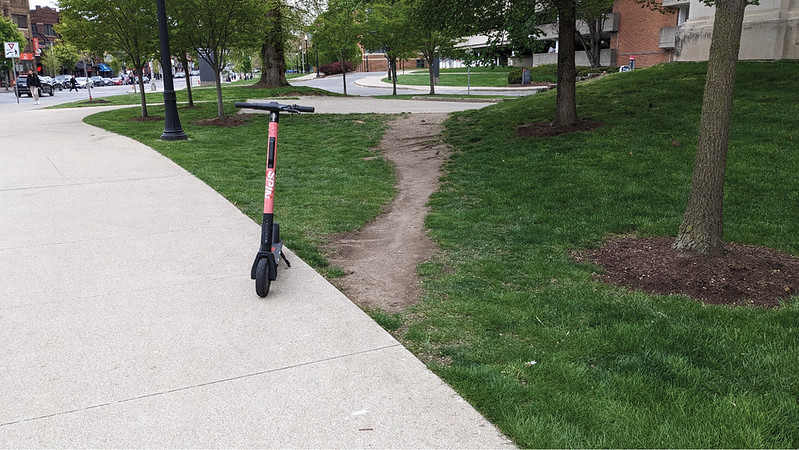
FIGURE 1.2 A desire path carved between the walkway and adjacent parking lot behind a building.
At first, these unplanned trails might just look like inefficiencies: people bypassing carefully laid-out paths in favor of their own. They emerge when enough people share the same impulse to step off the paved route, eventually carving a new trail that reveals a gap between intended design and real-world behavior. It’s tempting to see desire paths as a result of a failure of design. Or to only see them through the clarity of hindsight: How could they have gotten that so wrong! In reality, every product is just a hypothesis frozen in time, an informed attempt to address users’ needs based on the available information. And like hypotheses, products are tested continuously. People, often without intending to, expose mismatches between design intent and lived experience (see Figure 1.3).
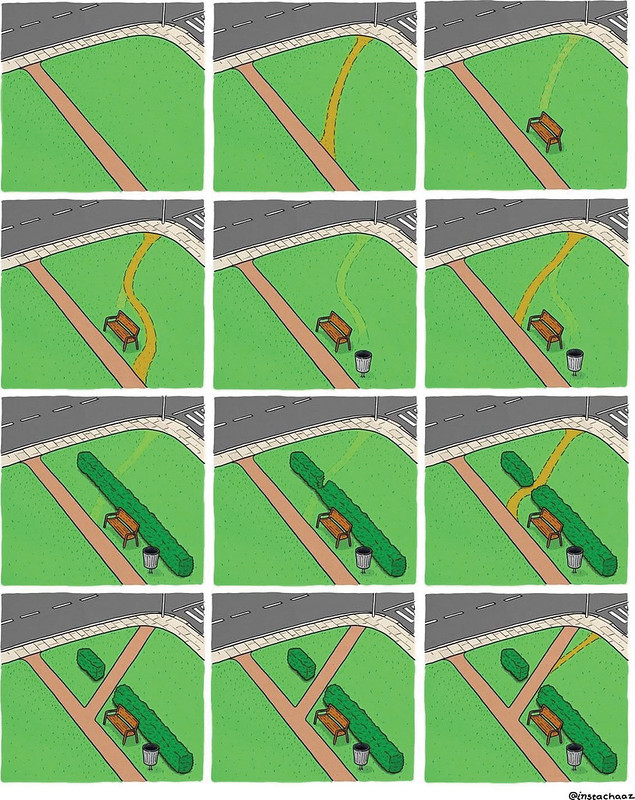
FIGURE 1.3 The work of design is never done because human needs are in constant flux and so designs evolve.
The traces that actions leave behind tell a visible story of human needs. When people fold the corners of a book page into a dog ear, they are marking their place in a novel. When someone tapes over a laptop camera, they are trying to improve their personal security. When someone slings their legs over the arm of a chair into an indentation, they reveal how they like to relax. These residues of human action can also become signals for change. When needs aren’t fully met, people leave behind evidence of their adaptations. Although some might abandon a product or experience, others create their own shortcuts. These symbolic and physical desire paths aren’t just signs of unmet needs, they are opportunities. They offer a chance to uncover what changed, where friction exists, and what gaps might need to be examined in your understanding of people’s needs.
Keep this in mind! Physical actions leave a trace. People’s past behaviors constantly reveal something about their needs and underscore opportunities. The body talks in many ways, so listen! ?
Gestures bridge your organization and your users, helping your team develop empathy for the people you are designing for. They bridge people and ideas, turning a creative spark into a shared reality. They bridge diverse expertise, perspectives, and priorities by linking members of different teams. They even bridge the past and the future, connecting a user’s past frustration to better design decisions.
Seen this way, gestures aren’t just isolated events; they are the through line in the journey from nothing to something. Using gestures well means consciously integrating what makes this process human. You live in and through a body. You engage the world with it, and you challenge the world through it. By attending to the body, you bring that fundamental human reality into the enterprise of making things for other people.
When leveraged effectively, gestures add a valuable layer of information, giving them a unique ability to enhance human-centered design throughout the entire product development process, from discovery to delivery. By incorporating gestures into your product toolbelt, you gain a new superpower that opens up creative avenues for developing products that meet real needs, enrich lives, and, if you’re fortunate, stand the test of time.
Gestures, simply put, do something for you in the product journey.
Navigating the Product Landscape
One important way that gestures drive action is that they help you navigate the twists and turns of product development. Product development isn’t a single road leading from an idea to a finished product. It’s a network of paths, filled with convergence, divergence, and realignment as teams work toward a shared goal.
The metaphor of a product roadmap may make the journey seem linear and well-understood, but in reality, product teams are constantly shifting between exploring new directions and coming back together to make decisions. This complex terrain is often a tangle of overlapping efforts (see Figure 1.4).
Some teams run ahead, scouting what’s possible. Research might be gathering insights for a feature that won’t be built for months, while engineering builds out technical capabilities. Other teams move in parallel, tackling different aspects of the same problem. And at key points, teams must converge to align on a shared direction before work can move forward.
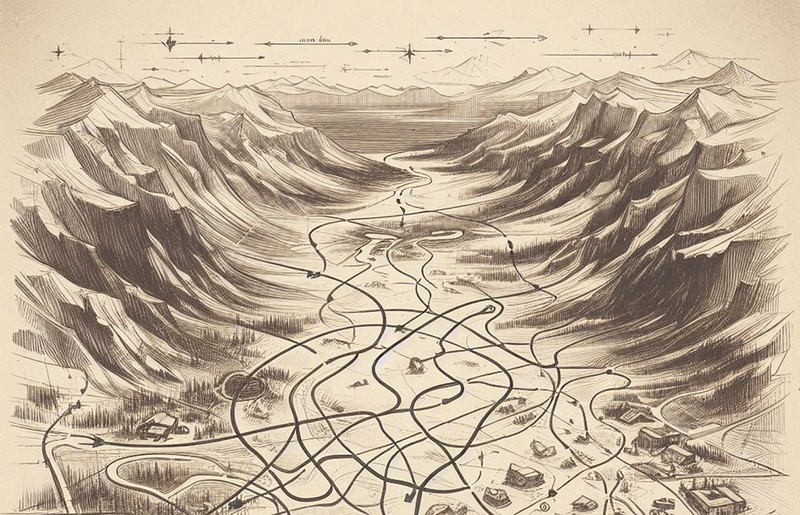
FIGURE 1.4 Reaching the goal of a product requires navigating a tangle of pathways.
To move forward effectively, you need to not only know what path you’re on but also be open to the paths that emerge. The main paths you will navigate in the broader product journey are the following:
- Research path: You gather evidence to ground decisions in real human behavior, providing the context and proof needed to move in a truly human-centered direction.
- Collaboration path: Your team strengthens its vision by blending diverse expertise, balancing aspirational goals with practical considerations to ensure inclusive and comprehensive decision-making.
- Design path: You translate research insights and collective ideas into concepts and potential solutions, seeking creative approaches that feel natural and effectively meet user needs.
- Innovation path: You venture into uncharted territory to explore new markets, pressure-test core assumptions about the problem space, and spark entirely new directions for the business.
These paths aren’t necessarily sequential, and changing priorities can cause you to jump between them rapidly. But when you know which path you are on in the project journey, you can navigate with intention and better see how gestures connect and guide your team’s progress.
Know Your Goals
Product organizations are guided by an overarching goal, their North Star. For many of you, this is creating a human-centered product that meets the real needs of people. In the rush of daily decision-making, you can sometimes lose sight of what you’re moving toward. The compass for navigating the many pathways in the product journey is comprised of knowing your goals. And knowing your goals has the added benefit of helping you see how gestures steer your progress.
An outgrowth of knowing which path in the product journey you’re on is that it helps you frame how to make use of gestures along the way. Not every gesture is meaningful for every moment. A sharpened focus allows you to filter out the noise and recognize the ones that support your immediate objective, while still keeping you oriented toward the destination ahead.
NOTE: STAY OPEN TO NEW DIRECTIONS
Find a balance between being attuned to what may support your goal, while staying open enough to see the unexpected.
Attend to Gestures That Matter
Not all gestures are created equal. Some hold a lot of meaning, others very little, and some none at all. Some can be large yet empty; others are small but densely packed with information. Some simply echo what’s already conveyed in speech, while others add depth and detail you can’t get from words alone.
No need to track every flick of the wrist or twist of the torso. The gestures that matter are the ones that help move your product work forward. In meetings, stand-ups, design reviews, workshops, and user sessions, look at the gestures that surface insight, clarify meaning, and spark new direction. These are the gestures that are more than background. They are tools. Use these to make ideas tangible, build team creativity, foster safety, and anchor design in real human experiences.
You’ll learn how to spot and use these gestures throughout the chapters to come. For now, remember this: gestures that matter are the ones that appear in the flow of product work and do something. They add nuance, surface insight, and spark collaboration, helping you move further on the journey toward products that truly resonate.
Don’t Worry, You’ve Got This!
Humans are inherently expressive, kinetic beings who are constantly engaged in a silent choreography of movement and words. Infants gesture with intent before they can speak. Parents use gestures to gently chide a child at the dinner table, colleagues gesture to emphasize a point, and you gesture to illustrate concepts. It’s as fundamental to human behavior as laughing, crying, eating, or sleeping. Everyone gestures, and everyone gestures a lot! It’s simply what humans do.
People are also instinctively adept at composing their gestures and effortlessly skilled at interpreting those of others. You know a head shake in the Western world means “no” without thinking about it, and you understand that a tap to the wrist, with or without a watch, signals time. This fluency is automatic, it’s intuitive, and it’s largely subconscious. But when you raise your awareness and step beyond instinct, the value of gestures amplifies. Using gestures to enhance your work isn’t about mastering something new; it’s about refining what you already do. The more you practice, the more natural it becomes.
Don’t worry. You’ve got this.
Prepare for Your Journey
Going deeper with gestures unlocks a new level of understanding— one that sharpens how you build products for and with people.
No matter what path you’re on, gestures help you do more. They can drive you toward deeper user insights, more inclusive and effective collaboration, more user-centered design, and more innovative products. They can help you navigate the curves and crossroads of product development. Watch them. Use them. Let them guide the way.
Grab your field notebook. Unfold your map. Open your eyes. And let the journey begin!
Takeaways
- You need to go deeper than what users say. Product development tools are often biased toward language, causing teams to miss critical insights. To truly understand user needs, you must look beyond words to what the body does.
- Gestures are functional tools for doing work. More than just “hand waving,” gestures actively support the product journey. They are tools that can be used to support thinking, enhance communication with layers of meaning that words lack, and coordinate action among people and teams.
- Know your goal to focus on the gestures that matter. You don’t need to track every twitch and shrug. By understanding which path of the product journey you are on—be it research, collaboration, design, or innovation—you can intentionally focus on the specific gestures that will provide actionable insight and help move your work forward.
- This is not a new skill to learn, but an innate ability to refine. You are already an expert at instinctively interpreting and using gestures. The goal is to bring this subconscious, fluent ability into your conscious professional practice. This reframes the challenge from learning a complex new discipline to simply sharpening a natural human skill you already possess.
FIELD NOTES FROM DANE
 As part of my job, I regularly have access to the recordings from various product leadership meetings. These gatherings are often long, jargon-laden, and at a business level that is beyond what I might think about day-to-day. When I’m busy, which, let’s be frank, is all the time, I am often tempted to just use a redux of these meetings, like the transcript or even an AI-generated summary.
But I often reflect on what I might be missing. Was there some unspoken gap in how members of the team were discussing the roadmap? Did someone subtly signal their authority, perhaps by raising a hand to quiet the room during a heated debate, revealing who the ultimate decision- maker really is? Would I have taken notice of the PM leaning back in their chair, disengaged while the engineers hash out technical details, a subtle signal suggesting this discussion may not be crucial for product direction and more about backend architecture.
So much of the knowledge that I rely on to make adept and strategic decisions in the product world simply is not captured in the transcript of a meeting. When I only pay attention to language, I miss out on the important aspects of team dynamics that are not possible to capture in language alone. Maybe you’ve noticed similar dynamics in the meetings you attend as well. It doesn’t take formal training; it takes practice. When you rely on your intuitive and innate ability to interpret gestures, you can do it, too.
FIELD NOTES FROM STEPHANIE
 As a former professional dancer (see Figure 1.5), I learned quickly that running choreography full out every time was inefficient. It takes stamina. So, instead of rehearsing with the entire body, dancers often let their hands do the dancing. We call this marking. Marking is a dancer’s shorthand: a reduced version of the movement performed through the hands. Standing in place, a dancer can replay an entire sequence with small gestures. A curved hand traces the larger pathway of the arms. A quick swirl of the finger signals a turn. A pause holds the timing of a phrase. The full dance is still there, but just compressed into the hands.
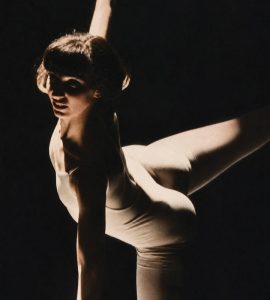
FIGURE 1.5 Stephanie performing at the Joyce Theater in NYC.
Dancers use marking to recall sequence, check timing, and work through transitions without expending the energy of a full performance. But marking is not simply a private cognitive aid. It is also a social and communicative act. As a teacher, I often use my hands to mark combinations for dancers. Without moving across the floor, I can show where the body travels, how timing unfolds, and how one movement connects to the next. The hands communicate the structure of the dance. They enact its direction, rhythm, form, and sequence. This is what makes marking so effective. It reduces the effort required to think through, remember, and communicate complex movements while preserving the essential features of the idea.
Excerpt from Body Talk: Using Gestures to Rethink Human-Centered Products. Rosenfeld Media, 2026.


