
Learn to automate intentionally with What Your Machines Should Do
08/21/2026Every team building with AI eventually runs into the same wall: it’s easy to automate something, but much harder to know if you’re automating the right thing, at the right time, in the right way. That gap (between what’s technically possible and what actually serves people) is the subject of a new book from Rosenfeld Media, and it’s now open for pre-order.
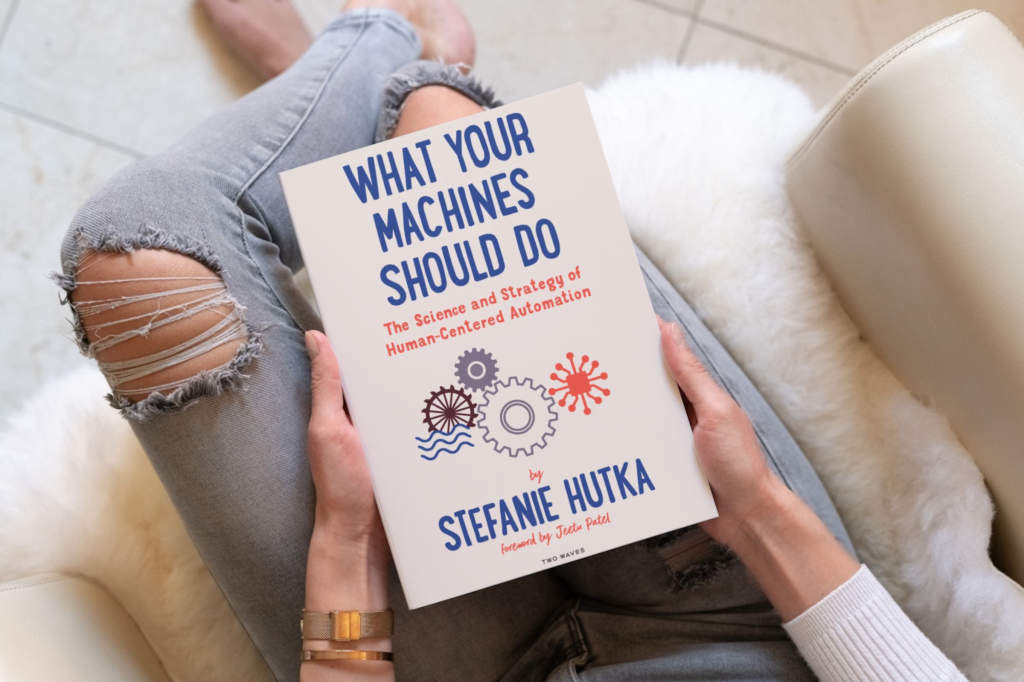
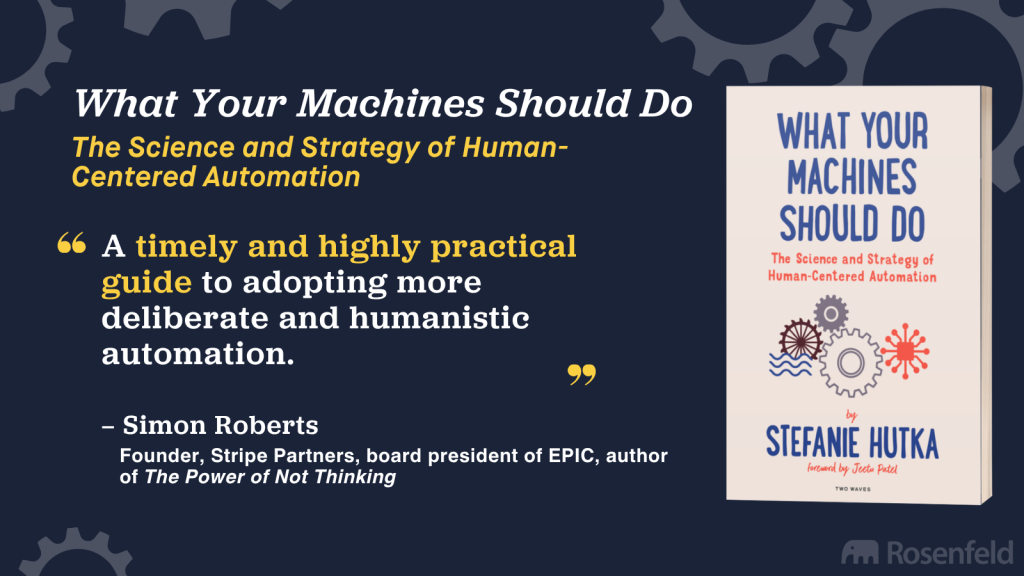
What Your Machines Should Do: The Science and Strategy of Human-Centered Automation, by Stefanie Hutka, is available to pre-order now through November 10, 2026 at 15% off. Here’s what the book covers and who it’s for.
How do I decide what to automate — and what to keep human?
That’s really the central question the book sets out to answer. Hutka’s argument is that AI isn’t a brand-new phenomenon requiring brand-new thinking — it’s the latest stage of a much longer automation story, and there’s decades of hard-won research in human factors, cognitive science, and systems design that already tells us how automation succeeds or fails.
Most organizations skip that research. They chase full automation because it’s exciting or because a competitor is doing it, without checking whether their team is actually ready or whether it will genuinely improve the customer experience. Hutka calls this mismatch the Automation Strategy Gap, and the book is a practical toolkit for closing it: how to set direction on purpose, roll things out in the right sequence, and make sound calls in the day-to-day work of building automated systems.
Who should read this book?
If any of these sound like you, this one’s for your shelf:
- You’re an IC trying to manage up. You want your team and leadership to have a realistic, grounded sense of what the technology can (and can’t) actually do — instead of hype-driven assumptions.
- You’re a manager making the calls. Every week you’re deciding what gets automated, what gets adopted off the shelf, and what stays firmly in human hands.
- You’re a senior leader setting strategy. You need technical capability and customer/business value to actually line up, not drift apart.
What are the key takeaways?
By the end of the book, you’ll walk away able to:
- Weigh customer value, organizational readiness, and technical maturity to prioritize what to automate and how.
- Build real intuition — through hands-on exercises — for the technology’s actual capabilities and limits.
- Judge an automation solution at three levels: the user, the task, and the wider ecosystem it lives in.
- Surface the assumptions already baked into your organization, since automation just accelerates whatever system you already have.
- Treat automation as a way to reinforce strategy rather than let it quietly replace strategy.
- Spot likely downstream consequences early, so you can head off risk and catch opportunity.
- Design systems that expand what people can think and do, instead of hollowing it out.
- Evaluate automated systems honestly, both before launch and after.
What’s covered chapter by chapter?
The book moves from mindset to method across 11 chapters, starting with why intentional automation matters, through frameworks like the Autonomy Decision Matrix and building “could we / should we” judgment, into setting direction, anticipating consequences, and finally evaluating and adapting your systems over time.
Order a copy before November 10 to save 15%.
Who is Stefanie Hutka?
 Stef Hutka helps teams bring useful, usable AI, XR, and robotics products to market. She is the founder of Sendfull, a boutique consultancy for emerging technology teams. Previously, Stef led design research and strategy for 0-to-1 product launches at Adobe, Meta, and DAQRI. Stef also teaches UX and systems thinking at UC Berkeley, and writes the leading Substack on emerging product design research (sendfull.substack.com). She holds a PhD in Psychology from the University of Toronto, focused on cognitive neuroscience. Read more »


