
Last week in the Rosenverse: Migration and automation
06/08/2026Last week in the Rosenverse, we hosted two sessions: one with Mark Rettig about the desire to journey into a different kind of work, and one with Maria Rosala about how AI can assist with your qualitative analysis.
Log into the Rosenverse to watch the recordings.
See what you missed below.
The Urge to Migrate
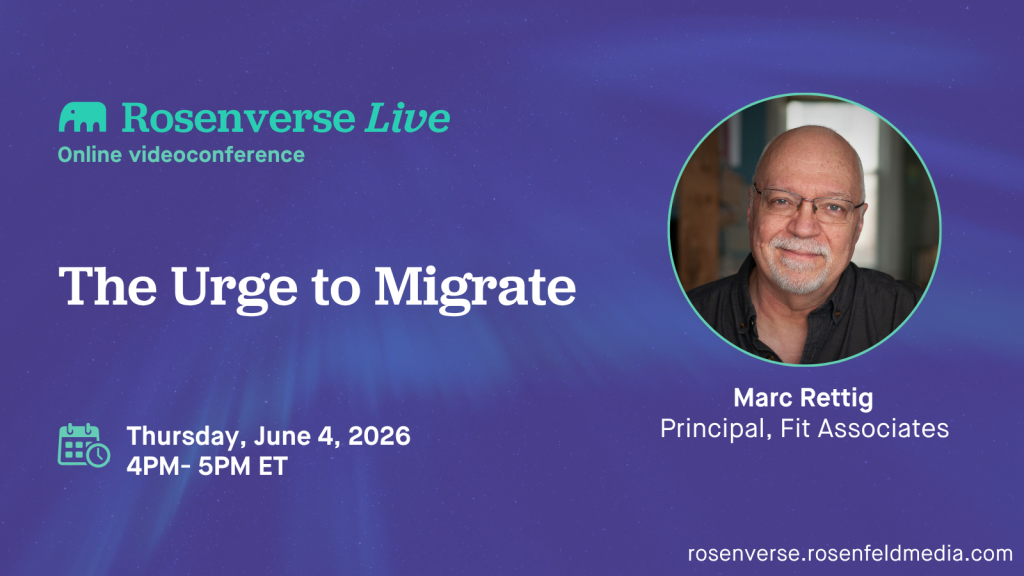
“The urge to migrate comes from restlessness, a longing for change, not just because the habitat becomes colder.”
June 4: This session starts with a feeling. A kind of itch. Maybe the project is touching questions we weren’t trained to answer. The outcomes feel smaller than the problems. Work as usual feels… uncomfortable. Or maybe it’s better than that: seeing the forces at play in the world, there’s a desire to contribute beyond the scale of an organizational agenda. Something is pulling. Toward what, exactly, you can’t yet say. This session is for anyone who recognizes that feeling, even faintly.
Marc Rettig spent decades in corporate design before following what his late collaborator Hanna du Plessis called “”the urge to migrate””—the push of a container that no longer fits, and the pull of something not yet visible. In his case, that migration carried him out of the familiar territory of design-led problem-solving, into a different kind of work: long-term co-creation with communities, and the challenge of shifting deeply ingrained social patterns. In a series of first-person vignettes, he traces that journey: the first spark, the crossings, the companions, and what he found on the other side. Not as a how-to, but as a personal lens useful to anyone standing at the edge of something they cannot yet name. Watch the recording »
About the speaker:
 Marc Rettig is a designer, educator, and part-time publisher. As principal of Fit Associates, he helps leaders and communities better see and create together. He also founded Okay Then, a production company amplifying voices that point to new ways of seeing, working, and being.
After a first career in software, Marc worked for two decades in corporate design research, strategic design, and interaction design. In 2009 he turned from business- and tech-focused design toward deeper social questions. This led to a fifteen-year immersion in group facilitation, emergent practices, and the invisible dynamics of self, relationship, and story that shape truly social design. Read more »
Q&A with our speaker, Mark Rettig
This Q&A was drawn from the Rosenverse Live session.
Q: How is AI changing the way people work?
A: AI is accelerating a shift that has happened many times before: technology reorganizes labor, changes which jobs survive, and pushes people toward new kinds of work.
Q: What kinds of jobs are hardest to automate?
A: The work that is hardest to automate is practice-based work, because it depends on trust, judgment, and direct human relationships.
Q: Why does community matter in the workplace?
A: Community matters because work is never just about output — it is also about belonging, accountability, and the human need to be connected to other people.
Q: What is the relationship between work and dignity?
A: Work is tied to identity and dignity, so when people lose jobs or lose meaningful roles, the impact is emotional and social as well as economic.
Q: Why are corporate jobs changing?
A: Corporate jobs are changing because the system that created them may be reaching its limits, especially as technology and social expectations reshape how value gets created.
AI-Assisted Qualitative Analysis: What to Automate and What to Own
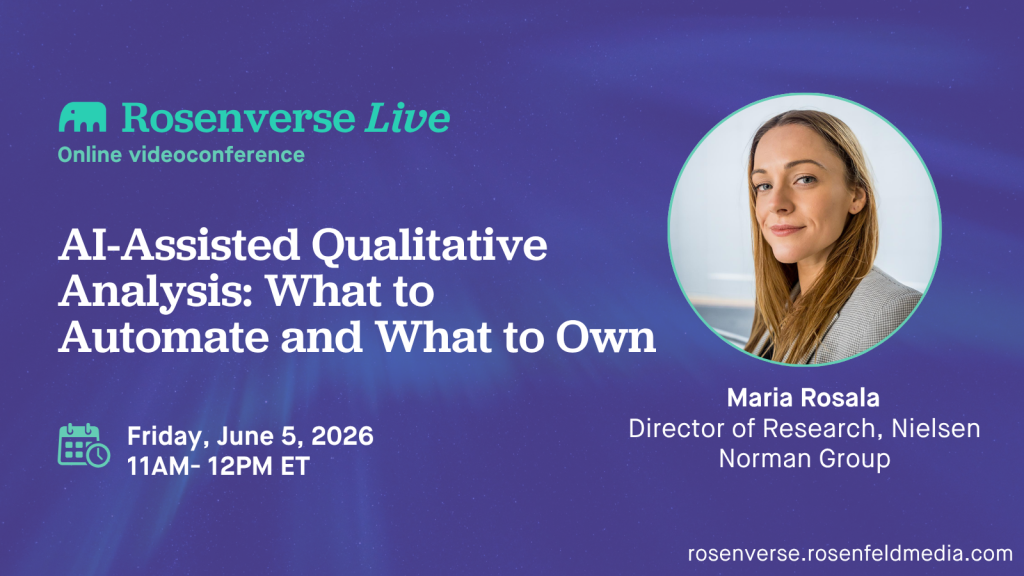
“AI is a tool. It can be as powerful as the person who is wielding that tool.”
June 5: Qualitative analysis is about more than summarizing common trends in your data. It’s about prioritizing and explaining what’s important, and that requires getting familiar with your data and thinking hard about what you’re seeing. AI can support that process, but it can also short-circuit the thinking you need to do if you’re not careful. In this session, we look at what qualitative analysis actually involves, where AI genuinely helps, and where skipping the process costs you. You’ll come away with a practical sense of how to use AI as an accelerant and thought partner while maintaining control of the work. Watch the recording »
About the speaker:
 Maria Rosala is the Director of Research at Nielsen Norman Group. With over a decade of experience leading research for digital products and services, she helps organizations understand user needs, reduce risk in decision-making, and build research practices that scale. At NN/G, Maria leads research efforts, consults for product teams across industries, and teaches UX professionals around the world.
Maria’s work frequently explores how emerging technologies are changing research practices. Through her research, writing, and the courses she develops and teaches, she has advanced practical approaches to discovery, qualitative data analysis, and research operations. Maria is known for transforming thorny research topics into clear, repeatable practices that teams can apply in the real world. Read more »
Q&A with our speaker, Maria Rosala
This Q&A was drawn from the Rosenverse Live session.
Q: What can AI automate in qualitative research?
A: AI can do a lot of the structured, repetitive work, like helping with coding, tallying, and other first-pass tasks that don’t require deep interpretation.
Q: What should researchers keep human?
A: Researchers should stay closely involved in the messy, rich parts of the data, because that’s where surprise, nuance, and important insights often appear.
Q: When is it safe to automate qualitative analysis?
A: Automation works best when the data is structured and the task is clear, but be much more cautious when working with messy, complex, or emotionally rich data.
Q: How does AI help with coding qualitative data?
A: AI can support the coding process by handling the first pass and reducing manual effort, but people still need to review, refine, and own the codes.
Q: What is the risk of relying too much on AI for research analysis?
A: One major risk is cognitive offloading, where you stop doing the harder thinking that qualitative analysis requires and lose some of the skill that makes the work valuable.
Catch up on last week’s recordings, and mark your calendar for upcoming events.
See you in the Rosenverse!


