
Last week in the Rosenverse: From UXer to social entrepreneur
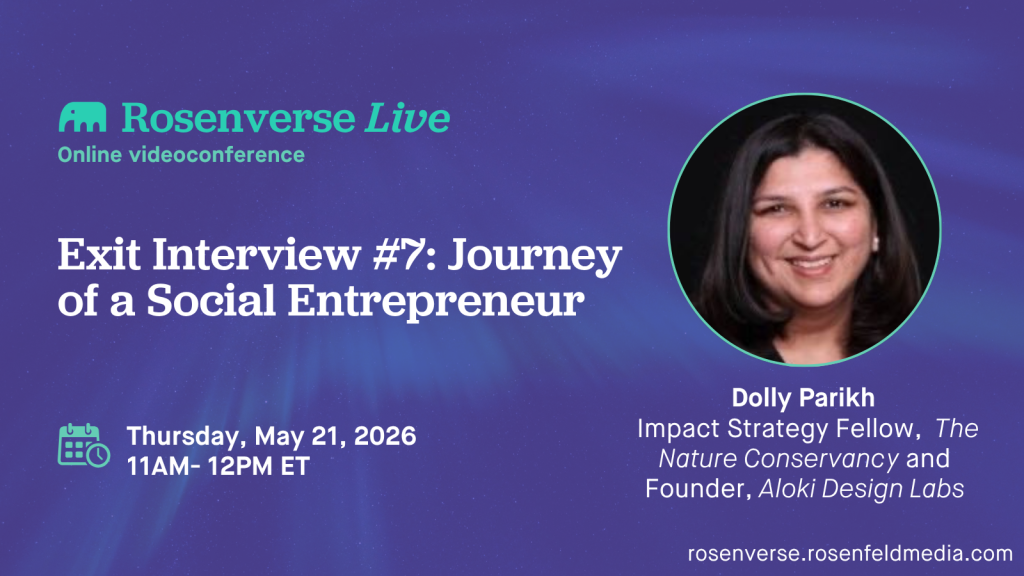
05/26/2026Last week in the Rosenverse, we hosted a session in which Dolly Parikh as a part of our Exit Interviews series. In it, Dolly discussed her transition from UX and product to social and environmental causes, and how others can make a similar change in their careers.
Log into the Rosenverse to watch the recording.
See what you missed below.
Exit Interview #7: Journey of a Social Entrepreneur
“UX mindset lets you see where the friction and gaps are to create value inside and outside organizations.”
May 21: Dolly Parikh reflects on her transition from a long career in UX, Product, and Information Architecture to her current work as an Impact Strategist and Social Entrepreneur advancing sustainable development. She shares how Human?Centered Design, Systems Thinking, and Innovation Practices became the foundation for her shift into Ecosystem Conservation at The Nature Conservancy and her mentorship of Global Social Ventures. This session offers UX practitioners an inside look at how design skills translate beyond the tech industry and how they can be leveraged to drive regenerative, systems?level impact in the social and environmental sector. Watch the recording »
About the speaker:
 As a social entrepreneur, Dolly Parikh focuses on impact, strategy, and innovation capacity building for sustainable development. At The Nature Conservancy, whose mission is to protect land, water, and ocean on which life thrives, she leverages Human-Centered Design, Systems Thinking, and Innovation methodologies to drive impact in ecosystem conservation. After spending a couple of decades as a Product, UX, and Information Architect in B2B and B2C Technology Companies, Dolly expanded her design and problem-solving practice for social good. Read more »
Q&A with our speaker
This Q&A was drawn from the Rosenverse Live session.
Q: How do UX skills translate into social impact work?
A: UX is fundamentally about understanding people, clarifying complex problems, and designing better experiences. Those same skills are powerful in the impact sector because they help teams communicate clearly, prioritize effectively, and build services that are easier for people to use.
Q: What is the biggest leverage point for design in this kind of work?
A: The biggest leverage comes from communication and storytelling. When you can frame a problem well and show why it matters, you make it easier for others to align around the solution and move the work forward.
Q: Why is AI especially useful in the impact sector?
A: AI can help close resource gaps when teams are underfunded, understaffed, or stretched thin. Used thoughtfully, it can support faster operations, better knowledge access, and more scalable service delivery.
Q: What makes transferable UX skills valuable outside tech?
A: Research, facilitation, synthesis, and design strategy are useful almost anywhere people need better decisions and better services. Those skills travel well because they are built around understanding behavior and improving human systems.
Q: How can mission-driven teams use AI responsibly?
A: AI should support people, not replace judgment. In the impact sector, it can help stretch limited resources, but it works best when teams stay focused on equity, context, and the actual needs of communities.
Catch up on last week’s recordings, and mark your calendar for upcoming events.
See you in the Rosenverse!


