
Make It So is now on sale!
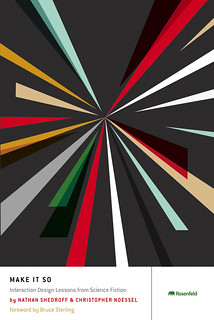
What could be more fun than learning interaction design from studying science fiction movies and TV shows? From Metropolis to Star Trek to Minority Report, sci-fi offers an unconstrained design milieu that can inspire and teach us, and in Make It So, Nathan Shedroff and Chris Noessel have captured those lessons in this ground-breaking book. From gestural interfaces to augmented reality, and from medical interfaces to future sex, you’ll be blown away by all this book has to offer.
Like all of our titles, Make It So is available in a lovely color 348-page paperback and three DRM-free digital formats (PDF, ePUB, and MOBI). Pick a copy here at our store or via Amazon.
Wired already has a nice write-up. Alan Cooper, The Bourne Identity’s Mark Coleran, and io9’s Annalee Newitz have weighed in with glowing testimonials. But we’ll let Bruce Sterling bring it home with his foreword’s conclusion: “I never imagined that I would be reading a book like this, or that it would be this good”.
Expert Interview: Christian Crumlish
You may know Christian, one of our crew of UX experts, from Designing Social Interfaces (O’Reilly, 2009), which he co-authored with Erin Malone. Or if you’ve spent time in the Bay Area, you’ve surely crossed paths with him at a BayCHI meeting. We asked Christian to help us better understand designing for social.
RM: What’s a common mistake people make when it comes to designing social websites and applications?
CC: Oh, there are so many. Let’s see, a few of the most common are to build far too much before launch based on hypotheticals. Much better to build something focused and amazing, invite some people in, and then start working with behavior.
Another common one these days is a sort of mindless “gamification” in the form of highly mechanical point systems, badges, or the like. They usually fail as games and can have many unintended distorting effects if not designed carefully as part of an overall engagement strategy.
RM: As you’ve investigated how clients approach the design of social experience, what’s one thing that’s really surprised you?
CC: Very little has surprised me on that front. Folks take all sorts of approaches, most commonly based on imitating or mashing together some effective, newly familiar models. I try to get people to take a step back and look at things on the ecosystem level, model things out a bit more, do a bunch of UX exploration and ideation, and then get back into the weeds of a roadmap and defining specific features and flows.
Honestly, the surprises always come from the users. A well-designed social experience establishes a framework and some ground rules, and operates as a good host and an honest broker. The real vitality of any such application or service comes from the critical mass of participants. Kindling the participation is one phase of things and has its own challenges, but beyond that the “folkways” of a social experience tend to ultimately invent uses and customs that might never otherwise have occurred to the founders and inventors. At that level, when a social environment is really humming along, it’s nothing but surprises, and the real challenge is figuring out which behaviors to amplify and reinforce.
RM: Thanks, Christian!
Now supporting Readmill
Readmill is pretty cool—it’s a web service and iPad app for storing, reading and sharing highlights of DRM-free digital books.
If you like Readmill, you’ll like this: you can now download your Rosenfeld Media digital books to your Readmill account. Just go to your Rosenfeld account’s Download page and click the “Send to Readmill” link next to each of your digital books. That’s it! Enjoy!!
Chris Noessel on learning from science fiction interface failures
Chris, managing director and practice lead at Cooper and co-author (with Nathan Shedroff) of Make It So: Interaction Design Lessons from Science Fiction, is the subject of today’s mini-interview. Make It So should go on sale in early September; sign up and we’ll email you a notice and a swell discount code as soon as it goes on sale.
RM: What came as the biggest surprise during the writing of your book, Make It So: Interaction Design Lessons from Science Fiction?
Chris Noessel: It’s the seeming “failures” in SciFi interfaces that can be the most rewarding to analyze. Yes, some are just nonsensical even after careful consideration. But most every interface that characters deal with serve a purpose, and their design has some core sense to it. If you can just hold on to that core sense and find a way to redesign or reconceive the parts that seem broken, you can have “Eureka!” moments that result in new, cool concepts. In the book we call this “apologetics,” and it’s one of the most surprising and rewarding concepts to emerge from the work.
How to get $100 off your next book order?
Simple: be one of the first ten people to register for our New York City workshops (October 10-12) with Kim Goodwin, Rachel Hinman, and Nathan Shedroff).
…or one of the first ten people to register for our Minneapolis workshops (November 12-14, with Louis Rosenfeld, Susan Weinschenk, and Steve Krug).
…or one of the first ten people to register for our Toronto workshops (November 28-30, with Steve Krug, Lou Rosenfeld, and Anders Ramsay).
We’ll send you a US$100 gift certificate that you can redeem at our store. It really is that simple! So is learning all about our fall UX workshop series; everything you need to know is here.
Indi Young on generative versus evaluative research
As part of our ongoing series of short interviews with Rosenfeld Media people, we turn to Indi Young, the author of our first book, Mental Models: Aligning Design Strategy with User Behavior. Since its publication in 2008, the book has become a perennial favorite; we just keep printing more!
RM: What’s the biggest mistake people make when it comes to mental models?
Indi Young: Someone said to me last year, “So I still don’t understand how to set up a scope to find out why someone would buy an iPhone over a Windows phone or an Android phone.” That would be evaluative research; mental models are a structure to contain generative research. The scope this person would explore generatively would be, “Tell me your thoughts around staying connected while on the go.” With a scope like this, you will hear the goals people have in mind—”Keep track of where the kids are,” “look up my client’s business address to find nearby parking,” “let my husband know I’ll be 30 minutes late getting home,” “change my flight reservation because this meeting is running long,” “listen to that new song my friend gave me after I get home, on my quality speakers,” “give that report to my co-worker after I finally remember during dinner at the pizza place,” etc., etc.
These are the things people are trying to get done, and they might use a mobile device to do it. Or they might use a phone book or the TV or a map or a piece of paper. It doesn’t matter. What matters is how each goal is supported. Does the Android phone support “give that report” as well as an iPhone or a Windows phone? You’d look at how each of these devices helps a person accomplish each of the goals. If there are stronger matches between certain devices and certain goals, then that indicates why a person might select the device with the stronger match. But just asking for the matches is a weak use of a mental model. Instead, use it to think up more specific, stronger ways to support a particular goal, for a specific subset of the audience.
Another mistake is the assumption that a lot of time and effort is required to create a mental model. Folks get scared off and never try one. True, if you go interview a bunch of people then yes, it will take six weeks or longer to get through all the steps. But you can also get a lot of insight using short essays people write about their thought processes regarding a particular scope. Or you can re-use existing research and your own knowledge of the customer perspective. These are a few ways to create, or at least sketch, a mental model within a week.
John Ferrara on “gamifying” experience
John Ferrara, author of Playful Design, is the subject of today’s mini-interview. If you find John’s answer interesting, you might check out the longer interview he did with Jenn Webb of O’Reilly Radar. Or, of course, buy John’s book.
RM: What’s the biggest mistake people make when it comes to creating game experiences in everyday interfaces?
John Ferrara: Paying insufficient attention to the quality of the player experience. It’s important to understand that there’s an innate selfishness to gameplay. People don’t play games out of loyalty to your brand or because they want to solve world hunger. They play because they value the experience. To the extent that designers trade off enjoyable gameplay to serve their own purposes, they are shooting themselves in the foot.
This is what concerns me most about the gamification fad. Too often, “gamifying” an experience means adding points and leaderboards but leaving it otherwise unchanged. This is even implicit in the word “gamification”, which suggests an experience that is by its nature something other than a game but dressed up to resemble one. These kinds of approaches will not survive because they don’t value gameplay, and so players will not value them.
Successful implementations recognize that games need to be games first, and give the highest priority to the player experience. These are intrinsically rewarding games that are enjoyed for their own sake. Their designers value play and understand it as a fundamental function of living.
Rachel Hinman’s The Mobile Frontier is now on sale
We’re overjoyed to report that Rachel Hinman’s much-anticipated book is now available! Here’s the blurb:
Mobile user experience is a new frontier. Untethered from a keyboard and mouse, this rich design space is ripe with opportunities to invent new and more human ways for people to interact with information. The Mobile Frontier will help you navigate this unfamiliar and fast-changing landscape, and inspire you to explore the possibilities that mobile technology presents.
If the testimonials from folks like Josh Clark and Luke Wroblewski don’t grab you, check out what readers are already saying nice things about the book.
Also peruse the table of contents, FAQ, the 390 illustrations, and an excerpt that UX Magazine has kindly published. They’re also giving away five free copies in an oh-so-easy-to-enter contest.
We hope you’ll enjoy The Mobile Frontier; please let us know what you think!
10 tips for better UX surveys
Are you a bit sceptical about surveys?
I was too – but researching this book has changed my mind.
If a survey is going to happen anyway, we need to make sure it’s a good one. So the first part of this talk has tips for better questions.
If you’re doing a survey from start to finish, the second part of this talk has tips for a better survey process.
View the slide deck: 10 tips for a better UX survey from Caroline Jarrett
Retiring an ebook format
When we published our first book back in 2008, we sold it in two and only two formats: paperback and a screen-optimized PDF. Both had been extensively researched, carefully conceived, and user tested. And we thought we were hot stuff for bundling print and digital from the very start.
Since then, the reading experience has changed dramatically. (To understate things dramatically.) In response, we rolled out printer-optimized PDF versions of our books, so customers could print them out more effectively. Then our books came out in iPad-friendly ePub format. Then, MOBI for the Kindle.
After the mad shifting of sands underfoot, things seemed to stabilize over the past year or two. A large portion of our sales are now digital only, and of them, ePub and MOBI files are the clear formats of choice for reading on mobile devices.
The odd man out? Our old-fashioned (four year-old!) screen-optimized PDF. And that makes sense—why use PDF, a format conceived for print, when there are newer formats designed to be used on your favorite mobile device? Additionally, publishing is a low-margin business, and producing a specially-designed screen-optimized PDF almost doubled our layout costs.
So, goodbye, screen-optimized PDF, and thank you. We’ll continue providing printer-optimized PDFs, as well as ePub and MOBI ebooks. When the ebook sands shift further, we’ll keep up. And our ebooks will remain DRM-free.
Please let us know if you have any questions or suggestions.
And as a reward for getting this far, you get to be one of the first to learn of our newest book, which just soft-launched a couple hours ago. Apropos of this discussion, it’s Rachel Hinman’s The Mobile Frontier. And here’s a 25%-off discount code to use when purchasing it: EASTEREGG (good for the first 25 people to redeem it).


