
New year, new book!
We’re celebrating 2014 by releasing our 19th title: Aga Bojko’s Eye Tracking the User Experience: A Practical Guide to Research. And here’s the “d’uh” statement of the young year: eye tracking is controversial. Some swear by it. Others, well…
I confess that even I was a bit surprised at how strongly people feel about the topic. That’s why I’m so glad GfK’s Aga Bojko wrote this book. Hers is a pragmatist’s perspective: while eye tracking isn’t, as some might claim, the greatest thing since sliced bread, it does offer incredible value when used in right situations. You know, like any other tool.
And, like any other hi-tech tool, it’s getting dramatically less expensive. If you’ve not yet encountered eye tracking hardware, you will in the not-too-distant future.
Are you ready? If not, we’ve got the book for you—beautifully written and illustrated, and hot off the presses.
QuickPanel: Drones, Amazon and Other
 Say what you will about Jeff Bezos, the man knows how to touch off a media storm. Which is precisely what ensued after Bezos told 60 Minutes that Amazon is testing the use of drones to deliver goods. Immediately, everyone was discussing the prospect of ordering a box of tissues from Amazon and having a drone arrive at your doorstep in half an hour. We’ve asked some Rosenfeld Media experts to join the fray on this audacious idea.
Are drones the next logical step for a service culture that demands ever more instant gratification?
 Victor Lombardi: Amazon knows that any commercial use of drones lies far off in the logistical future. Kevin Roose argues that Amazon is therefore dabbling in some sort of pre-lobbying of the government, but I prefer David Steitfeld’s wider view that Jeff Bezos spun a tale of drones as a masterful use of public relations, mostly to counter negative criticism.
But even this interpretation fails to grasp the power of Amazon’s imagination, the company that started by selling books, grew into a marketplace for anything, and then offered its own cloud computing platform for sale. Clearly, they aspire to more than mere retail. But they know for us to take them seriously they must put forth an image of themselves as something more, something special.
Don Norman calls this reflective design, which goes beyond our senses and perception of usability to influence our understanding of who the company is and who we become when we patronize it. In my book I discuss how Apple publicized the iPod. It didn’t emphasize how pretty the device was or how great the features were; Apple showed us how we would feel using the device. I think Amazon is doing something similar: inspiring us, getting us to think differently about who Amazon is and what we think about ourselves when we shop there. Before, I shopped at Amazon to save money and time. Now, I’m affiliating myself with this cool company that thinks about drones and how awesome their customer service can become. Now when I shop there, I’m cooler, too. Thanks Jeff.

 Nate Bolt: I don’t think there’s any inevitable progression towards autonomous quadcopters playing a role in our service culture. But drones are absolutely fascinating. We’ve been largely introduced to sophisticated drones as killing machines. That’s been our biggest cultural exposure up to this point, aside from all the other small-use cases we see. Most of us understand that drones themselves can offer all sorts of functionality that wasn’t possible even a few years ago. If there’s any logical progression happening, it’s simply military technology always disseminating out to the rest of us. I do think many of us in the tech world will continue to experiment with drones, because flying and autonomy cut so close to the dreams of every nerd. [Editor’s note: Nate once flew a drone around the Rose Reading Room of the New York Public Library.] It sparks the imagination to think of all the issues in the physical world–search and rescue, agriculture, photography–that can be improved by drones.
Every time I hear people worry that a new way of doing something is going to fundamentally change society or destroy civilization, I remember that these same concerns were raised about the printing press, the train, the personal computer, the Internet, and the waltz.
At the very least it was a brilliant marketing effort for Amazon. Taco drone, pizza drone, France post office drone–it’s really all been marketing. I wouldn’t be surprised if Amazon kills this program internally when it stops keeping their name in our conversations. I generally like it when large companies pursue things just because they are cool, but it’s usually driven by marketing. The product designers and engineers at Amazon and other large companies don’t have quite as much leeway to simply investigate technology they think might be cool in five or ten years. But I wish they did.
 Laura Klein: I don’t think they’re the next logical step. They are a possible step, but I think that a much more logical next step would be same-day delivery by humans (which is already being done in some areas) or even self-driving cars. Amazon picked drones as the announcement because drones are a thing that everybody is talking about right now. They get a lot more press from talking about drones then they would from slightly improving their supply chain to roll out same-day delivery to a few major metropolitan areas.
The phrase “a service culture that demands ever more instant gratification” seems needlessly derogatory. There’s nothing inherently wrong with not wanting to wait two days for a purchase you make. We expect to get our purchases right away when we’re in a store. What’s wrong with getting our purchases right away when we buy them other ways, as long as it’s not hurting anybody? Sure, getting packages immediately may seem like a needless extravagance, but at one point so did stores staying open on Sundays.
It’s a longshot that this will ever happen. But let’s imagine for a moment that Amazon pulls this off. A terrible road to go down, or awesome?
Laura Klein: I’ll take a stab at “awesome”. Drones make it possible to get things where they need to go faster and more flexibly than they currently can. Your mail gets delivered to your house once a day. Your email gets delivered to you when it gets sent, which immediately makes people more productive. I think that’s a big reason why email is destroying snail mail.
On a small level, it could improve traffic. Not only would there be fewer UPS trucks traveling down narrow San Francisco streets, there would also be fewer suburban folks like me having to jump in their cars to go grab that thing they forgot to get at the drug store. If I need it in 30 minutes, I can have it in thirty minutes without driving.
Now when I shop there, I’m cooler, too. Thanks Jeff.
It also makes things much cheaper to send to difficult-to-reach places; for example, delivering medicine and food to places where roads have been destroyed by natural or manmade disasters.
But the real reason I’m predicting that it will be awesome is that every time I hear people worry that a new way of doing something is going to fundamentally change society or destroy civilization, I remember that these same concerns were raised about the printing press, the train, the personal computer, the Internet, and the waltz. Not all of the changes brought about by those inventions has been fabulous or predictable, but they’ve certainly been largely positive in my life.
We fall in love with ideas, with visionaries, with progress for the sake of progress. And that leads to failure.
Nate Bolt: Here’s what will happen:
-
An individual or company will crash a drone in a populated area and it will hurt or kill someone. Hobbyists know this happens with RC [radio control] aircraft all the time, but when it’s an autonomous quadcopter, the media will be much more interested. It’s the autonomous flight capabilities and awareness of its environment that make a drone a drone. These things offer the promise of flying themselves, and a crash highlights the scariest part of technology–unintended consequences. So it might be a car accident, the props might cut someone, it might just hit a pedestrian; who knows?
-
A high-profile privacy lawsuit will come about because of a drone.
I do think many of us in the tech world will continue to experiment with drones, because flying and autonomy cut so close to the dreams of every nerd.
-
There will be a media shitstorm from #1 and #2.
-
The laws that exist will be enforced much more, and new laws will be passed. It will all of a sudden be laughable to think that in 2013 you could buy a DJI Phantom and crash it in the middle of Manhattan without much fear of prosecution.
-
The cost and complexity of anything drone-related in populated areas will increase. This is inevitable and probably a good thing. If Amazon or anyone wants to fly in populated areas, the amount of failsafe technology required will make self-driving cars look like cake. It will also cut down on the ability of photographers to legally capture images and video for artistic purposes. That last part is a bummer and why I try to cram in so much #DroneLucy photography right now.
-
Some use cases will eventually emerge where drones make sense for delivery. Basic physics aren’t going to change any time soon, and that means to carry even a five-pound payload, props and batteries will have to be big enough to make these things rather valuable and rather dangerous. But with the right object avoidance and failure algorithms, they will indeed make sense in some cases.
-
Sweet new gangs will emerge that are dedicated to shooting down drones, and they will get to design awesome stickers to represent how many drones they’ve shot down.

Victor Lombardi: The danger is in trying to answer this question using reason rather than experimentation. And that’s because drone package delivery is so new we have no idea if it’s awesome or not. To find out, we need to test it. The reason we fail to get these things right is because we fail to treat them as experiments. We fall in love with ideas, with visionaries, with progress for the sake of progress. And that leads to failure.
The very fact that we’ve written this piece and you are reading it means we’re interested in this as an idea. Meanwhile, there’s another organization testing the idea, quietly.
Like what our experts had to say? Guess what: you can have them bring their brains to you. Laura Klein and Victor Lombardi are available for consulting and training through Rosenfeld Media. And we’d be happy to introduce you to Nate Bolt.
QuickPanel: Disaster Relief
Natural disasters such as Typhoon Haiyan, which last month devastated much of the Philippines, bring immense information challenges, from reports and warnings issued beforehand to the web sites that handle donations afterward. How does UX factor into disaster preparedness and response? We asked a panel of experts to weigh in.
How have web and mobile technology changed the donation process for example, the ability to text donations? Have non-profits such as Kickstarter, Indigogo, and Crowdtilt raised the bar for easy experiences?
 Lisa Welchman: I believe these sorts of organizations have improved the experience for donation, but they’ve also crowded the field, which makes it hard for donors to determine the nature and status of the organizations doing the fundraising. We all want to be sure that we are donating to an organization that will make most effective use of our funds. On the positive side, newer donation methods make it easier for an individual to target their donation either to a specific geographic region or to fill a particular gap in infrastructure, such as housing or food supply. And, the ease of donation can also put demands on the physical supply chain.
Non-profits should take care to understand the full process, from making the quick donation all the way to the goods or monetary instruments reaching those who need them. Kiva loans are powerful, for instance, because there is a direct connection between the one supplying the loan and the one receiving it. That connection, and reporting back on the use of the loan, helps give the donor the confidence that they are really making a difference.
 Kelly Goto: When Katrina hit in 2005, I donated using Red Cross because I had heard it was the best way to ensure your money was going to the right places at the right time. Later, I donated to my local church, which was very well connected to local churches in the hurricane-hit area. That seemed even more direct and helpful but a fluke because it was based on a personal relationship. Today, there are sites that help you vett who to donate to, and the ability to send $10 via SMS is compelling and very friction-free. The “crowdsourced” assurance that your funds are going in the right direction works on that local community-based level, which feels the most impactful.
There was some debate over Kiva in the last few years, where you were not assured that the micro loans were being handled properly, and the information on the web site was not 100 percent clear or accurate. Local/community-based services such as Task Rabbit and AirBnB help jumpstart activity on a local level while assuring systems of privacy and protection are in place. The same local-based mentality of helping someone you know or a project you respect via Kickstarter, or joining a smaller cause where you can see the effect directly, does seem to have more emotional resonance, and thus a bigger impact for smaller funds. Not only is the experience friction-free, but the meaning is there, thus the desire to join in and believe you can make an impact.
Whitney Quesenbery: The ability to text a small donation, charged to your phone, is an amazingly successful way to allow people to act on their natural, human impulse to help out in a crisis. Ushahidi and similar SMS-based systems let everyone not only have access to information, but contribute information as well.
We see this sort of bottom-up information system in our daily commute. Drivers’ reports of accidents or traffic jams are reported on maps and even in radio traffic updates. And the data from navigation systems supports real-time predictions of travel time.
Mobile money is also having a profound effect on humanitarian aid. Getting supplies into the affected area is important, but this article in User Experience describes how relief agencies are using mobile money so that families can make their own decisions about what they need and have the resources to get it. The author, Gabrielle Smith, writes, “There has been overwhelming evidence from many humanitarian relief efforts around the world, that cash transfers give people more dignity and flexibility in meeting their day-to-day needs.” Isn’t that a goal worth designing for?
Is there anything we can take away from Haiyan to be applied to future catastrophes?
Kelly Goto: There was a disconnect of language and communication on a very straightforward level that really hit me. The term “storm surge” rather than “tsunami” was used and unheeded by so many. No one knew what a storm surge was but everyone knew what a tsunami was. If the government and news had used “tsunami”, I heard 80 percent more people would have evacuated, even if the term wasn’t 100 percent correct. (A tsunami is a wave or series of waves caused by an earthquake in the ocean that come in as rapid surges. A storm surge is caused by a hurricane, typhoon or cyclone. They are wind-driven, generally come in more slowly, and are easier to predict.)
How we handle these warnings and respond now, as well as take lessons away for the future, is a “life cycle” of great magnitude. Kind of like two friends of mine who have PhDs in social welfare, but one’s on the hands-on side of social work and the other on the policy/plan-for-the-future side. It takes both disciplines to make change happen, over time, while dealing with the crisis on the ground.
I could not help but think about an amazing lecture I heard by Ravi Sawheny of RKS Design on the methodology used to design the Hydropack technology—I was mesmerized to see similar frameworks we use in user research to help companies like Samsung “innovate” while RKS was using their focus to change the world.
I would like to see a brain trust (not just a think tank) of donated time from smart individuals and teams dedicated to solving more of these types of problems. As someone who lives along a tsunami warning-labeled coastline, it does hit home.
Lisa Welchman: A storm surge is a storm surge and a tsunami is a tsunami. I think accuracy is important. If people don’t know the difference, then the focus should be on educating them so that they do. Perhaps we need to stop talking about catastrophes using meteorologically focused, sound-bite naming conventions and start quantifying and talking about them in terms of the catastrophe’s impact on a number of different factors—things like loss of home, loss of life, loss of services. We do some of that already, but it would be interesting to create a scale using those factors. Folks could then be socialized into the new measurement paradigm. Storms are interesting, but what drives me to donate is their impact.
I was mesmerized to see similar frameworks we use in user research to help companies like Samsung “innovate” while RKS was using their focus to change the world.
Whitney Quesenbery: Words and definitions are important, but it’s more important that people understand not only what they mean but what actions they should take.
That fits the definition of plain language (from Ginny Redish and international plain language organizations, including the Center for Plain Language) that clear communication means that people can
- Find what they need
- Understand what they find
- Act on the information
During Hurricane Sandy, my town didn’t have flooding, but our power was out for ten days. The county used the emergency-response phone systems, and neighbors went door-to-door to get out the word about both the situation and what help was available.
There was a disconnect of language and communication on a very straightforward level that really hit me.
Maybe one lesson to take away is that when information is as important as life and death, we need many different ways to communicate it: flags, sirens, phone, web, social media, person-to-person, etc.
Information after a crisis can be just as critical as clean water and medical supplies. What can UX professionals offer in this regard?
Whitney Quesenbery: I’m working on a project with the U.S. Health and Human Services emergency response planners to create tools to help them understand and manage a crisis.
There are very few UX folks inside these sorts of organizations and it shows.
As we talked to people at federal headquarters and in the regions, I was struck by their need for a big picture and a way to find and manage details—at the same time. This is just the sort of wicked problem where good UX can make a huge difference.
There is a chain of connections between national policy (How many medical response units do we deploy? What equipment and supplies do they need?) and first responders on the scene. It crosses time and geography, but also levels of government, NGOs, and citizen response. If they cannot communicate clearly in rapidly evolving events, they cannot respond well, let alone get ahead of the crisis to respond effectively.
As a UX person, there is not much I can tell dedicated professionals about their job. What I can do, however, is listen carefully to what they want and use my UX skills to shape tools that are even better than what they imagined.
One of our tools is an online “All-Hazards Plan” that uses a visualization as the main entry point. Someone at the operations center can look across different response “functional areas” to see what teams have action steps now, at any stage of the event from preparedness, through the event, and into recovery. That sort of overview is critical for good coordination. We workshopped a dozen different design ideas to find the one that worked for them.
Kelly Goto: There is a before, during and after. I think UX can be best incorporated in the “before,” much like how policy works on the welfare side. It’s not that I would choose not to address the “during” or “after”; however in our field, we can provide charts, graphics and help people visualize the situation and provide better insight on how they might react and respond.
Storms are interesting, but what drives me to donate is their impact.
I live in a coastal area of California. We have signs for tsunamis with arrows on where to go and what to do, along with a calling system for people who have regular phone lines in the area, and a local SMS system for all local alerts (traffic, emergencies, missing persons, etc.) I am signed up for these services and have seen how they work. However, the truth is no one thinks a tsunami will actually occur, and I doubt the preparation for a real disaster is even present.
There seems to be “hurricane fatigue” in areas that are the hardest hit, so even when the danger is the most prominent and the awareness is present, people are still not aware of how impactful a natural disaster can be. Awareness at multiple levels—from individual to family to the community to local government—should include visual output and localized communications (both analog and digital). And this should also include the “what to do in the aftermath” should power and communications go dark—for example, people most often stress about their pets—and how to handle safety. Perhaps RFID tags and other devices can be also established?
Lisa Welchman: I’m actively working with NGOs and other governmental organizations about their ability to deliver accurate information in a crisis. Much of the impetus for addressing this came from information management problems that have arisen during some recent natural disasters. How organizations determine what they say and don’t say to people in a crisis, and when they say it, is interesting—and not as organized as it could be.
This is just the sort of wicked problem where good UX can make a huge difference.
It might be interesting to explore how often the right information gets to the right person at the right time in a catastrophe and to understand what the limits are for certain channels, not just for those impacted by the catastrophe but for those trying to help others. Catastrophes are by their nature confusing but that could be improved by more thoughtful information flow. A lot of that flow is based on legacy paper-based processes; changing that requires creative thought from people who understand the capabilities of new digital channels as well as the mission-critical agenda of governments and NGOs. There are very few UX folks inside these sorts of organizations and it shows.
Like what our experts had to say? Guess what: you can have them bring their brains to you. Kelly Goto, Whitney Quesenbery, and Lisa Welchman are available for consulting and training through Rosenfeld Media.
QuickPanel: Digital Cocooning
With our eyes on our screens more and more, what’s happening to our public spaces? Are they less congenial, less bustling, less safe? A number of recent books, such as The Circle by Dave Eggers and Ambient Commons by Malcolm McCullough, cast a critical eye at an always-online society. And in a tragic turn, a San Francisco State University student was killed in September while leaving a crowded train; passengers, engrossed in their devices, hadn’t noticed a man on the train waving a gun around. We asked a panel of UX experts to weigh in on the ramifications of digital cocooning.
With smartphones, we walk around with the capacity to be talking to, texting, or tweeting each other all the time. Yet we’re missing out on what’s happening right in front of us. Why does social media make us, in some sense, antisocial?
 Christina Wodtke: Everyone is talking about our need to be connected all the time, but no one (as far as I’ve seen) is talking about our increasing cocooning of ourselves from each other. The police procedural constantly provides us examples of bad things that can happen to us, with shows like “CSI” illustrating that apparently safe people can become our kidnappers and killers. But to be continually hyper-alert is exhausting. So instead we put up digital “do not disturb” signs so we don’t have to deal with strangers, which makes us more vulnerable to significant harm.
They also shield us from the petty guilt of not helping our fellow humans who are less fortunate, such as the homeless, the beggars, and old folks in need of a seat. In San Francisco, where a recent shooting occurred, one is continually asked for money. Even the kindest of us can’t give to everyone who asks, so it becomes easier to hide.
‘Down time’ used to mean a chance to relax and look around. Now it’s considered ‘dead time’ that needs to be filled.
 Randy Farmer: Attention is a scarce resource, and it can be dangerous to focus inwardly all the time. I first noticed this before smartphones. Airports used to be social/public spaces (and I liked to spend time interacting with people there) before cell phone and Bluetooth headsets. Now, time spent at airports is seen as “down time” that could be more efficiently used for business/personal relationships (texting), so these public, “third” places are quickly losing their efficacy as a way to interact with the greater community. And it’s only getting worse. The FAA is allowing more use of electronics on flights, and all the parks in NYC have Wi-Fi.
“Down time” used to mean a chance to relax and look around. Now it’s considered “dead time” that needs to be filled. Heads up has become heads down. Sad.
 Brenda Laurel: At the memorial of the 50th anniversary of the death of Martin Luther King, we saw King’s great speech at the Lincoln Memorial over and over again. I was haunted by a picture of what that moment would have looked like today. Everybody would be taking pictures or texting with their phones. Dr. King might himself have felt isolated. To paraphrase Cassius in Julius Caesar, the fault is not with our cellphones but with ourselves. This is a failure of civility—of plain old manners—as well as a failure of mindfulness. As interaction designers (paradoxically), I think we can make some interventions in this space.
What are some design approaches that could mitigate the effects of digital cocooning?
The iPhone already has a ‘do not disturb’ setting; maybe it’s time for a ‘please disturb’ setting.
Christina Wodtke: Design could help this problem in a myriad of ways, from having a “public place” setting that allowed only audio or only visual. When I run or bike, I only listen to porous audio like podcasts so I am alert enough to react to danger. Once we shut off our ears and eyes, we are utterly defenseless. The iPhone already has a “do not disturb” setting; maybe it’s time for a “please disturb” setting.

Design could also help in a much more significant way by reminding us of the humanity of our fellow passengers and making sure places like trains and subway read as safe so people would not feel such a strong urge to psychically hide. Ride a Skytrain in Bangkok. Bangkok has the same degree of homelessness and crime, same varied socioeconomic status of riders, yet the Skytrain feels safe and a only handful of folks hide in electronics. The trains are well designed, well maintained and comfortable, with many signs reminding you to give seats to children, pregnant ladies, older folks, and monks. As well, there is always a TV on, and while in Bangkok only shows commercials, I can imagine a world in which news or sports are shown as well, encouraging people to be eyes up. When places feel safe, we can relax and people-watch, and this makes those places even safer. Jane Jacobs, in her amazing treatise The Death and Life of Great American Cities, points out that what makes a place safe is “eyes on the street.” Our public transit needs eyes on each other to keep each other safe.
Randy Farmer: Though technology has been developed to prod us into changing new potentially harmful behaviors (such as smartphones auto-disabling texting while moving in a vehicle), it’s no replacement for changing our culture.
We need to consider designing our environments to remind and teach us how to interact and consciously seek “down time.” Some businesses have taken on the role of etiquette guardians:
Brenda Laurel: Both Christina and Randy make good points. I imagine “public interactives” that might allow us to see together our own public environments and gatherings in different ways. Mindfulness meditation apps already exist (for example, Smiling Mind and Take a Deep Breath). Beyond this, design applications or environment remind us to breathe and be present.
Do you engage with strangers when you’re in a “third space”—standing in line at the post office, waiting out an airplane delay? Or, in those cases, are you grateful to have an electronic device at hand?
Christina Wodtke: Most of the time, my biggest fear is being put into that situation. I’m intensely introverted. On a recent flight back from Prague, the entertainment system was not working. When the food heating system also broke, my neighbors and I started talking. We ended up connecting, but it took a shared misery. As well, it helped that I was playing a game on my iPad. The iPad is a big surface, easy to peek at, and games are inherently social. If I had been watching a movie, especially if I’d had headphones on, my seatmate wouldn’t have used the game as a social object to start a conversation. He was really interested in watching me play Frontier Rush, asked about how to play, and started to suggest moves I should make. (He was a man in his 70s whose wife was trying to talk him into an iPad. I made the sale that night.) I wonder if the post office or the airlines could create similar play spaces where it would feel safe to connect.
Our tools are teaching us a new kind of social helplessness.
Randy Farmer: Recently I was in a fast-food restaurant and an older woman came in, looking lost and asking for driving directions. The twenty-year-old at the register was at a loss for helping her, even though I am certain he was carrying a smartphone. I was waiting for my order, so he asked me to help her. I quickly loaded my maps app and told her the step-by-step directions (which she wrote with pencil on her physical map). The cashier was grateful and a bit embarrassed that he didn’t know the directions (how would he, growing up without paper maps?) and that he didn’t even know how to handle the social encounter well enough to figure out that he had the solution in his pocket.
Our tools are teaching us a new kind of social helplessness, and also providing us an easy means for escape when we can’t cope with the fact we’re directly interacting less and less. This is a vicious spiral.
Social rules design has helped in the past and can help us today. Our technologies can, and must, take a role in this, but we must start with the goal in mind. We’ve started using tech for physical exercise, something that was also declining, and we can do the same for social health. One might imagine a Fitbit for socialization. Or you could just get a t-shirt:
Sometimes excellent interaction design isn’t technological.
Brenda Laurel: Randy, I want one of those. I do see many folks staring at their phones when waiting in line and the like. I love observing and talking to people in those situations, so I rarely bury my head. On the other hand, if the wait is two hours or something, I’ll certainly end up grabbing my iPhone. I agree with Randy that this is really about socialization. I don’t think we can design social “rules” (although we might model more civil and sociable societies in things like multiplayer games).
One of the best social times I’ve had lately was at the LGBT luncheon at the Grace Hopper Conference. It seemed like the usual conference lunch scene—sitting next to people you didn’t know, some of whom knew one another. But the “emcee” suggested topics for discussion and eventually we got into making comments to one another publicly on a variety of subjects. I felt the community draw closer, and I had special buddies throughout the conference because of that experience. At Grace Hopper I also learned about “lean in” circles as a way to enhance our engagement in discourse as well as community.
Sometimes excellent interaction design isn’t technological.
Like what our experts had to say? Guess what: you can have them bring their brains to you. Randy Farmer, Brenda Laurel, and Christina Wodtke are available for consulting and training through Rosenfeld Media.
Dave Gray to write Agile Design Principles book
2013 isn’t quite in the can yet, but why dilly-dally? We’re already hard at work on our lineup of books for 2015 publication.
A few weeks ago we had the great pleasure of announcing Stephen Anderson’s next book: Design for Understanding. Today’s news is just as exciting: Dave Gray will be writing Agile Design Principles.
You likely already know about Dave–he helped start the visual thinking community, did groundbreaking work at XPLANE, and co-wrote two wonderful O’Reilly books: Gamestorming and The Connected Company.
For a publisher, Dave’s approach is a dream–he takes a journalistic approach to learning and writing about a topic, and does so in the open. Dave will publicly interview successful Agile teams to learn what principles and patterns worked for them–and might work for us all. We invite you to join Dave on his journey and share your own experiences; follow his book blog, or join the LinkedIn group or Google+ group to participate and keep up with Dave’s progress.
Dave’s book will fill a gap in our catalog–one that Anders Ramsay was working to address with his book Designing with Agile. Anders made a Herculean effort to tackle this topic, but it’s a slippery one, and ultimately the book was not meant to be. The good news is that the process of learning about design in Agile environments made Anders an expert on the topic; in fact, you can hire him work with your team via Rosenfeld Media. And we’ll maintain his book site, as it contains Anders’ excellent thinking and writing on the topic.
QuickPanel: Air Travel
Must it be so miserable? Cheap fares and favorable weather may be outside the reach of good design, but surely some aspects of the flying experience could benefit from a little UX love. We asked a few of our experts how to make trips to the friendly skies more user-friendly.
What are airports doing, and what can they do, to become nicer places to spend time?
The reason why we have so many bad experiences… is that the parts in between are not designed at all.
 Andy Polaine: We talk a lot in service design about the transitions between touchpoints being as important as the touchpoints themselves, if not more so. The reason why we have so many bad experiences—even with services whose individual parts seem well-designed (think of even good airline websites and check-ins)—is that the parts in between are not designed at all. Those dead spots don’t have to be filled with entertainment and lots of noise, but they could be way better than standing in a long queue in very dreary surroundings.
One example of this is the security area in Göteborg Landvetter Airport in Stockholm, which is decorated like a nice hotel foyer, as you can see in this photo I took. (I rushed the photo because I’ve gotten so used to the idea that I might get arrested for taking out a camera in security, although probably no one would have minded. There’s an article and another photo here.) It still has X-ray machines and scanners, but they’re clad in white instead of jailhouse grey; it’s actually a pleasant environment to wait in and doesn’t make you feel like a criminal. I think a lot more could be done to encourage that third space downtime rather than trying to use it to force more stuff onto us.
 Mike Fisher: To Andy’s point, one of the recommendations I made to [an airline I consulted for] a while back had to do with making their gates more pleasant and traveler-friendly. Fortunately for all of us, in the last few years some airlines have begun to look at their gates as part of the overall experience—in some cases offering simple conveniences like power plugs, etc.—though I think overall they could go further.
Some airports (Portland comes to mind) have done a good job of improving the experience of their public spaces and making them more relaxing and traveler friendly. Minneapolis’s Humphrey terminal has several areas set aside with restaurant booth-style seating areas with power. And at each of the terminal elevators they’ve thoughtfully placed pencils and notepaper for travelers to write down the location of their car.
Sadly, I have yet to come across a good TSA experience; they seem to be varying shades of awful.
Sadly, I have yet to come across a good TSA experience; they seem to be varying shades of awful. Even if we assume that body scanning is necessary (I certainly don’t think so, but that’s a different conversation), there’s plenty of room for improvement in terms of logistics and basic service design. For example, at the U.S. airports I’ve seen there appears to be no system in place to quickly respond to increased passenger flow by bringing more agents online to check boarding passes. I suspect they have some system for this, but if they do, it’s not adequate. Instructions could be better, too. I’ve watched a lot of novice travelers get caught up in various shoe/belt/laptop/toothpaste conundrums because the rules are explained inconsistently or not at all.
 Indi Young: The airline I consulted for seemed to think that the “club” lounges were what they should concentrate on. We heard quite a bit from passengers about both gate and lounge experiences. There was a lot of frustration expressed by people hoping to use the lounge but being refused entry. (The airline has very complicated policies regarding when passengers can use the lounges.) But the airline was putting effort into its lounges and its check-in process, not the gate experience.
…they ignored our findings because they’re not used to investing in something that doesn’t directly return a profit.
I think they ignored our findings because they’re not used to investing in something that doesn’t directly return a profit. Investing in improving the “dead spots,” as Andy put it, would result in more passengers choosing that airline, but that isn’t a directly connected profit. At least that is what I think their reasoning is; I was blocked from speaking with the decision makers. (I’m still trying.) Oddly, the airline was also interested in creating a vacation-choosing service. None of the 100 people we listened to needed help figuring out where to go on vacation, but I think our findings fell on deaf ears. Someone higher up was excited about lounges and vacation-choosing services, and so that’s what was happening.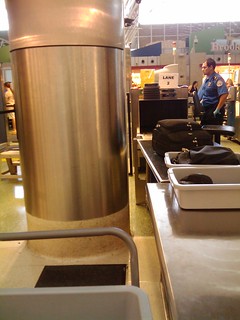
Meanwhile, as a contrast to Andy’s photo of Göteborg Landvetter Airport, here’s one I snapped (surreptitiously, for the same reasons) of an obstacle passengers have to navigate to get through security in San Antonio International Airport.
A lot of people may not realize that airports’ customers are, in fact, airlines, not passengers. How does this impact airports’ attitudes toward the people who flow through their space?
Indi Young: In my year-plus with [a major airline], I found out they have an “attitude” about the airports. Airports aren’t owned by them, and any physical upgrades, especially infrastructure upgrades, are done by the airport itself. It’s kind of like leasing office space. You do your own decor, but most of the stuff is already in place. (Seats, doors, windows, carpet, outlets, etc.) You could negotiate for some upgrades, but somehow the attitude is to not prod that sleeping dog.
Andy Polaine: Yes, this will be news to a passenger who has spent anything between a few hundred to a few thousand dollars on tickets, only to be treated like a criminal at best and mindless shopping robot at worst. It is an example of a broken, reverse or negative service ecosystem from the customer perspective.
…it’s not about an ongoing relationship, but selling someone a ticket and getting out of the relationship as quickly as possible…
It’s also a great/bad example of how the cracks between the different service providers aggregate to form an experience crevasse. Each provider or department believes it’s someone else’s job to deal with experience X (the “attitude” Indi mentioned). I’m sure, if it was about branding, the airlines would put pressure on the airport to change the decor. When it is about passenger experience, they don’t have to bother because they’ve already got your money. That’s what happens when a service is sold with a product mentality—it’s not about an ongoing relationship, but selling someone a ticket and getting out of the relationship as quickly as possible with the minimum amount of commitment.
Why is there such a difference between countries in the quality of air travel?
Andy Polaine: There are some real differences that are, in my experience, usually cultural clichés but relatively true. I recently experienced the difference between Germany’s Lufthansa and Singapore Airlines on my way to and from Australia. Same planes; very different cultures of service and ambience. Singapore was very much about warm service; Lufthansa was efficient and not unfriendly, but a little bit withheld. These are small generalizations, and I’ve experienced the opposite on both airlines, but this was my overall experience.
There are also cultural norms in the sense of what passengers have been educated to put up with. I see Americans taking their shoes off for the X-ray machines as a matter of course, even though they’re not required to. They’ve just clearly gotten used to having to go through such a rigamarole with TSA.
Mike Fisher: I traveled to Tel Aviv on El Al a couple of years ago and found both the in-flight and in-airport experiences fascinating. El Al not only served reasonable food (at least by American standards), they left plenty of snacks in the galley area and encouraged passengers to “graze” while stretching their legs during the long flight. I think on a U.S. flight you’d be either admonished or tackled for taking food from the galley without explicit permission.
…in Tel Aviv, the security agents couldn’t care less if you have a bottle of water or a tube of toothpaste with you…
At Ben Gurion Airport in Tel Aviv, the security agents couldn’t care less if you have a bottle of water or a tube of toothpaste with you (in fact they laughed when I asked if I should throw it away). Instead they watch expressions, body language, and other factors that can reveal a potential troublemaker. They achieve a very high level of security with a relatively small staff, and without wasting resources the way TSA seems to. Baggage gets scanned by machine but people receive individual scrutiny. It’s a smart system and in my view far less invasive than what we’ve become used to with the TSA.
Indi Young: In the U.S. sometimes the flight attendants are not completely on board with the airline, if you will allow me that euphemism. Flight attendants often belong to a separate organization that frequently fights with management. I’m not sure about gate and counter personnel, but in all cases, it’s these employees who interface with passengers the most. Again, attitude plays a big role, whether positive or negative. The passengers I listened to didn’t tell stories about differences in countries (except Amsterdam’s airport, which apparently draws everybody’s ire). They did tell stories about individual personnel members who treated them with great suspicion—assuming that this passenger was thinking the worst or being greedy, and letting that assumption influence their treatment of this passenger.
…we were unable to get the higher-ups interested in a study involving gate personnel or flight attendants.
In our research, we were unable to get the higher-ups interested in a study involving gate personnel or flight attendants. The one flight attendant that I got to listen to at length is a purser on international flights—she’s in charge of all the personnel on the plane, except the captain and others on the flight deck. She even complained about the attitude the flight attendants had: “I’d rather be serving the masses than catering to the asses.” Or vice versa. She implied that flight attendants (clearly not all of them) either prefer to work in Economy and deal with passengers’ uppity demands with a level hand, or to serve in Business or First Class, where the demands are at least valid, because passengers have paid more, but they tend to treat flight attendants like servants. You can begin to see where flight attendants, and gate personnel, come from; they don’t like being treated like servants. They don’t like being asked for extra services that aren’t a part of their normal work process. They try to limit their interaction with passengers and treat everyone with their own rote style of interaction. One flight attendant told me, “I’m only here for safety.” Of course, this is not true of everyone. I wish I’d been able to hear from the gate personnel and flight attendants. But to answer the question, the differences in treatment come more from the attitude of the personnel, based on their work conditions and how they personally handle dealing with hundreds of passengers a day. Many airlines don’t seem to have any strategy around this. Some do.
Like what our experts had to say? Guess what: you can have them bring their brains to you. Mike Fisher, Andy Polaine, and Indi Young are available for consulting and training through Rosenfeld Media.
Stephen Anderson will write Design for Understanding
The UX community may be mushrooming, but it still manages to retain something of a small-town feel. I’ve had the pleasure of knowing Stephen Anderson, our newest author-to-be, for quite a few years, and have been following his work for even longer.
I’ve always hoped we’d have an opportunity to work together, and now I get my wish—Stephen will be tackling Design for Understanding, due out in 2015. It’s an ambitious topic, but if you know Stephen from his presentations and writing, you know that he has an absolutely incredible knack for making the complex clear. Really, I can’t think of someone else who could pull it off. And I’m thrilled that he’ll be writing a Rosenfeld Media book.
From Information to Understanding
If you’ve made it here, you’ve no doubt figured out—“this guy is writing a book about…” Well, what is this book about?
Let me answer that with an email I received a few months ago from a health care organization:
With the Affordable Care Act taking effect later this year, we are all very focused on trying to help consumers understand the confusing world of health insurance and to help educate and drive them to make better-informed healthcare decisions (e.g., taking better care of their health, going to Urgent Care vs. the ER if it’s not a true emergency, choosing a generic over a brand-name drug, etc.).
So how do you help someone understand— truly grok—something as complex as health care options? How does one move from that place of bewilderment to the sudden “I get it!” point of enlightenment?
That’s what this book is about. The means by which humans make sense of new of complex information. For those of us who design experiences, this is about how to design for understanding. While there’s plenty I could write about here, this picture sums up much of the territory I hope to cover:

At this moment, I’m interested in the connection between play and learning. How, when you start to play with something—especially a concise representation of a difficult concept—pattern recognition sets in. We learn through playful, visual (and spatial and…) interactions. Yes, interactive visualizations will be a focus of this book, but I’m more interested in exploring how things like vision, spatial memory, or physical interactions contribute to sense making.
The best single introduction I can offer at this time is my 15 minute TEDx talk on this subject:
Basically, how do we get from “I don’t understand…” to “This finally makes sense!” How do we get from information to understanding?
I’m thrilled to be writing this book. I’m thrilled to be writing this book with Rosenfeld Media, a publisher very invested in the writing process and production some of the highest quality books in my library. I’m thrilled by the writing team forming around this book (I can’t wait to tell you about some of the truly stellar people who have agreed to help me with this book). And finally, I’m thrilled to be writing this book with you. Yes, you. While there is much I’ve already learned, I’m more excited by all that I will learn by sharing as much a possible along the way.
Stay tuned—exciting times ahead!
QuickPanel: All About The Benjamins
The new $100 bill went into circulation Tuesday. While Benjamin Franklin’s mug still stares out at us in mild rebuke (“You’re buying that?”), the bill introduces bells and whistles previously unseen in modern U.S. currency, such as color, raised printing, and embedded images that can be seen only by tilting. USA Today gives us a look.

The $100 bill is the most frequently counterfeited American banknote, so enhancing security was a major driver of the redesign. Still, counterfeit bills account for less than 0.01 percent of all American currency in circulation.
We asked three UX experts to weigh in on this high-tech re-jiggering of an American icon.
Rosenfeld Media: Stodgy though U.S. money may be compared to the colorful bills of other nations, it is certainly distinctive. Might abandoning the hallowed greenback damage the American brand?
Jason CranfordTeague: Abandon the greenback? Why not just abandon paper money altogether?
The difference between U.S. currency and British currency reminds me of the difference between a user experience created by developers versus one created by designers.
But if we are stuck with it, the appearance—at least for branding purposes—seems beside the point. Don’t get me wrong; I really like money with aspirational characters such writers, scientists, and philosophers à la the British pound. It helps promote national pride and a sense of shared history, but that’s interesting about once (the first time you see it) and then becomes irrelevant. The difference between U.S. currency and British currency reminds me of the difference between a user experience created by developers versus one created by designers. U.S. bills are primarily concerned with functionality—aesthetics seemingly an afterthought. On the other hand, British bills are both functional and aesthetically pleasing. However, it may be the very utilitarian appearance of U.S. currency that differentiates it from other world currencies and makes it feel more reliable.
Christian Crumlish: Perhaps, although this makes me a bit sad, sort of like hinging American exceptionalism on the fact that we’ve successfully resisted the metrics system. There are some interesting accessibility drawbacks to the mighty uniform greenback. For one thing, a blind person cannot tell by touch if they are handing over a sawbuck or a Benjamin.
Christina Wodtke: Brian Collins once defined brand by telling a pirate story: the Jolly Roger is the brand promise that looting and pillaging fulfills. The reason the Jolly Roger is so powerful is because pirates who fly that flag come over on your boat and you are well and truly in trouble. That’s what made it so powerful when the Macintosh team flew it over their group that rivaled the Lisa. The moment someone flies that flag and then plays nicely, the game is over.
The greenback has always symbolized a stable and growing economy to the degree that countries switch to it when their economy is in trouble. I’d worry more about what is happening in Congress right now than what color our bills are. Because the day the greenback symbolizes ideology over stability, our brand will die worldwide.
I don’t think the challenges Yahoo faces has anything to do with their logo font, or who designed it, and I don’t think the U.S.’s brand will move one inch toward toward ruin because Ben gets a splash of color.
Rosenfeld Media: Most of the changes address audiences, such as counterfeiters and financial institutions, who aren’t consumers. How might these changes impact how consumers see U.S. currency–and the institution behind it?
Jason CranfordTeague: For usury users, the security features are obviously key to prevent counterfeiting. However, for most users (i.e., the public) what matters is how quickly they can tell the difference between the different denominations. The new bill addresses this somewhat by adding the tactile feel of raised printing. This should be of value to sight-impaired users especially, but the key differentiator of size was still not addressed. Most paper currencies will vary the size to make it easier to identify denominations at a glance. U.S. currency is still one- size-fits-all.
Money becomes invisible in some ways, except for its information content.
Christian Crumlish: I doubt the typical citizen is going to even notice such a change, especially those aimed at counterfeiters. Even when they went to those “large head” designs (which I love and find a bit, if I can admit this in the U.S.A., more European), it didn’t seem like most people paid them much mind. Money becomes invisible in some ways, except for its information content.
Christina Wodtke: Most people hate change of familiar objects they know and understand. The more radical, the more they refuse to accept it. If it also causes them to change their habits, they like it even less.
Take the dollar coin. It looks different, it feels different, and most importantly, it requires you to change your habits to carry and use it. People who don’t usually carry a coin purse must consider one, and when you reach for a dollar you must change where you reach and what you expect to grab. Dollar coin after dollar coin has failed, to the degree the U.S. treasury now stores $1 billion of them.
The Benjamin has two key assets that will help it make a smoother transition: first, everyone wants a Benjamin and, second, not everyone has one. If you are rich enough to have easy access, you probably use credit cards. If you are poor, just holding one is special, and I don’t think you’re going to fuss much over a small color change. The security need is just the spoonful of sugar to make the change more palatable.
Rosenfeld Media: Are there any usability concerns with this new bill, or with U.S. currency in general (for example, the lack of a dollar coin)?
Jason CranfordTeague: I love dollar coins. They are easier to carry, easier to use in machines, easier to tip with, and last longer, meaning that they cost less to use. Most currencies now offer at least a single unit coin (pound, Euro, etc.) with some currencies having coins in denominations of 2 and 5 units.
From a usability standpoint, dollar coins seem like a no-brainer. The problem is that the designs seem to have fallen flat. The Susan B. Anthony coin in the late 1970s looked too much like a quarter, and cash registers didn’t have separate spaces for them. You might also argue that since this coin featured a prominent leader in the women’s rights movement there was some sexism involved.
Over the years, it’s become fait accompli that a dollar coin will never work and that US citizens will never accept them. Given recent failed attempts to bring in a dollar coin with US Presidents, I’m afraid this is something that will never happen for the US.
Christian Crumlish: I’ve long been a fan of, and believer in, the value of a dollar coin, but it’s hard to argue with the fact that three attempts have, for various reasons, failed to meet the needs of the U.S. public. (I’m also a big fan of getting rid of pennies.)
Like Third World countries who leaped over landlines to go straight to cell phones, we’ll probably never fix our money. We’ll just move to the next best thing.
Christina Wodtke: Our money is not the best. It’s confusing to blind people, who have to fold corners to keep track of the value. Even sighted people can easily hand over a five when they mean a twenty, and it makes it easy for con artists to excuse flimflammery as honest mistakes. It’s flimsy, and rips.
But it’s our money. We handle it every day. It reminds us of our hard efforts and promises rewards to come. Emotionally, change will be hard. The key problem is the U.S. government has never explained to its citizenry how they will benefit from the change. The points Jason makes are in terms of him, the end user; yet when the government talks about change, it is always how it benefits them in terms for fraud and efficiency. If you want to make change happen, you must sell it and sell it hard.
I think we’ll go to all-plastic cards before we go to new money. I think we see that as more and more farmer’s markets have vendors who use Square. Like Third World countries who leaped over landlines to go straight to cell phones, we’ll probably never fix our money. We’ll just move to the next best thing.
Like what our experts had to say? Guess what: you can have them bring their brains to you. Jason CranfordTeague, Christian Crumlish, and Christina Wodtke are available for consulting and training through Rosenfeld Media.
QuickPanel: Launch a Healthcare Exchange with No User Testing?
The Wall Street Journal just informed us that “Groups Leading Insurance Sign-Ups Haven’t Tested Program’s Web Tool” (login required, sorry). The exchange sign-up process, expected to take as long as 45 minutes, would help U.S. citizens through complex issues, such as understanding their coverage options, deductibles, and prices. But it hasn’t even been tried by the community workers whose job it is to help citizens through the process.
Still, “a state Department of Health spokesman said… that everything was ‘on track’.” Good idea? We asked some of our UX experts to weigh in on the process:
Rosenfeld Media: Should state governments have delayed launching their health exchanges to perform user testing, even if it meant missing their launch deadline?
Steve Portigal It’s interesting that in some contexts we applaud moving quickly, launching in beta, and having real users give feedback to help refine the product. Granted, there’s more at stake here for the producers (e.g., the states) and the users than there would be (say) for an app that finds dog walkers in your area, but it’s intriguing how we reframe this as a clusterfuck already. Meanwhile, if there’s a “should” here, it’s that they should have developed a plan that included time to expose the exchange signup process—in whatever form—to real people.
If just one small piece fails, that can be enough to keep someone from succeeding.
Aarron Walter: Healthcare is complicated even for the experts who drafted the legislation, so it should come as no surprise that U.S. citizens with varying levels of proficiency with technology and the English language will struggle and fail to enroll in the new ACA system. Lives are quite literally at stake. If healthcare is to be a fundamental right of Americans, then the system that provides it needs to be usable and accessible for all on day one of the launch.
Whitney Quesenbery Was there really “no usability testing”? Or was there not enough testing, so that each piece of the system was strong? I know that work on the health exchanges started long ago, including some early design research and templates. But a design framework, even with a good interaction style guide, is just the start of a large complex system, and getting all those details right is a real challenge. If just one small piece fails, that can be enough to keep someone from succeeding.
Rosenfeld Media: Just like flubbed launches, delayed launches are embarrassing. Is there a sweet spot here? In other words, at what point is continuing user testing less valuable than launching?
If there’s a “should” here, it’s that they should have developed a plan that included time to expose the exchange signup process—in whatever form—to real people.
Steve Portigal: Context is everything. If the thing you are launching is on the front page of every paper and your vociferous opponents are willing to shut the government down rather than have you launch, then you probably want to be as flawless as possible. Launch a reduced experience, but make sure it works. If you are delivering a product for a small set of elite users, you have more forgiveness baked in. Backlash is a function of hype (see: iOS7).
Whitney Quesenbery: I’d like to suggest a different question. I don’t think there was any way that the opening was going to be delayed—that just isn’t politically feasible in the current context. Maybe the question is what could have been done to make the first 24 hours more of a success.
The real test of the usability of the system will be what happens after the opening day (or week) rush. First, they need to solve the technical problems. The best designed site is useless if you can’t sign on or if you hit bugs. Then, we’ll be able to see if people can understand how to set up an account, compare their options, and complete an application.
I agree with Steve’s comment above that a better process for getting everyone ready—especially the front-line health workers is the big “should.” Demos, training, and support could all have helped everyone be more confident that they knew how the exchanges would work. It’s really hard to see something for the first time on the day that you’re supposed to be helping others.
Rosenfeld Media: If you were consulting for an exchange that had launched without user testing, what advice would you be giving them this minute?
Steve Portigal: Pay my invoice ASAP. Okay, more realistically, I’d be encouraging them to develop a triage plan. What are the elements of the experience (e.g., accuracy, completion, actionable) that are essential, and how can they, even anecdotally, begin to take the temperature of those measures and to develop a way to determine iterative changes and rapidly issue incremental releases.
If healthcare is to be a fundamental right of Americans, then the system that provides it needs to be usable and accessible for all on day one of the launch.
Whitney Quesenbery: I’d want the team out in the community health centers and listening in on the support lines, observing, listening, and learning. Make sure they know where the barriers are and understand exactly what problems people are having: Where is the process is confusing? Where people don’t understand the instructions or information? Where is the interaction counterintuitive? It’s an opportunity for doing usability testing in the field and seeing first-hand how the marketplaces are working. Those insights are critical to both prioritizing the work of fixing problems and making sure any changes are done right. The worst thing they could do is flail around. Fix the most immediate and visible problems, and then keep working on the others in a careful way.
Like what our experts had to say? Guess what: you can have them bring their brains to you. Steve Portigal, Whitney Quesenbery, and Aarron Walter are available for consulting and training through Rosenfeld Media.


