
Sample Chapter: Product Design Engineering
This is a sample chapter from David Siren Eisner’s book Product Design Engineering. 2026, Rosenfeld Media.
Chapter 1
Why Doesn’t This Match? (Designing by Proxy)
It was the last day of the sprint, and we were checking engineering’s latest build against our designs. The design team had spent time researching the problem, testing prototypes, and polishing final screens. Everything was based on approved design system components, tokens, and interaction patterns. Product and engineering had been working with us through the whole process.
But the build didn’t match the designs.
Some issues were large. A piece of functionality had been cut without discussion, and an edge case showed users a screen that none of us had seen before. Other issues were small, but taken together, they had a real impact. Spacing and padding were inconsistent. The wrong typestyle had been applied to multiple titles. A modal used the wrong button size. One design system component behaved differently in code than it did in our design library. The issues were immediately visible to the designers in the room. The functionality was right, but the design was off (see Figure 1.1).
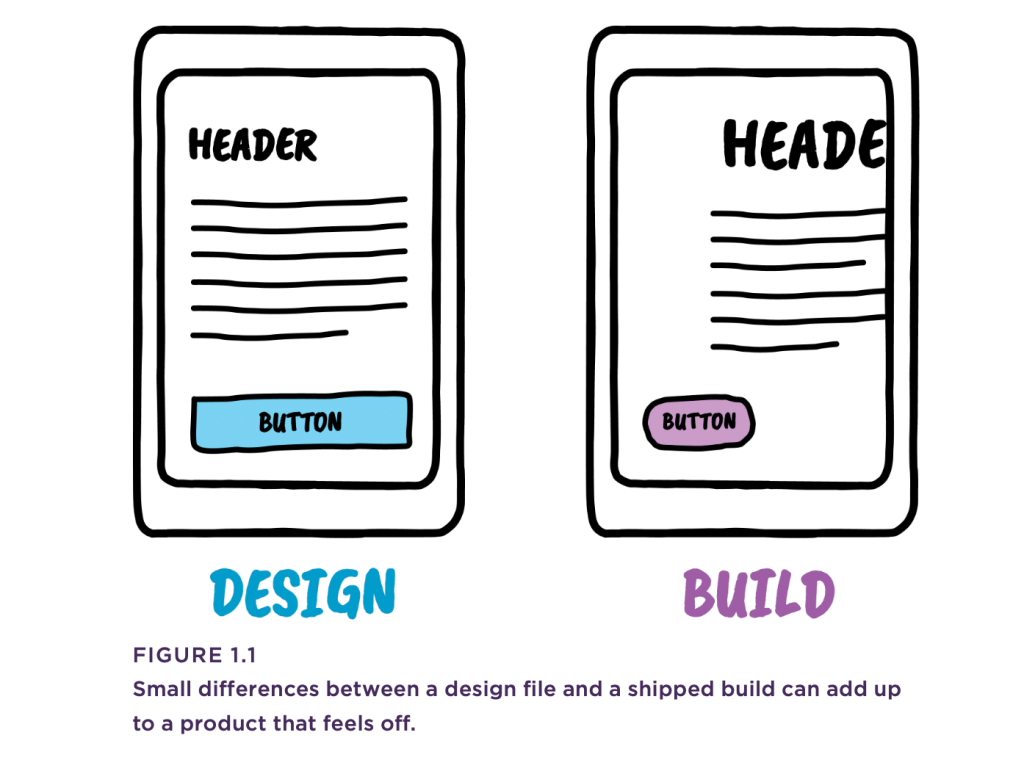
We were working with thoughtful engineers who cared deeply about quality and consistency, and most of the build was strong. But even with great partnerships, it is surprisingly easy for issues to slip through. For example, a small assumption made late in a sprint. A padding property for an internal component that breaks the rhythm of the larger layout. Or a bug introduced by a dependency that only surfaces once the code is running.
We went through the familiar ritual for each bug, creating tickets, capturing screenshots, noting platform and version, and describing the steps to reproduce. For each issue, we tried to identify the value or property that needed to be updated. Even small fixes took significant time to document well, sometimes more time than the fix itself. Larger ones took much longer. And after all that, there were still too many issues to fix before launch, so we had to prioritize which ones were most important. The rest would hopefully get addressed in a future sprint. For now, they became design debt and were added to our backlog of unresolved issues.
As a leader, it’s hard to watch any of your team’s effort get lost between design and delivery. Everyone had put real care into their work. And it is even more frustrating knowing how much harder it is to fix issues once they’ve been released. It was a scene that every designer recognizes. Despite good process, collaboration, and communication, the final product still drifted from the design. In the traditional setup, some of the thinking, polish, and intention we put into the design was always lost along the way.
Designing by Proxy
For decades, design and engineering have lived on opposite sides of an artificial wall. The assumption was that the skills required to be great at each discipline were too different to live in one person. There were always a few exceptions, but they were rare. The separation became so normalized that most people never questioned it.
Organizations built entire processes, teams, and tools around this divide. Designers created the blueprint, and engineers brought it to life. That system put people in specialized roles, and work had to pass from person to person. But every handoff creates room for drift. Details can shift, intent can get harder to see, and carefully considered decisions can be translated into annotations, tickets, and documentation for someone else to interpret.
Designers often think of their design files as the source of truth. But users never interact with those files. They experience the product as it is built. When designers rely on someone else to translate their work into the final product, they are still designing, but they are designing by proxy.
As designers, we’ve tried to address this gap with better systems and stronger processes. We’ve created design system components that match coded ones, introduced tokens and templates to keep things in sync, and added annotations to make our intent clear. We’ve set up tools to inspect code, detect visual drift, and flag inconsistencies automatically. Each of these has helped, but none has solved the root issue.
There are two main reasons these tools and processes can only go so far. First, understanding degrades every time that work changes hands. No matter how thoughtful someone is, if they are building from someone else’s design, they don’t have the full context behind every decision. They see the output, not all the choices that shaped it. Second, a representation is never the same as the real thing. Design tools are abstractions of the experience. They can’t perfectly replicate the way real data loads, the motion of transitions, or the feel of interactions across devices and environments.
The best way to close these gaps is for designers to work directly in the final medium.
A Simple Experiment
As we worked through the design quality assurance (QA) list that day, I kept wishing we could fix the bugs ourselves instead of filing them. Eventually, I decided to just give it a try.
This was still the early days of AI coding assistants, but I had been experimenting with them on the side for a few months. The tools were improving fast, and they made coding feel accessible in a way it hadn’t before. As a designer, it felt incredible to actually build something instead of just planning it. In those side projects, I had already updated code more complex than the bugs that the team was identifying.
I knew designers could learn to make changes in small projects with a little training and the help of AI. What I didn’t know was whether that same approach would work inside the complex engineering environment of a real company, where the codebase was larger, the stakes were higher, and the ownership was distributed.
Watching my team spend hours writing tickets for simple updates, I decided to run an experiment. I picked one of the simplest issues, a card with double padding, and tried to see if I could fix it myself. I knew if I could do it, I could teach my team to do it, too.
I immediately ran into roadblocks. At the time, access to AI tools was limited, and no one outside of engineering had ever pushed production code in the history of the company. There were no systems in place to give me the access I needed, and no simple way to know what to ask for in the first place. Everything required a special request or a one-off approval. Eventually, I got access to code repositories, installed the right code editing tools, and was approved to use an AI coding assistant.
I learned how to find the right code repository, how to run the code locally, how to make updates safely, and how to test them. And I learned how to create Git branches and open pull requests.
At first, the engineers were openly skeptical about a designer writing code. They worried I might skip normal engineering processes, let AI loose in the codebase, duplicate existing patterns, break things I didn’t understand, and create tech debt they would have to clean up later. To earn their trust, I made a few commitments. I would not let AI make decisions for me. I would use it for guidance, but I would only change code when I understood the recommendation and agreed with the path forward. I would follow the same process as engineering, creating tickets, doing QA, and submitting every change for code review before anything reached production.
The new process was less difficult than it was unfamiliar. With AI support, making code changes was easy. The biggest adjustment was learning all the engineering processes and tools that surrounded those changes.
It took weeks to get my first update pushed live. It was a tiny fix, but it felt incredible. It proved that the design team could deliver production-quality code that met engineering’s highest standards.
Once I understood the process, I started training my team. We began with simple visual updates, and soon every designer was fixing bugs. The changes were small, but it was unbelievably freeing to be able to see an issue in our product and fix it ourselves. Designers were cleaning up the little things that had bothered them for years.
Slowly, we moved on to more complex fixes and started delivering some of our regular work as code. We built trust, gained confidence, and started to understand the codebase better. In only a few months, the team had gone from never having written a line of code to delivering most of our work as Git branches.
A Better Way
What started as an experiment became a new way of working. Once we began delivering our designs as code, the process improved dramatically. Design QA disappeared, not because we skipped it, but because we no longer needed it. The designers were polishing their work directly in code, so there was no question if the code was right or not.
All of a sudden, designers were working in the final medium. If we noticed something off while building, or saw an issue in the live experience, we could fix it ourselves. Since design was doing the frontend code, we were involved in any changes that came up. There were no more surprises.
The handoff to engineering was gone. The designer who understood the user’s needs, who knew the design system and our standards, and who knew all of the goals and discussions around the flows, was the same person who wrote the code.
Instead of feeling like a land grab, it ended up being a win for everyone involved. Designers loved being able to control the final product directly. Engineers felt freed from visual tickets and appreciated having more time to focus on complex technical challenges. The business was happy that work was getting done faster, and everyone took pride in putting out a better product.
The impact was dramatic because we used AI to remove a major source of friction from the process. It did more than speed up existing work. It expanded the role that designers could play, letting us take on work that otherwise would have been handed off to someone else.
Working this way also revealed something deeper. The same traits that made someone a great designer also made them great coders. Their attention to detail, systems thinking, ability to connect dots across several areas, and the drive to make complex things simple were powerful assets. They brought their design perspective and turned code into just another design tool.
For design, this is more than a process improvement. It is an evolution of scope and influence. When designers can concept, design, and code, they gain a new kind of credibility within their organizations. Design becomes the undisputed owner of the frontend experience. They research, design, and build it end-to-end.
This is what product design engineering represents. It is not about replacing engineers or asking designers to do more for the sake of efficiency. It is about giving designers a more direct hand in building the product, so more of their creative vision reaches production. It closes the gap between what was imagined and what gets built.
The wall that once divided design and engineering no longer needs to exist. AI has given designers the tools to step through it.


