
Starting as a UX Researcher? 3 sessions you must watch
11/09/2026Starting as a UX researcher?
These three Rosenfeld sessions offer a practical starting point: Maria Rosala’s “AI-Assisted Qualitative Analysis: What to Automate and What to Own,” James Lang’s “Hopeful Futures for UX Research,” and Feyikemi Akinwolemiwa’s “Uninvited, Not Unwelcome: What Researchers Bring When Nobody Asked.”
Together, let’s explore how to use AI thoughtfully, navigate a changing profession, and recognize the value of your research skills.
1. AI-Assisted Qualitative Analysis: What to Automate and What to Own
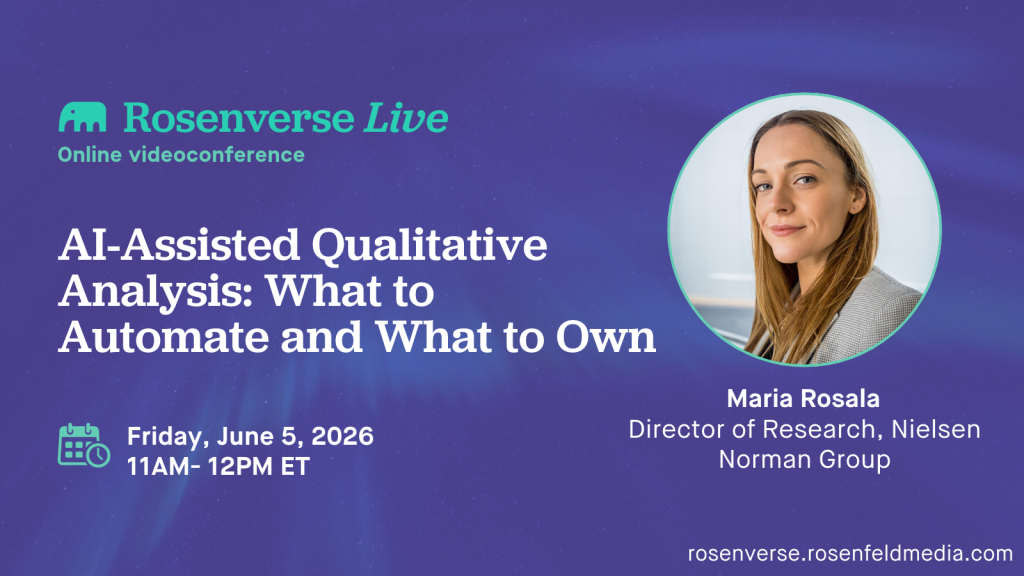
Learn to use AI without outsourcing your understanding
Maria Rosala, Director of Research at Nielsen Norman Group, explores something every budding researcher should understand: qualitative analysis involves more than summarizing what participants said. Researchers also need to explain patterns, assess their importance, and make findings meaningful for their audience.
That distinction matters when introducing AI into your workflow. A convincing summary is not necessarily a strong interpretation. Maria describes an approach where researchers break analysis into steps, review AI-generated outputs, and refine the results rather than accepting the first response as finished work.
For someone getting started with UX research, Maria also raises an important question: what do you lose when you automate the very work that helps you develop expertise? Coding qualitative data allows researchers to get familiar with participants’ experiences. Delegating too much can mean missing unexpected insights and opportunities to build analytical skills.
What to take away
- The difference between summarizing data and interpreting it
- Where automation can support qualitative analysis
- Why researchers need to review outputs and remain responsible for the findings
Watch now: AI-Assisted Qualitative Analysis: What to Automate and What to Own »
Here’s what you can do next: Analyze a short interview excerpt, then compare your interpretation with an AI-generated analysis. Look for differences in emphasis, missing context, and unsupported conclusions.
2. Hopeful Futures for UX Research
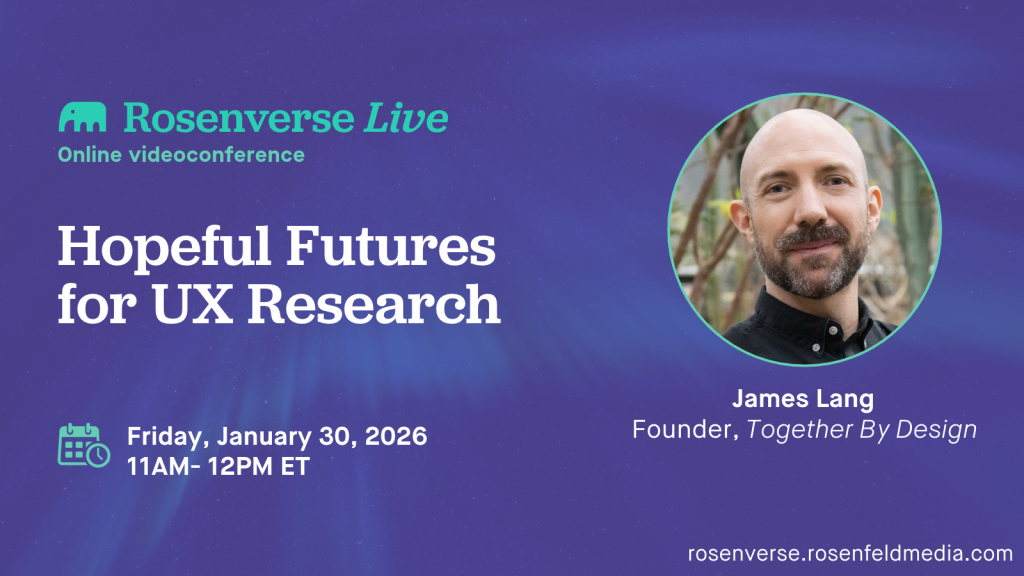
Build your career around capabilities, not only job titles
James Lang, founder and collective member of Together by Design, addresses the uncertainty surrounding UX research, such as AI, research democratization, layoffs, and pressure to do more with less. Rather than dismissing those concerns, he explores how researchers can respond with agency.
Drawing on more than 50 articles and insights from over 100 UX researchers and technology professionals, James talks about how research careers might evolve. A key takeaway? The distinction between a job title and the capabilities behind it. Those capabilities can have value across changing roles and organizational structures.
For a beginner, this session offers a useful alternative to planning around one ideal job description. James encourages exploring other areas, including research operations and knowledge management, while treating hope as something expressed through action and experimentation.
What to take away
- A broader view of where research capabilities can contribute
- Ideas for exploring adjacent skills and career directions
- A way to think about uncertainty without waiting for the profession to settle
Watch now: Hopeful Futures for UX Research »
Here’s what you can do next: List three capabilities you want to develop. For each, identify situations where it could help. Separate what you want to learn from the title you hope to hold.
3. Uninvited, Not Unwelcome: What Researchers Bring When Nobody Asked
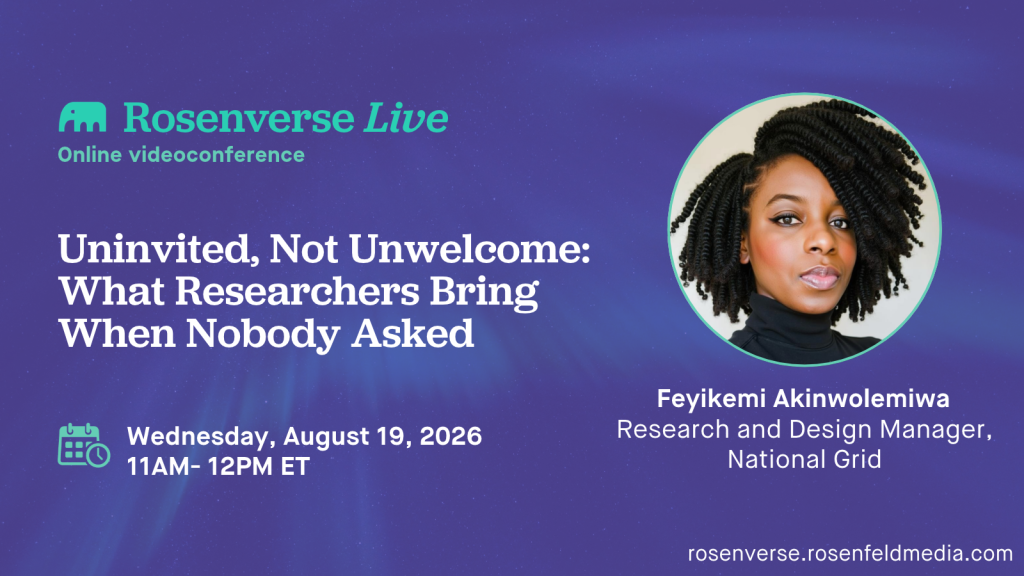
Understand your value beyond a research deliverable
Feyikemi Akinwolemiwa, Research and Design Manager at National Grid, explores capabilities researchers may use without naming them: making sense of ambiguity, facilitating difficult conversations, aligning stakeholders, and supporting decisions.
The session challenges a narrow view of research contribution. Interviews, studies, and reports matter, but what’s behind them may also help with product strategy, responsible AI, and organizational change.
For someone starting a UX research career, this takes the question from “Which method should I use?” to “What does this situation need, and how could my skills help?” Feyikemi encourages researchers to recognize those skills and test their wider contribution through a deliberate 30-day experiment.
What to take away
- Language for describing research skills beyond methods and deliverables
- Examples of where those skills can contribute outside a traditional study
- A prompt to turn reflection into a small, practical experiment
Watch now: Uninvited, Not Unwelcome: What Researchers Bring When Nobody Asked »
Here’s what you can do next: Choose one unresolved question in a project. Identify a small contribution you could make—such as clarifying assumptions or synthesizing conflicting perspectives—before proposing a full research study.
Frequently asked questions about starting in UX research
Which session should a beginner UX researcher watch first?
Start with Maria Rosala’s session if your immediate priority is understanding qualitative analysis and AI. Choose James Lang’s session for career direction, or Feyikemi Akinwolemiwa’s session for a broader understanding of how research skills contribute within organizations.
What should beginner UX researchers learn about AI-assisted analysis?
Learn to distinguish AI-generated summaries from research interpretation. Rosala’s session emphasizes familiarity with data, reviewing AI outputs, and staying responsible for the analysis rather than treating automation as a final answer.
Are UX research skills useful outside traditional research roles?
Yes. These sessions discuss how research capabilities can contribute to knowledge management, research operations, product strategy, and organizational change. They extend beyond running studies to interpreting information, navigating ambiguity, and helping people make decisions.
Turn your watchlist into practice
Use the three sessions as prompts for action: protect one part of your analytical learning, explore one capability beyond a job title, and test one way to contribute outside a formal research request.
That gives you more than a list of videos to watch. It gives you a starting point for deciding how you want to work.


