
Sample Chapter: What Your Machines Should Do
This is a sample chapter from Stefanie Hutka’s book What Your Machines Should Do: The Science and Strategy of Human-Centered Automation. 2026, Rosenfeld Media.
Chapter 6
Reinforcing Strategy Through Automation
When you enter the tiny town of Futaleufú in Chilean Patagonia (population: ~2,000), one of the first things you’ll see is a butcher shop (Figure 6.1). The butcher knows all the locals by name and who can be trusted to pay next week. He adjusts inventory based on local festivals and the rhythm of the seasons. He strikes deals with nearby ranchers over a cup of mate, sealed with a handshake. Nothing about this operation is especially efficient, but it works because he can hold all the necessary information in his head.
It’s a century-old painting brought to life, animated by an AI- powered platform called Mirage 2 (Figure 1.1). Give the system any image and text description, and Mirage 2 turns your prompt into a world to explore. It feels like walking around a 3D video game, but this isn’t the prerendered map of a traditional game engine.

Figure 6.1
A butcher shop in Futaleufú, Chile, operating at a small, stable scale.
The butcher shop has likely operated this way for decades because the town’s remoteness slows change. To give you a sense of how hard it is to get here, my partner and I flew to Esquel, Argentina, negotiated a ride to the Chilean border with a local taxi driver, walked across that border, and hitchhiked into Futaleufú. People make this journey primarily to raft the Futaleufú River, home to some of the best whitewater rapids in the world—and leave. If you’re the local butcher, this isolation limits volume, dampens competitive pressure, and preserves a pace of life where local knowledge and memory remain “good enough” as coordination systems.
What if something in Futaleufú changed in a big way? For argument’s sake, let’s say gold was discovered on a nearby mountain like Cerro Alto El Petiso. (Hey, it wouldn’t be Patagonia’s first gold rush.) People flock to Futaleufú to establish gold mines. The butcher shop is overwhelmed with demand. It’s no longer feasible to hold all those moving parts in memory. The butcher needs to scale and, as a result, faces challenging trade-offs. Should he prioritize speed and throughput, or preserve relationship-driven service? Should he broaden offerings (perhaps even beyond meat), or focus on a tightly repeatable core of beef, chicken, pork, and lamb?
After making these choices, the butcher will need to execute on them. This is where automation enters the picture. If he’s prioritizing speed and throughput, it would be sensible to adopt an automated point-of-sale system to coordinate payments at scale. The system would expedite transactions and reduce coordination overhead. It would also mean that the days of informal credit are over, removing the trust-based flexibility that once defined relationships with regular customers. Some of these customers will complain about the loss of personal connection. However, if the quality is high enough that they reliably return week after week (and total revenue keeps increasing), you can conclude that the butcher had a good strategy.
DIFFERENT SCALE, SAME CHALLENGE
What does the story about a butcher in rural Chile have to do with modern organizations in the age of AI? Both face the same fundamental challenge: as operations grow more complex, the knowledge that once lived in people’s heads must move into digital systems that enable coordination at scale. Automation solutions can help, but they need to be chosen intentionally.
The evolution of sales coordination tooling illustrates how automation can be successfully adopted in response to scale. For decades, sales professionals managed customer relationships through Rolodexes and notebooks. Customer knowledge lived within salespeople’s heads. As companies grew, they needed shared visibility into customers and pipeline health. Desktop customer relationship management (CRM) tools like GoldMine emerged to meet this need, standardizing records and introducing early automation-like task reminders and basic reporting. Enterprise platforms like Siebel then centralized this information for organizations and added stronger automation, such as structured workflows and task assignment. Rolodexes and notebooks became a thing of the past.
As sales operations expanded globally, cloud-based systems like Salesforce largely displaced earlier solutions by offering real-time access across geographies. They also added more sophisticated automation, such as workflow triggers and opportunity routing. Today, organizations are moving toward agentic CRM workflows that promise more efficient, effective workflows at scale. These tools help coordinate tasks and surface insights, acting on behalf of teams. This marks a shift from automating routine tasks to offloading increasingly sophisticated judgment calls onto software. Automation will always be a possible response to scale. The key challenge is adopting solutions in a way that supports strategy.
Automation Choices Are Strategy Choices
But wait! Isn’t strategy just a plan? The common phrase “strategic planning” suggests as much, and strategy is often described as a sequence of steps designed to reach a goal. If the goal is to scale your butcher shop, a plan might lay out when to hire and which automated systems to adopt.
The story of the butcher in Futaleufú (unrelated sidenote: a great name for a horror novel) shows why this framing falls short. Strategy is not a checklist of actions, but a set of interdependent choices that determine what an organization prioritizes. Decisions that look like execution, such as how to automate, are strategic because they reinforce previous choices and commit the business to a particular way of working.
This is why strategy and execution cannot be cleanly separated. Automation choices both support and shape strategy. And, unless you are operating a butcher shop in Futaleufú, you’re making these choices in a world that is constantly changing around you. What often gets labeled a failure of execution, such as reactively adopting full automation, is more accurately a failure to make intentional trade-offs and align your choices (see “The Automation Strategy Gap,” Chapter 1). To make this concrete, let’s turn to A.G. Lafley and Roger Martin’s Strategy Choice Cascade, a well-established framework for understanding how strategic choices reinforce one another and examine where automation decisions belong within it (Figure 6.2).
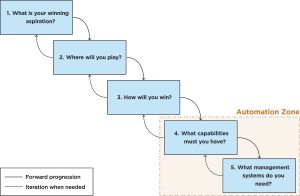
Figure 6.2
Choices about what automation solutions to adopt are typically responses to questions about capabilities and management systems in Lafley and Martin’s Strategy Choice Cascade.
Their Strategy Choice Cascade helps you visualize how the choices that comprise your strategy fit together, using five questions:
- What is your winning aspiration? This is synonymous with your organization’s North Star. It’s a choice to go after one potential future and not another.
- Where will you play? Decide which customers and use cases you want to serve.
- How will you win? Choose how you’ll succeed against competitors in this space. Will you stand out by offering something better or different, or will you compete by being more affordable?
- What capabilities must be in place? These are the skills and strengths you choose to enable your organization to deliver on your strategy. What must your team be really good at to win in the way you’ve chosen?
- What management systems are required? These are the tools, structures, processes, and metrics you choose that keep everyone aligned during execution. Collectively, these systems will turn strategy into tangible results. Examples of management systems include automation solutions (tools), organizational structure (structures), employee training and hiring criteria (processes), and Objectives and Key Results (metrics).
Each choice shapes the next choice, while that next choice reinforces the previous one. This is why there are bidirectional arrows between each choice in the Strategy Choice Cascade. Automation decisions typically appear in the later stages of the cascade to reinforce capabilities and help you scale them through management systems. Returning to the butcher shop, meeting the surge in demand requires new capabilities, such as the ability to forecast demand and maintaining a consistent customer experience while volume increases. Those capabilities only become real when the butcher makes specific management system choices.
That might include implementing point-of-sale solutions, hiring and training people to use these systems effectively, and automating scheduling and payroll. You can adopt the same logic to your own organization: you choose how you intend to win, which then informs the capabilities you need. To support those capabilities, you make choices about management systems, including what you decide to automate. What matters is being intentional: ensure that these decisions not only follow from earlier strategic choices but also positively reinforce those choices. You can use an activity called the Automation Choice Check to help you take this intentional approach.
ACTIVITY
The Automation Choice Check
The Automation Choice Check (Figure 6.3) is an activity to help you examine whether the automation solution (insert “new shiny agentic tool” here) you’re considering fits within your broader strategy. Use this activity before you commit to choices that are hard to reverse, such as investing significant budget in infrastructure to support that automation solution. The goal is to surface insights now to help you make better decisions.
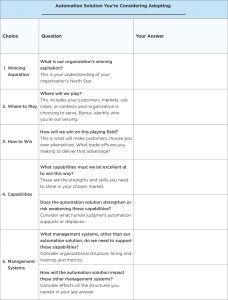
Figure 6.3
The Automation Choice Check.
Begin by writing down your proposed automation solution. From here, you’ll write down your answers to the questions in the third column. These questions correspond to the five parts of the Strategy Choice Cascade. Once you name the capabilities you need to “win,” you’ll assess whether the automation solution strengthens or weakens them. Finally, you’ll identify the other management systems you need to support your capabilities and consider how your automation solution will impact those management systems.
Why Automation Is Special
You may have noticed the last activity question asked you to reflect on how your automation choices were linked to your other management systems. The question was included because automation has a distinct impact on organizational structure, hiring and training, and metrics (Figure 6.4). Yes, management systems influence one another even without automation. For example, changes to your organization often shape hiring needs. However, automation uniquely changes how decisions flow by shifting which choices are handled by machines and which require human judgment. That influences reporting, handoffs, and collaboration (organizational structure).
At a more granular level, automation shifts work from doing tasks to monitoring, verifying, and orchestrating them. This changes what skills your employees need (hiring and training). Automation also often nudges organizations toward what is easiest to measure, such as speed and volume, because of its close association with “efficiency” (Chapter 4). Because of that, you need to keep your Objectives and Key Results grounded in how you’ll “win” in your chosen market (metrics).
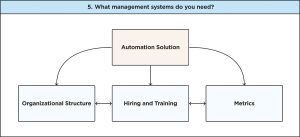
Figure 6.4
Automation affects other management systems, such as organizational structure, hiring and training, and metrics in an interconnected web.
THROWBACK TO “CLIMB HIGH, SLEEP LOW”
In Chapter 2, I introduced the metaphor of “climb high, sleep low” to describe how to approach automation. Identifying where you are today and where you want to go on the Autonomy Decision Matrix helps you plan your ascent (Figure 6.5). This ascent generally occurs in the Automation Zone, between capabilities and management systems (Figure 6.5).
Figure 6.5
“Climb high, sleep low” on the Autonomy Decision Matrix reflects the sequenced strategy that’s part of Automating with Intention. This is shown here in Klarna charting a path from present day to where you want to end up.
Automation and Organizational Structure
Organizational structures determine how work gets coordinated and consequently, how decisions are made. These are the same dynamics that automation impacts by redistributing where human judgment comes online. To understand how automation interacts with organizational structure, it helps to start with a clear view of different structure types. Management theorist Henry Mintzberg offers a useful lens, outlining four organizational forms grounded in decades of research on how organizations coordinate work.
- The Personal Enterprise: A lean, loosely structured organization built around a leader who keeps most authority in their own hands. Formal planning and systems stay light so the leader can personally steer key hires, operations, and direction. The butcher in Futaleufú is a good example.
- The Programmed Machine: As the name implies, this is an organization that runs like a well-oiled machine. Jobs are broken into specialized tasks, work is governed by rules and procedures, and performance is closely tracked. It is designed to repeatedly deliver the same output, in the same way, at the same level of quality. Think of a McDonald’s kitchen line, where each step is scripted so a Big Mac in Toronto tastes roughly the same as a Big Mac in Vancouver.
- The Professional Assembly: A highly decentralized form where work is carried out by trained professionals who rely on their education, shared standards, and peer status more than top-down control. Managers focus on securing resources and buffering outside interference rather than directing day-to-day practice. The Mayo Clinic illustrates this structure: physicians and nurses coordinate through medical protocols and expertise; administrators manage budget and operations and are not involved in clinical decisions.
- The Project Pioneer: A project-based structure that clusters experts into fluid teams to tackle novel and often complex work. Managers act as connectors and catalysts, helping keep different parts of the project connected. Film production typically operates this way: crews are assembled for a specific film and disband once production wraps. The producer acts as the manager-catalyst, coordinating resources and constraints while creative judgment remains with domain experts.
Now, introduce an automation solution into each of these organizations. Remember that automation doesn’t magically make work disappear. Instead of doing tasks hands-on, you now need to monitor the automated system’s performance and verify that it’s producing output that meets your quality bar. This shift will have different downstream effects based on how your organization is structured. Table 6.1 outlines the potential pros and cons of automation on each type of structure.
Table 6.1
Impact of Automation on Different Organizational Structures
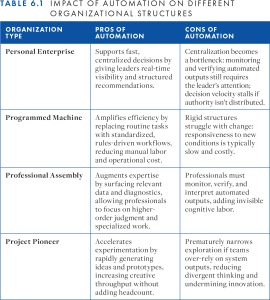
Knowing how your organizational structure will react to automation helps you anticipate whether implementing your solution will reinforce the capabilities you need to win. To help teams assess how their own organization
might react to automation, I recommend that they “SET”:
- “S”—See your Structure: Understand which of the four structures best fits your own organization.
- “E”—Examine the Impact: Play out automation’s impact on your organization. For example, how will automation change who owns decision-making for whatever workflow it affects?
- “T”—Train for Transition: Identify which human skills are most critical after automation is deployed. For instance, systems thinking becomes more important to orchestrate “the big picture” once more granular tasks are handled. What needs to change about training and hiring to meet these needs?
This last point is where automation most visibly intersects with people’s roles and required skill sets. Performing a task hands-on is different from reviewing that the task was done correctly, which is different from directing automated systems to perform the right “thing” in the first place. Automation can also unlock net-new tasks, as it obviates old ones. As a result, organizations must consider their training and hiring practices when adopting automated systems. Without this consideration, you might be left with a skills gap after implementing your automation solution.
Automation and Human Resources
In 2020, The Hartford, a Fortune 500 insurance and financial services company, maintained a team of 20 claims administrators responsible for “medical-only” workers’ compensation claims. These were cases in which an injured employee needed reimbursement for straightforward medical treatment, like stitches or medication, but did not lose wages or time at work. During an annual departmental review, leadership recognized that these lower-complexity claims were strong candidates for automation. By automating this portion of the workload, claims administrators could redirect their efforts toward more sophisticated cases typically handled by higher-paid staff, who could then shift their attention to even more specialized edge cases.
If you’re a claims adjuster and hear about this impending automation effort, your first thought is probably, “Will automation replace my job?” Now, with this limited information, a design researcher is deployed to work alongside you, taking notes and asking to understand how you work (contextual inquiry, see Chapter 4). You’re probably not going to be too thrilled to let this person shadow you, only to teach your ways of working to an AI agent.
Instead, The Hartford’s learning, quality, and leadership team got ahead of employee concerns. First, they involved the affected teams: executives, data scientists, and importantly, workers’ compensation leads. These were the leaders from the claims adjusters group that would be affected by automation. These stakeholders worked together to determine how best to use machine learning to automate medical-only claims. This multidisciplinary partnership helped build trust. Leads then deconstructed claims adjustment roles into tasks (see “The Three Principles of Automation,” Chapter 1; “Task Analysis,” Chapter 4) to understand where automation could take over versus where human judgment remained essential. Throughout this process, team leads communicated to staff early and often, providing clarity around what was changing and why. This communication helped reduce speculation and confusion.
Next, employees received targeted online training based on existing materials from higher-level claims roles. This step anticipated the increase of more complex work following automation, providing employees with the skills needed to handle these future tasks. The automation solution was introduced gradually from September 2020 to June 2021, through pilots and iterative improvements. Productivity improved, and the team could now handle a larger number of complex claims. In fact, by 2023, the team grew by three employees.
The Hartford did several things right to mitigate fears that automation would replace people: they involved affected teams early and communicated transparently with them throughout the process. They deconstructed roles into tasks and structured upskilling. Finally, they sequenced rollout of the solution (the Autonomy Decision Matrix can help; see Chapter 2), running experiments in the form of pilots. This playbook is a good one to mirror if you’re introducing an automation solution into your organization.
It’s worth noting that directly involving the affected teams might feel scary at first. Again, employees might be concerned that you’re engaging with them only to automate them out of a job. However, being engaged early helps diffuse this tension. They might even come to realize that these automated systems aren’t all that. Consider this story that human-robot interaction specialist Dr. Leila Takayama shared about easing a new warehouse robot, “Carter,” into day-to-day use during an early pilot deployment (Figure 6.6):

Figure 6.6
A shop floor worker interacts with Carter, a warehouse robot designed to assist with warehouse picking operations: locating, selecting, and retrieving items from warehouse storage to fulfill customer orders.
Before Leila’s team could run the robot in the warehouse, they had to build map to help it navigate. So, the team showed up at the warehouse and pushed around a “ridiculous” camera rig to capture the space. Floor associates came over because it looked funny. This created an easy, low-stakes opening for conversation. Leila’s team was transparent about the robot’s limits. They explained that the robot “doesn’t know its way around” and can’t do any- thing until people onboard it. Seeing the “sausage making” made the system feel less like magic, and therefore less like a threat. It also helped workers learn who to talk to when the robot was annoying or misbehaving, which built rapport and reduced fear.
Their approach paid off post-launch. Workers embraced the robot. They trusted Carter to help them, working with it as a tool under their control. In one case, a worker recovering from foot surgery reduced unnecessary walking by sending Carter to the packing station while she continued picking inventory. This successful partnership was reflected in pilot outcomes: productivity increased because Carter was easier to push straight than the large, unwieldy carts workers had been using. The story of Carter’s deployment offers an important lesson for designing automation tools and managing deployment: keep the people affected by automation involved in the process early. This transparency builds trust, and trust enables adoption.
LAYOFFS: THE ELEPHANT IN THE ROOM
You might be reading this section wondering, doesn’t automation actually mean layoffs? It sometimes does. Automation has historically eliminated some jobs and created others; generative AI is no exception. What’s different about AI is the speed at which the reshaping is happening. How organizations treat the people affected by that reshaping, be it through retraining, redeployment, severance, or none of the above, is a management choice. How societies absorb the broader shift is a policy choice. None of this analysis minimizes the real impact on people who lose their jobs to automation. This important issue sits beyond the scope of this book. If you’d like to explore it further, start with one of these titles:
- A World Without Work: Technology, Automation and How We Should Respond by Daniel Susskind: An examination of how automation may structurally reduce demand for human labor, and why societies must proactively redesign education, income distribution, and social roles rather than waiting for disruption to run its course.
- Power and Progress: Our Thousand-Year Struggle over Technology and Prosperity by Daron Acemoglu and Simon Johnson: A historical and economic analysis of how technology’s benefits and harms are determined by the people who control them. These choices determine whether innovation drives shared prosperity or entrenches inequality.
Automation and Metrics
Metrics are a type of management system that help you determine whether your strategy is working. Frameworks like Objectives and Key Results (OKRs) are widely used for this purpose: Objectives (“O”s) capture the outcomes you’re trying to achieve, and Key Results (“KR”s) make progress toward those outcomes testable. When organizations introduce automation, especially when it’s powered by a much-hyped technology like generative AI, productivity metrics like speed and volume often become the main character. Quality and customer satisfaction are often relegated to side character roles. This becomes problematic because doing something faster doesn’t mean that you’re doing it better, especially if you didn’t choose to prioritize speed over, say, quality.
Consider this example: your “O” is to improve customer support by helping customers successfully resolve issues more quickly. To support this, you deploy a generative-AI-powered agent to handle common requests. Your key KR tracks average handling time, and within weeks it drops from 11 minutes to 2. On your analytics dashboard, this looks like a clear win—all hail the AI agent!
A very different picture emerges when you look more closely at the customer experience: customers are rage-quitting their sessions, frustrated by repetitive responses and the inability to reach a human agent. That’s where your nine-minute drop is coming from. Unless you’re measuring customer satisfaction or successful query resolution, you’re not going to diagnose this issue until something more extreme occurs, like customers moving over to a competitor. This example is loosely based on that of Klarna’s generative AI-based customer success assistant. In 2024, the company reported that customers resolved their sessions in under 2 minutes, relative to 11 minutes pre-AI. Except, customers were reportedly experiencing issues like flawed handoffs to human agents and incorrect responses. These issues ultimately led Klarna to thaw a hiring freeze on human support agents in 2025.
In the AI agent example, the “O” was reasonably well-defined, anchored to how you intended to “win.” However, the KR fell short. KRs need to measure whether you’re tracking toward that choice, rather than indexing on what the automated system makes easiest to count.
AI-First Strategy
By this point in the chapter, you might have rightly concluded that good strategy is hard. You need to constantly adapt to your market landscape, making difficult trade-offs under uncertain conditions. More recently, strategy is further complicated by the fact that generative-AI-based automation solutions are evolving much faster than previous technologies. Speed is significant because of its impact on long-term strategic thinking. Technology that used to be years away might arrive in a matter of months. In addition, your team is actively figuring out how to leverage these new tools and adopt new ways of working in real time. And, new competitors are entering the market with a native understanding of this new technology, unencumbered by legacy processes or assumptions.
AUTOMATION IN PRACTICE
Then Versus Now
When I first started teaching Introduction to User Experience Design at UC Berkeley in Fall 2022, students created prototypes “the old-fashioned way” using a software tool called Figma. This was the case up until Fall 2024. However, since then, generative-AI-enabled design tools, such as Lovable and Figma Make, have entered the market. These tools enable “vibe coding”: typing a natural language prompt to generate a functioning prototype in minutes. By Fall 2025, I was teaching students how to incorporate these tools into their process, and most final project teams used Figma Make for prototyping. Tasks that would have seemed implausible to automate even a year earlier had become standard practice. The pace of change I saw in the classroom mirrored the reality that was facing organizations.
The term AI-first strategy has become a trendy phrase that describes what “doing” strategy should look like in the age of AI. It’s often used to indicate that automation capabilities are the starting point for decision-making that is, what your technology can do will determine how you’ll win. This is problematic because under this framing, generative AI becomes a hammer looking for nails, disconnected from trade-offs about how you’ll win in your chosen market.
Instead, try this reframe: strategy-first AI, looking at generative AI through the lens of “strategy as choice.” Think of generative AI as a powerful but rapidly evolving management system that you can choose to adopt over other options to reinforce your capabilities. You can still anchor on where to play and how to win: just know that you’ll have to adjust course a lot more often than you did pre-generative AI, remaining flexible by adopting a mindset of experimentation and learning.
A good example of a company that is doing strategy-first AI well is Superside. They offer subscription-based, on-demand creative services to enterprise companies facing high-stakes branding initiatives. Their clients typically have in-house creative teams that are running at full capacity with no foreseeable head count relief. With tight deadlines and rising executive expectations, it’s not viable for these companies to vet and onboard contractors from marketplaces like Fiverr or Upwork.
Superside fills this gap by providing pre-vetted creative teams on demand. After you submit your request, a dedicated project manager assembles a team of specialists—the “top 1% of global creative talent”—matched to your needs. As a result, you can quickly scale your creative output, working with the project manager to ensure that deliverables meet your internal quality bar. Since its founding in 2015, Superside has grown a client roster that includes Amazon, Intuit, Boston Consulting Group, Figma, and Lyft. This growth is evidence that their strategy is working: i.e., they’re making the right trade-offs and strategic choices complement each other. How did Superside respond when generative AI entered the market? They doubled down on the technology, investing in AI tooling, workflows, and production pipelines. This choice had positive (and measurable!) outcomes: faster turnaround, lower costs, and higher output, while clearing client quality bars. In one case, Superside built an interactive game for a construction convention for National Gas Metering in the UK, saving thousands of dollars and delivering in one-sixth of the typical production time using generative AI tools like Midjourney. Their adoption of generative AI reinforced how they had already chosen to win: by scaling creativity for enterprise clients while maintaining quality. The tools strengthened Superside’s existing capabilities rather than redefining its purpose.
This brings us full circle to Futaleufú (Figure 6.7). Generative AI has created fast-moving rapids that organizations need to navigate. The speed of change makes it feel like reacting is the only option. These are the preconditions that give way to the Automation Strategy Gap: pressure narrows your field of vision and unexamined mental models fill the gap by driving behavior. As a result, strategy is shaped by urgency, operating in defense mode. To run rapids, you need to remain flexible while intentional. You need a sense of where you want to go (your winning aspiration) and pick your line accordingly (where you’ll play and how you’ll win). Whatever path you scouted while on dry land must yield to real-time conditions once your raft is in the water. Success looks like adapting while in motion, while staying oriented toward your destination. Your underlying values and mental models drive how you adapt in real time, which is where the understanding you gained in Chapter 5 comes into play. If you do need to dramatically change course, you’re now better equipped to make it an intentional act rather than one of accidental drift.

Figure 6.7
Generative AI is like running rapids: movement is inevitable; drift is not.
Takeaways
- Automation choices are strategy choices. Automation choices are never stand-alone execution decisions. They’re intentional choices that are coherent with your broader strategy.
- Automation affects other management systems. Automation redistributes decision-making, which affects organizational structure. It changes required skills, which affects hiring and training. It often puts the spotlight on efficiency over effectiveness, which can bias which metrics are prioritized.
- Involve people early, communicate proactively. Automation shifts work from doing to overseeing, reshaping roles. You should involve affected teams from the start, be transparent about what’s changing and why, and provide upskilling before deployment.
- Measure what matters, not what’s easy. Automation makes speed and volume easy to track, pulling attention away from outcomes like quality and customer satisfaction. Ensure that your OKRs track whether you’re winning in your chosen market, and not just whether your automation solution is running efficiently.
- From “AI-first strategy” to “strategy-first AI”. Don’t let generative AI’s capabilities dictate your strategy. Instead, anchor on where you’ll play and how you’ll win, using AI as a rapidly evolving tool to reinforce those choices. Stay flexible and experiment often, because capabilities that used to take years to develop now arrive in months.


