
Read the first chapter of The Product Management Playbook by Julia Barham
07/10/2026The Product Management Playbook: Create, Ship, and Optimize Winning Products by Julia Barham gives you the tools required to master one of business’s most rewarding roles. You’ll assess your skills, learn core concepts, apply 21 proven methods covering the full product life cycle, and learn from expert insights and real-world examples that will sharpen your product sense. Along the way, you’ll become the PM everyone wants to work with.
Read chapter one for free below!
Chapter 1
Ask a product manager to describe their job, and you’ll hear classic analogies, like orchestrators, translators, and team quarterbacks. Ask their design and engineering partners? You’ll get cheeky responses like cat-herders and chaos-wranglers. Or there’s what your family calls you. . . a project manager. (I promise, it’s not the same thing, Mom!)
But honestly speaking, product management is a practice and titles don’t matter. Outcomes matter. And the product manager’s job is to accomplish one outcome: define and ship useful products that create value for customers and companies.
So, product managers do whatever it takes. They wear multiple hats, learn many skills, and get really nosey—developing expertise across business, the market, design, data, and technology domains to define the North Star vision and product strategy. Along the way, they build bridges by bringing partners and experts together to create alignment and momentum. And they provide strategic leadership and structured planning to guide teams across the product development process—from problem exploration to solution design, delivery, and continuous optimization.
Are you considering a career in product management? It’s a lot harder than it looks. Fair warning: your day-to-day duties and blockers will fluctuate depending on your solution and your company’s maturity. Constraints are a daily reality in this ‘eld, so remove “easy” from your vocabulary entirely. On good days, people will still call you a project manager, and on tough days, you might call yourself crazy. But if you love rallying teams, making sense of ambiguity, and building useful products that create value for customers and companies, product management can be the most energizing role in the world.
NOTE PRODUCT MANAGERS VS. PROJECT MANAGERS
Product managers are responsible for defining why a solution matters, who benefits from it, and what the solution requires before shifting into when and how it’s delivered. Project managers usually focus on when and how work is delivered after the solution is defined. That said, lines can blur at some companies.
The Product Manager’s Role Explained
This book is for product managers (otherwise known as PMs) who define, build, and ship technology-enabled solutions, including digital products, services, and experiences. As the connective tissue behind solutions that define our everyday lives and drive business growth, PMs are dynamic team players that tackle a staggering list of responsibilities. Figure 1.1 shows the duties many PMs shoulder today.
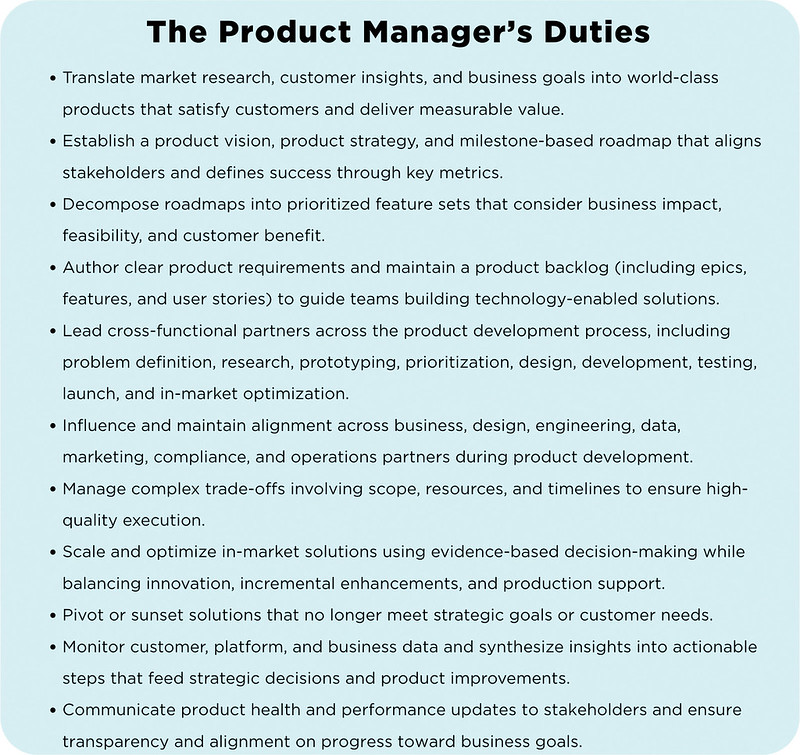
FIGURE 1.1 Duties and methods will vary across companies. Chaos-wrangling is universal.
In an ideal situation, the product manager’s role closely resembles this description, but what’s on paper often doesn’t reflect reality. For example, not all companies clearly articulate their business goals, which makes translating those goals into solutions very difficult. Also, many PMs lack durable access to user research, design, data, and marketing experts. Even worse, some businesses are still learning why product discovery and customer research matter. When reality and expectations don’t align, every product manager harnesses an essential superpower: tackling ambiguity.
CLARITY IS THE JOB: THE FOUR TYPES OF AMBIGUITY PRODUCT MANAGERS TACKLE EVERYDAY
Product management is uniquely an end-to-end process. Few roles span the entire product development process from initial insight to post-launch optimization. End-to-end ownership is rewarding, but it also creates pressure to have all the answers. Because PMs sit at the intersection of many stakeholders and handoffs, your teams will look to you for direction when chaos starts to rise. To lead effectively, you must learn to tackle these four types of everyday ambiguity with a steady hand:
- Problem ambiguity: Business stakeholders speak in “features” while users speak in “symptoms.” In a sea of conflicting feedback, PMs don’t just listen—they synthesize. They use data and sharp judgment to define what really matters, why it matters, and who to optimize for.
- Priority ambiguity: On Monday, you have one clear goal and by Tuesday three “fires” landed on your desk. When everything seems urgent, the PM operates as a filter for team focus, deciding what’s important to tackle first and why.
- Solution ambiguity: A brilliant strategy with poor execution leads nowhere. Great PMs partner closely with design and engineering teams to understand the art of the possible. And they craft holistic requirements to ensure that the team builds a solution that meets customer and business needs.
- Organizational ambiguity: Fuzzy reporting structures, multiple handoffs, and shifting dependencies are a rite of passage for PMs in large organizations. The best PMs don’t wait for blockers to emerge. Instead, they build informal networks, call their contacts, and influence decision-makers to clear organizational blockers before they stall progress.
The Core Domains of Product Management
Shipping world-class products requires multidisciplinary skills and a collaborative mindset. To be successful, product management demands expertise across five core domains: the market, your business, design, technology, and data (see Figure 1.2). By fusing and synthesizing insights across each of these areas, PMs develop a product sense: the ability to craft technology-enabled solutions for products that satisfy customers and build durable businesses. Knowledge across these domains also makes you, the product manager, a stronger collaborator and partner when leading cross-functional teams. Throughout this book, you will find concepts, methods, and resources to level up your domain knowledge across each area.
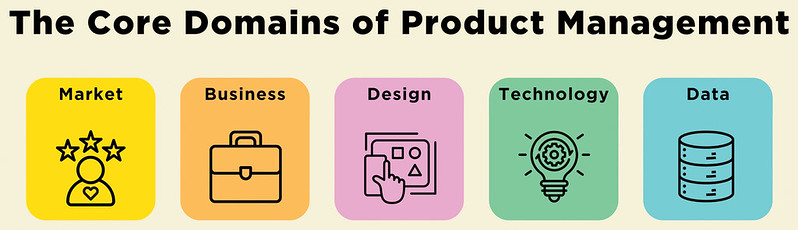
FIGURE 1.2 Expertise in one or two of these domains makes a transition into product management easier.
Domain expertise doesn’t just help you make better decisions—it helps you master a vital skill in everyday product management: influence-based leadership. Yes, new PMs should build knowledge in each domain to develop a strategic point-of-view, but success often hinges on how well you use that knowledge to align disparate roles and voices into a singular mission. Depending on context, domain expertise can help you be the shield for your team (protecting them from distractions or chaos) or the sword that cuts through indecision by communicating in a way that resonates with your stakeholders.
Flavors of Product Management
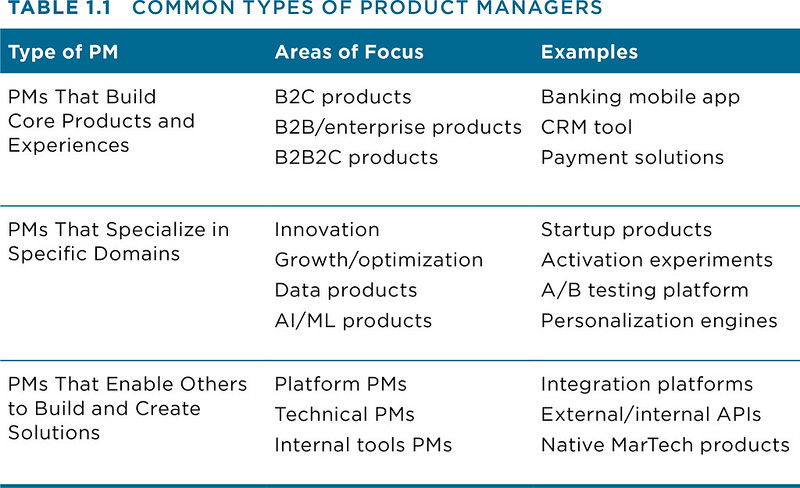
There’s no ideal path into product management. The field is a mosaic of professionals that arrive from diverse backgrounds. Many PMs start in product management with a T-shaped skill set, meaning they arrive with deep expertise in one or two domains and broad competence in the others. Depending on the company’s needs and individual expertise, they either step into generalist or specialist roles. Generalist PMs are like a Swiss-army knife—they have a broad range of knowledge and can work across the entire product life cycle. Specialist PMs often excel in specific technologies or business outcomes. Table 1.1 shows several common flavors of product management roles today. (Keep in mind, these are not mutually exclusive; some PM roles are a hybrid version of these.)
Like the role itself, product team structures vary widely. Depending on the company, you might find yourself aligned to business outcomes, customer segments, user journeys, specific features, or technical architecture boundaries. As an individual PM, you won’t be dictating team topology or org charts; however, understanding how to navigate your organization is a critical skill. Having awareness of the company’s structure and reporting relationships will help you quickly identify and collaborate with partners. Start building your network now!
THE ORIGIN STORY OF PRODUCT MANAGEMENT
If you’re wondering where modern product management comes from, here’s an abridged history lesson that starts in the 20th century.
1920s
To combat product commoditization, Procter & Gamble began market research to understand how and why customers used their household products. In 1931, they invented brand management teams to ensure that consumer insights shaped product, packaging, and distribution strategies.
1950s
The Toyota Production System, developed in the mid-1900s, transformed the manufacturing process through two core principles: jidoka (automation with a human touch) and just-in-time (continuous production flows that minimize waste). This product management strategy scaled high-quality, low-cost production by blending machine automation with human wisdom.
1990s
Toyota’s approach inspired Lean, a business management framework focused on value stream efficiency and the elimination of unnecessary activities. Businesses, nonprofits, and government functions embraced this new way of working to develop, deliver, and manage goods and services.
2000s
Influenced by modern business management and manufacturing methods, seventeen experts published the “Agile Manifesto” in 2001 to overcome rigid software development practices. The manifesto principles inspired several product management methodologies rooted in user-centered development, cross-functional teams, and continuous delivery. The shift in product development practices transformed early product managers from isolated requirements owners to a central team figure focused on aligning why, who, what, how, and when across the team.
2020s
Today, product management is a high-leverage, interdisciplinary function at thousands of digitally-transformed companies. PMs are no longer an extension of technology teams; in many cases, they now report to product teams and chief product officers. In the modern era, PMs operate at the intersection of customers, business, design, and technology to continuously define, build, and ship products that are useful, feasible, and viable.
The Biggest Myths in Product Management
Some of you reading this book are current PMs trying to level up your game. Others are considering the leap into product management. Regardless of your stage, there are two big misconceptions that skew expectations and stall growth for product managers worldwide. Let’s debunk these myths right now so you can move forward with a clearer sense of purpose and empowerment.
Myth 1: The Myth You’re Told
Contrary to what you read and hear, product managers are not mini- CEOs. Yes, there are some parallels, given the ownership mindset and leadership skills required to be a PM, but overall, the PM’s job comes with less razzle-dazzle and a lot less authority than a CEO. It’s true that in some small companies, many product managers often execute founder-driven ideas. However, while the PM may have a broader responsibility for the customer experience, they usually have less influence in the product’s vision and strategic direction than the co- founder. In large companies, many PMs lead small, cross-functional teams with a well-defined scope, but they are removed from broader vision and strategy conversations. Across all companies, it’s rare for product managers to own the P&L (profit and loss) responsibility. For example, CEOs can choose their teams, dictate resources, and control the budget. Product managers, however, can’t do any of that.
Instead of a mini-CEO, here’s a less glamorous, but more accurate metaphor: product managers are the glue of organizations. They are masters at unifying, filling gaps, and combining discrete insights together to establish product sense. They align customer needs to business goals and operate at the intersection of five large domains— business, customer, technology, data, and design—to create valuable solutions. Along the way, they bring together dozens of partners, subspecialties, and dependent teams, ensuring that everyone understands the core vision and works toward the same goals. And they do it without any formal authority.
Myth 2: The Myth You Tell Yourself
Despite what job descriptions say, many early career PMs do not participate explicitly in vision setting and strategy formation. This is especially common when PMs own specific features or capabilities in a large product. In this environment, it’s easy to believe that leaders create the vision and strategy, and you just deliver it. (And yes, many times product leaders are responsible for a cohesive product vision across a large portfolio of products and services.)
But the myth is believing that your scope is not worthy enough for a vision and a strategy, too. Even if your boss doesn’t explicitly say so, no product scope is too small to think strategically. Take authentication, for example. If you own the log-in experience of an app, what’s stopping you from imagining the North Star vision and crafting a strategy to make that a world-class solution? Nothing. The same thinking applies to other examples, too. Whenever you own a specific problem area, you should find inspiration, create a vision and strategy, and proactively share it. You don’t need to wait for someone to ask you—start practicing now, especially if you see a product leader role in your future.
Why Product Managers Matter More Than Ever
Recent advances, mainly driven by AI technologies, are starting to blur lines across product thinkers, product builders, and everyone in between. Today, it’s easier than ever to create a product and launch a solution quickly. But speed often sacrifices quality, and developing a solution instantly doesn’t mean it’s inherently useful and valuable. Remember, product management is a practice that requires strategic thinking across multiple domains, not just execution chops.
Companies will always need individuals who think deeply about market opportunities, customer problems, and user needs. They need people who will envision brand-new value propositions and build solutions in previously unimaginable ways. And of course, they’ll need thinkers and doers who can navigate organizational politics and keep teams moving toward a shared vision. These skills will become more critical as automation eliminates mundane tasks.
Yes, AI is reshaping and accelerating parts of the product development life cycle in powerful ways, but even AI product teams require human-in-the-loop checkpoints. To be sure, the future still needs product people. Truth-seekers and truth-tellers. Strategists and executors. The glue that holds everything together.
Tackling the Confidence Gap PMs Feel Today
Right now, thousands of product managers are fumbling their way through product work every day, and honestly, who can blame them? Job descriptions don’t match reality, teams are spread thin, and many PMs work for companies that are attempting half-baked transformations. As more companies have gone all-in on digital, many people flipped into product management job titles with zero coaching. Zilch! And when PMs change companies, most are thrown into the deep end on day 1 without any training. To make matters more concerning, many PMs are panicking about career longevity, given the rise of AI.
The confidence gap many product managers face today is real. But you can still become an exceptional product manager despite these constraints. You just need a realistic mindset about your responsibilities, a toolkit of best practices, and a ton of grit. That said, becoming an exceptional product manager is a marathon, not a sprint. Set your expectations accordingly. Even with great coaching, it’s impossible to become a solid product manager in less than two years.
To develop real product sense, you need experience with different solutions, teams, and product life cycles. (And product life cycles can move slower than you’d expect.) Sure, you can attend bootcamps or conferences, but hands-on exposure is where real learning happens. It helps you recognize patterns across people, products, and processes that lead to success or failure.
But with any race, success is so much easier when you’ve got support and advice. Across each chapter, you’ll acquire skills and methods to tackle every aspect of the product life cycle with examples, expert advice, templates, and practical strategies. You’ll learn tips to develop a stronger brand with partners, adopt a player-coach management style, and prepare for a journey toward product leadership. By the end, you’ll have an end-to-end view of the product manager’s responsibilities and techniques for tackling whatever assignment comes next. . . and tackling it with confidence.
So, consider this book your product management marathon coach. Your training starts now.
Excerpt from The Product Management Playbook: Create, Ship, and Optimize Winning Products. Rosenfeld Media, 2026.


