
Last week in the Rosenverse: UX in healthcare & measuring success
04/27/2026Last week in the Rosenverse, we hosted two events, including an Ask Me Anything (AMA) about a designer working in healthcare, and a session about team psychology and measuring success.
Log into the Rosenverse to watch these recordings.
See what you missed below.
An AMA on UX’s Role in Healthcare

“Healthcare is not just a user journey, it’s an interdependent journey of layers and phases.”
April 22: Watch Eric Shumake’s rapid-fire AMA following his recent Rosenverse Live session. We dove deep into the practical strategies designers use to build influence, navigate regulated spaces, and drive UX investment within healthcare organizations. Watch the recording »
Q&A with Eric Shumake
This Q&A was drawn from the Rosenverse Live session.
Q: What is the biggest challenge in healthcare UX today?
A: The hardest part is not designing screens; it’s getting enough influence to change how healthcare organizations make decisions. In healthcare, stakeholders care first about clinical outcomes, safety, compliance, and cost, so UX teams have to connect their work directly to those priorities.
Q: Why does UX matter so much in healthcare?
A: UX matters because healthcare is full of high-stakes workflows where confusion can lead to errors, delays, and bad outcomes. Good UX helps patients, clinicians, and administrators move through complex systems with less friction and more confidence.
Q: How can designers build credibility inside healthcare organizations?
A: Start by translating UX findings into the language leadership already uses: risk reduction, operational efficiency, adoption, and patient safety. Small wins build trust, and trust opens the door to bigger influence over time.
Q: Why is interoperability still such a pain point in healthcare?
Q: How is AI changing healthcare UX?
A: AI is already showing up in documentation, decision support, and administrative workflows, but the real opportunity is in helping people understand and act on information. One especially important use case is patient education, where AI can translate medical jargon into plain language from admission through discharge.
Measure Behaviors, Not Results
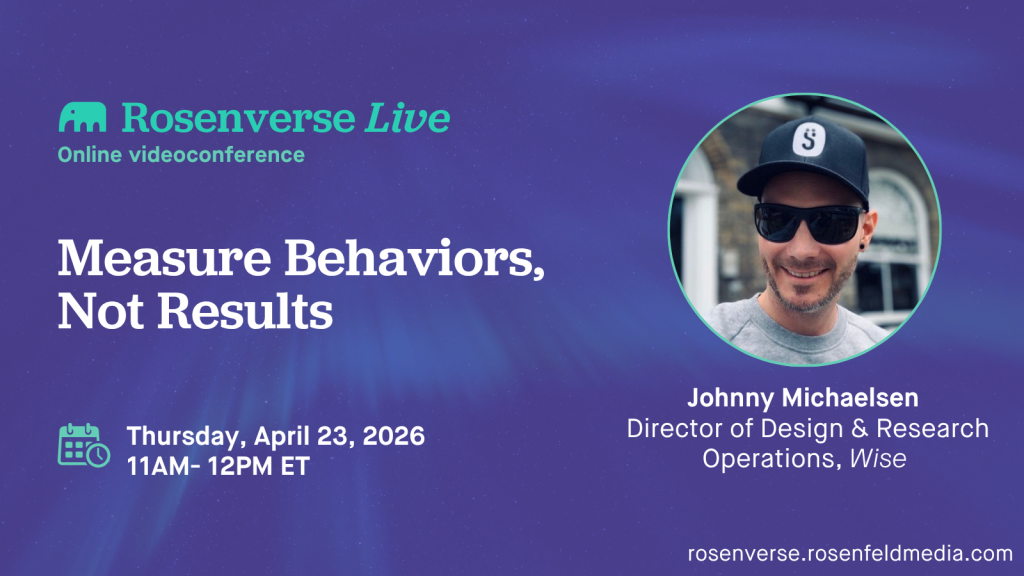
“Effort doesn’t mean progress, hard work doesn’t guarantee a harvest.”
April 23: How can design operations professionals measure success when we can’t always measure or control the results? Sometimes, even our best efforts don’t lead to the outcome we expected, but that doesn’t mean the work wasn’t valuable. I believe positive feedback from stakeholders always outweighs vanity metrics. In this talk, Johnny Michaelsen shares the core behaviors the Design & Research Operations team at Wise uses as the foundation for how their team operates. These behaviors focus on how to show up for the people being served, for each other, and importantly, for ourselves. They ultimately determine their focus and help build trust while delivering a positive change for the Design & Research environment across Wise. Finally, hear what was learned from a three-month experiment where the team at Wise aimed to measure themselves against these behaviors, rather than just measuring the results of their efforts. Dive into team psychology and explore why the right behaviors might actually matter more than metrics from final outcomes. Watch the recording »
Q&A with Johnny Michaelsen
This Q&A was drawn from the Rosenverse Live session.
Q: Why should teams measure behaviors instead of results?
A: Results can hide the real story, while behaviors show how a team actually works and whether it is building trust, clarity, and impact. Measuring behaviors gives us a better way to understand team health and to improve the things that lead to strong outcomes.
Q: What behaviors matter most in design and research operations?
A: Three behaviors matter most for our team: delivering value now, being observant and of service, and creating visibility with clarity. Those behaviors keep the work practical, people-centered, and aligned to the needs of the organization.
Q: How does this approach help with prioritization?
A: Clear problem framing and sponsor alignment make prioritization much easier. When the team understands the real problem and the people behind the request, it can focus on work that creates the most value.
Q: How do you build trust through operations work?
A: Trust comes from relationships, not just process. If you take time to understand what people actually need beneath their complaints or requests, you can create support that feels useful instead of procedural.
Q: Where does AI fit into this way of working?
A: AI can speed up delivery and help with impact reporting, but it still needs clear direction. Used well, it helps teams move faster without losing focus on the behaviors that create real value.
Catch up on last week’s recordings, and mark your calendar for upcoming events.
See you in the Rosenverse!


