
Sample Chapter: Service Design (2nd Edition)
This is a sample chapter from Lavrans Løvlie, Andy Polaine, and Ben Reason’s book Service Design, 2nd Edition: From Insight to Implementation. 2025, Rosenfeld Media.
Chapter 1
Insurance is a Service, Not a Product
Insurance rarely comes to mind as an industry that provides a rewarding customer experience. The only time people find out whether their insurance company is actually any good or not is when they are at their most distressed and vulnerable. When they find out their insurance is awful, there is nothing they can do about it. They are at the mercy of small print they either did not read or did not understand, and they may end up spending hours on the telephone or filling out more paperwork. There should be insurance against mistreatment by insurance companies.
For many insurance companies and the people working for them, the lofty goal is to be the least awful with the minimum effort possible. The insurance market has ended up in a race to the bottom, competing only on price because customers do not understand their complex policies, hence the proliferation of insurance price-comparison websites.
Part of the problem is that insurance is complicated, involves multiple stakeholders and channels, and is a classic example of a service that is often sold as a product. The mix of complexity, human experience, multiple stakeholders, and delivery channels, combined with customer dissatisfaction with an industry stuck in its ways, makes insurance a perfect candidate for service design.
Beyond Satisfaction
When we published the first edition of this book in 2013, the first chapter was a case study from the insurance industry. It detailed how the largest general insurer in Norway, Gjensidige (pronounced yen-SEE-dig-ah), used service design as a key ingredient in a fundamental organizational reorientation toward customer centricity.
Twelve years later, Lavrans sat down with newly retired CEO Helge Leiro Baastad and director of innovation Kim Wikan Barth to reflect on the Extreme Customer Orientation program they ran from 2008 to 2010 and their effort to create a business that performed “beyond satisfaction” over time.
The starting point for Leiro Baastad when he took over as CEO in 2003 was an observation that this was a company and an industry ripe for modernization. While there was a structural need to recapitalize, reorganize, and improve operational efficiency, the management team could only identify one area where they believed the company could build and keep a unique position in the market over time: customer centricity.
There was a fundamental recognition that a sustainable advantage could be made by an insurer that serviced customers in smarter, warmer, and more empathetic ways. This led to a strategic and ongoing dedication to building a customer-centric culture, anchored in leadership, and including training, incentives, and a clear narrative that great customer experiences were great for business. Service design capabilities were brought into the business in 2008 to help manifest the strategic vision in how the services were actually delivered with customers.
Gjensidige went public in 2010 as Extreme Customer Orientation went from a corporate program to everyday practice. By 2024, the total returns for the owners were 700%. (Note that customers own half of the company and receive annual dividends.) At the same time, the company has consistently ranked at the top of national customer satisfaction indexes.
The deeply embedded culture of customer centricity has also provided a strong foundation for the company to succeed with new strategic efforts over time. The insurance industry was slow to digitize services compared to banking, but when Gjensidige mobilized to digitize claims in the mid 2010s, the transformation was rapid. In a year, more than 50% of customers switched to reporting accidents digitally rather than by phone. The company’s capability to act on customer insights, design good customer journeys, and test solutions with customers helped to get the transition to digital right the first time around.
During the same decade, the company was able to capitalize early on the developments in behavioral psychology (the work of Daniel Kahneman and others). The capability to design for an experience of trust was another example of service design that benefitted both the business and customers. To put it succinctly: Customers who trust the insurance company cheat less.
During the 2020s, the investment in customer centricity has provided a valuable base for helping Gjensidige launch innovative insurance services in the market. Kim Wikan Barth, who drove Extreme Customer Orientation in the 2000s, now heads the company’s innovation department. Building on their deep knowledge with customer experience design, the company now combines design and creative business skills to take new and unique positions in the market. In the last couple of years, they have launched innovative, sustainable insurance products, as well as home insurance that includes a physical alarm system in order to prevent burglary and accidents at home.
To understand just how far they have come, let’s return to 2013 when we first told the story of Gjensidige’s first steps into customer centricity and service design.
Extreme Customer Orientation
In 2008, Gjensidige decided they had had enough of competing in this toxic marketplace on the same level as their competitors. A major challenge was a structural one. Gjensidige was organized as a chain of activities from product development to sales, with expert staff working in silos. This industrial model made it difficult to orient the silos to work together to deliver a unified experience to customers. Because the CEO wanted the change to be driven from the heart of the business, he asked marketing director Hans Hanevold and, at that time, brand director Kim Wikan Barth to leave their jobs for two years to run the company-wide change program called Extreme Customer Orientation. Both Hanevold and Barth had long track records with the company, enjoyed the respect of their colleagues, and knew how to engage the organization.
Hanevold and Barth began by identifying change agents in every business unit within the company. The underlying principle was that customer orientation should be grown from the inside out rather than being driven by outside consultants, and that the activities should be funded by the business units themselves. To support these activities, they created a training program for everyone in the business and then set about identifying what ultimately amounted to 183 concrete actions to improve customer experience. For some projects, the business units required specialist expertise to fulfill their ambitions, and service designers were hired to help design a better service experience.
Gjensidige embraced service design as a way to help bridge the gaps across the silos and develop their services in more customer-oriented ways. Service design methods helped them create a complete and shared picture of service features that really provided value to the customer, as well as processes to join up the experiences.
As a lead-up to their change program, Gjensidige employed service designers to challenge their thinking and to design what the ideal insurance service would look like. The initial task was very broad— Gjensidige wanted to find out about people’s behaviors, motivations, and relationships to insurance. It was important, however, not only to understand the mindset of Gjensidige’s customers, but also the mindset of staff.
The actuaries—the mathematicians and financial wizards who came up with the complex “products” on which insurance was based— belonged to the product group. The name of this department was a clue to the shift that was required in the company’s internal culture. What the company was really selling was a service. Customers could not hold insurance in their hands, and their experience of their insurance policy was made up of the service interactions they had with the company. For example, when customers bought a physical product, they could inspect it for build quality, flaws, or damage. However, it was much harder to do that with services, especially ones that were essentially a contract based on the chance of a future event, such as an insurance claim for a fire. Many people buying insurance did not really know what they were buying and only found out what was covered at the worst possible moment—when disaster struck. That was not the time to begin haggling over contract details.
Customer Insights
The approach taken in the “ideal insurance service” project was an example of classic service design—qualitative research, analysis, and synthesis to surface insights, workshops, service blueprinting, service proposition development, concept sketches and presentations, experience prototyping, testing, and delivery. A fairly small sample of users was involved in the research, but the research went deep. The design team spoke with people working in Gjensidige’s call centers and offices, as well as customers, to look at both the delivery side and the recipient side of the service. Gjensidige already had a great deal of quantitative information, but this information didn’t have the detail of the qualitative research needed for an innovation project. Quantitative methods are good for creating knowledge and understanding of the field, but they are not very useful for translating knowledge into action and helping organizations do something with it. Qualitative studies are very good at bridging this gap.
Five different areas were researched with the participants: insurance in general, social aspects, choices, contact, and tools for staff. What Gjensidige and the service design team discovered were some important differences between what people said and what they did. Some of the insights that were uncovered are described next. Many are questions and needs, and you can see how this kind of research immediately gets the problem-solving juices flowing.
Trust
Insurance is built on trust. When customers pay their premiums, they trust that they will get value for money—and that the insurance company will still exist when they need it. But trust is very fragile. It takes time to build and is quickly broken. All the small glitches in delivery—letters sent to the wrong address, billing errors, problems with communication, customers having to repeat details multiple times—damage people’s trust in an insurance company. They wonder whether similar chaos happens behind the scenes. Fixing the small glitches can have a big impact on the level of trust.
Comparison and Purchasing Criteria
People say they make insurance purchasing decisions based on quality, but they find it hard to do this in reality. It is very difficult to compare what is inside of different insurance policies and make a rational choice. People feel that insurance is not very transparent, especially with regard to quality, so it is easier to compare on price. This means that designers cannot simply trust what customers say they want but have to work smartly around price and quality issues.
With most other services and products, customers can easily see the differences between the premium version and something cheaper, but not with insurance. As with much service design, the challenge is to make the invisible visible, or to make the right things visible, and get rid of the noise in the rest of the offering. In the project, then, one of the key challenges was to develop a service proposition that eliminated price as the key deciding factor.
Expectations
People expect an insurance payout when something happens, and they expect help. This is another issue related to quality. Customers who buy a cheap insurance product get money but will not get much help, whereas Gjensidige has a very good system for taking care of people when something happens. For example, when customers have damage to a car, they just take it in for evaluation and Gjensidige issues a rental car and takes care of everything else. This fact needed to be made visible as part of the service proposition.
Insurance in Many Places
Many customers have insurance in different places, from credit cards to employee benefits and with their chosen insurance provider. It is very difficult for people to tell whether they are covered because there is no way for them to see all of this information in one view and all in one place. The challenge is to achieve this information overview in a transparent and trustworthy way for customers.
Social and Cultural Interactions
Many invisible social touchpoints affect the entire service experience. The researchers discovered that a lot of different people were giving advice about insurance who should not be. For example, friends and family were frequently believed to be the best source of insurance advice. People trusted their father to give them good advice about an insurance policy more than they trusted an insurance agent.
The challenge was how to work together with all of these invisible touchpoints. Insurance originally dates back to a time when people in a small community would pool their money to pay for an accident, such as someone’s barn burning down. This example stimulated thinking about bringing back this social aspect, because insurance had evolved from a collective effort into these machines that customers didn’t trust.
Choice
From an insurance specialist point of view, the more options you have, the better you will be covered. Covering certain items, such as a new bike, but not others, such as an old PC, allows people to have insurance tailored to their needs.
At the same time, customers want simplicity. The paradox discovered in the customer research was that customers wanted very simple products, but they wanted to feel like they were making a choice from an array of complex products. The underlying need here was that they did not want to have to choose from lots of options, but they wanted the experience of having made their own choice.
Documents
When it comes to reading insurance papers, one of the typical quotes from interviewees was, “I just can’t do it.” This connects back to the issue of trust. On the one hand, customers do not read the details of their insurance policies, which means they blindly trust the insurance company to be right. On the other hand, customers do not trust the insurance company because they do not know the details of their policies.
Insurance companies produce enormously long documents, which is the main reason that customers do not read them. Customers were saying, “Can’t we have just one document and could it be on one page?” but what people actually wanted and needed was a “What if?” structure they could study—one to explain that if this happens, then the customer will get that from the insurance company.
Another reason people did not know what was in their documents was that most of the text was written by lawyers in “legalese.” Over the years, more and more text had been added to these documents without much serious thought about what was still needed. To counter this, Gjensidige reduced the size of their insurance policy documents by 50% to 60% just by taking out extraneous words and simplifying the language as much as legally possible. It took a team of four people a year and a half to do this, but they did a brilliant job. Gjensidige also gained a small side benefit from reduced printing costs, but the big benefit was in customer experience.
Company Insights
A key principle and mindset of service design is the idea of frontstage and backstage. Along with understanding customer experiences, it is also critical to understand the organization’s perspective backstage. It is the interplay between the frontstage and backstage that largely constitutes the service experience and quality of the service.
Offering Good Advice
Customers need this information, and they need people to talk to who can give them good advice, not just salespeople who are more interested in selling an insurance product than in what customers need.
In many organizations, the underlying issue involves reaching hard targets for sales quotas and organizational structures, which actually discourage customer service representatives from taking proper care of people. Gjensidige needed to change the way they measured performance internally so that the benefit could be experienced externally. The greatest cultural effect came about when Gjensidige implemented individual customer satisfaction measurements for all customer-facing staff, reported daily. The main data was gathered by sending customers an email asking if they wanted to rate their experience after every customer contact by telephone or at a branch office. This feedback was added to a mix of other metrics to make up a comprehensive customer experience measurement system. Guess what the most satisfied customers repeatedly said: “They gave me a piece of advice I’d never thought about before!”
Consistent Communication Channels
Respondents wanted Gjensidige to stay on their channel, meaning that if they telephoned, they wanted the company to call them back, not send an email or a letter. If they sent an email, they wanted an email back. Gjensidige made the strategic decision to keep all of their channels open, which was more costly because it was more complicated to manage, but the company believed it was worth the expense and effort because it created a better customer experience.
Language
Laypeople (customers) really do not understand the language of insurance. A lot of people thought a “premium” was actually a prize, for example. As such, Gjensidige needed to be careful that the insurance language that was clear to them in their business actually meant the same thing to their customers across all communication channels.
Formalizing Personal Routines
When researchers visited Gjensidige’s offices to interview staff, they saw a lot of sticky notes on salespeople’s desks and on their computers (Figure 1.1). Many people had created their own routines for dealing with customers more efficiently. The insight here was that some of the processes developed “on the shop floor” could be adopted and integrated into Gjensidige’s systems as standard approaches.

Figure 1.1
Sales staff build their own routines to make their process more efficient.
Redesigned processes deeply founded on insight from customers and staff were initially implemented as paper-based routines to avoid waiting for enterprise software to be developed (Figure 1.2). Later, these new routines were built into Gjensidige’s new customer relationship management (CRM) system.
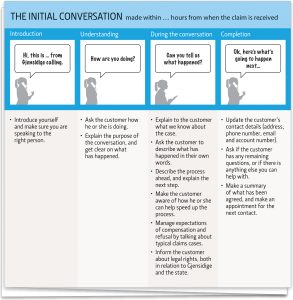
Figure 1.2
Paper-based routines were a quick fix for sales staff.
Putting Insights into Practice
One of the things that hampers product innovation in insurance is the time delay. Organizations only find out whether an innovation will make or lose them money after they see the level of claims, which can take several years. Thus, the insurance industry traditionally is conservative about innovating new insurance products. The customer insights gathered by the design team helped by introducing design research as a capability and inspired confidence to speed up improvement and innovation.
Using the material from the insights research, Gjensidige ran co- design workshops with different groups within the company and generated 97 ideas, five of which were chosen for further development. Finally, the team came up with one new service proposition for “the ideal insurance service.” The idea was to radically simplify the products both digitally and physically, make the connection between price and quality clearer, and communicate with customers in a human and accessible language.
Experience Prototyping the Service
Anders Kjeseth Valdersnes, the design team’s Microsoft Excel maestro, built a prototype of the product in Excel, which had all the tools required to handle complex actuarial tables with real pricing and live information visualization. Rather than spending a week or two designing and coding a web prototype with a functioning back-end database, Anders did it in two days and designed it to look like a website so that it could be tested with customers (Figure 1.3).

Figure 1.3
An experience prototype of the insurance website built in Excel to make it easy to use real data in testing with customers.
With this prototype, Gjensidige was able to carry out experience prototyping with customers discussing and buying insurance, a salesperson selling insurance, and someone trying to make a claim. They tested what it was like for customers to try to buy the services face-to-face and what it was like for the sales staff. They also tested this process over the phone and observed the process from both sides of the call. To test the claims process, they went through the material with someone who had just had an accident. Actual staff and actual customers took part, and even though they knew they were taking part in testing, the conversations they had were very real. Through this process, the project team learned a lot about what needed to be done to shape, explain, and sell the new service proposition.
It was clear from the prototyping that the new approach changed the conversation from being about buying products to one about service. It meant that customers considered what they could afford on a monthly basis, taking into account what they earned, what was in their “rainy day” savings account, and what they would need in the event of a tragedy. They were able to see the difference that their decisions about excess and payout levels made to their premiums, and the conversation was much more open, with the customers in control.
A series of touchpoints were prototyped—the one-page contract, informational leaflets, fake advertisements in a financial newspaper and a tabloid newspaper, and the bill customers would receive at the end—so that a broad range of the service experience could be tested.
The one-page contract prototype was a good example of the difference between what people said they wanted and what they actually wanted (Figure 1.4). Many interviewees said that they did not read long contracts and thus did not know what was in them, leading to a lack of trust in the insurance company. They suggested that a one-page contract would be much friendlier. During prototyping, however, it turned out that customers did not trust a one-page contract either, fearing that too much important detail was hidden from them, as their previous policies had been about 40 pages. As a result, Gjensidige ended up creating contracts with around five to ten pages.
Prototypes were also made of the claim process confirmation documents. Traditionally, customers simply received a letter stating, “We have received your claim,” which left them uncertain about how the claims process was handled within the company. The redesigned confirmation showed the customer how the process unfolded over time and helped to manage their expectations (Figure 1.5), much like tracking a package. This way they knew when to be patient and let
the process take its course, and when they had cause to follow up. A few years later, this model became the main feature that enabled digital claims to take off and be successful with customers.
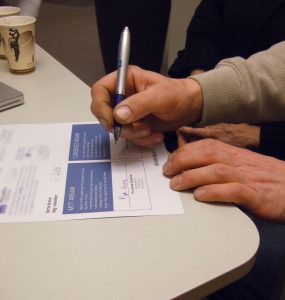
Figure 1.4
A prototype of the one-page contract that so many interviewees claimed they would prefer. However, evidence showed that they did not trust it.
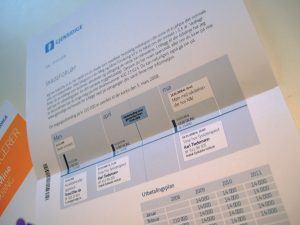
Figure 1.5
A prototype of a redesigned claim confirmation. This model managed customer expectations by illustrating how the process unfolded over time. A few years later, this would become a key feature, when claims forms were digitized.
Lastly, the team prototyped an offer sent out in the mail after a sales call or meeting (see Figure 1.6). The insights research showed that this was one of the most crucial touchpoint failures, and the company did not realize the potential of improving it. Previously, customers had had an interaction with a salesperson in which they talked through a complicated policy; then they would go home and explain it to their partners but could not remember the details well enough to explain it. Because they could no longer understand it, customers could not make a decision.
Redesigning this touchpoint helped people make a decision at home, and the company avoided losing customers because of this hidden problem. This is a good example of how services are created and experienced by interactions between people, often in a completely different context than the usual customer-provider paradigm.

Figure 1.6
A prototype of the mailed offer, which was an important touchpoint for customers. This document served as the focal
point for discussion and making a decision. This prototype showed an offer that could be revised by customers before the contract was signed.
The End Is Just the Beginning
The value of gaining real insights from all stakeholders—customers, staff, and management—is only half of the story. Translating these insights into a clear service proposition and then experience prototyping the key touchpoints were essential. This process allowed for feedback not only on the design of the physical touchpoints themselves but also on the entire service proposition and experience. Prototypes were also created to test unknowns—for example, was this a low-end or a high-end offering? The two types of newspaper advertisements helped reveal how the marketing of the service would feel in those different contexts.
Thinking through radical ideas and prototyping their experience helped mature the cultural mindset within the company, and many of the insights have fed into Gjensidige’s orientation of becoming a totally service-oriented company. The Extreme Customer Orientation team acted as champion for the customer experience and the internal changes that needed to happen to deliver it well. A company-wide framework for customer orientation called the Gjensidige Experience was also implemented.
Mapping out a big idea like “the ideal insurance service” in detail gives organizations an overview of problems and opportunities all in one place. It helps them make strategic decisions about what to deal with when, how those decisions relate to other parts of their business, and how to scale their service innovation up or down according
to budgets and resources.
Gjensidige’s 183 activities involved a very large number of improvements. Some were small; others were large undertakings rolled out over several years. The bottom line was important, of course, but it was not the sole focus. The change process required top-level leadership to buy into all aspects of the business—from committing to quality in their computer systems by removing glitches to simplifying their products and language, focusing on the service experience as well as internal funding, and paying attention to branding, education, and measurement.
For example, 130 Gjensidige managers, including the CEO, gathered their own rich data by calling 1,000 customers (see Figure 1.7). They loved it, because they realized that many of them had not spoken to customers in years, and it was often those interactions that had sparked their interest in the business in the first place. Managers were deeply familiar with their statistics about customer satisfaction, as well as the challenges that needed to be addressed. But it made a real difference to experience for themselves how many customers said they really liked Gjensidige and to feel people’s emotions firsthand when they talked about things that didn’t work as they should have. The symbolism of this is important. When a CEO sits down to talk to customers to find out what they think, it sends an important signal to the rest of the organization and the industry.

Figure 1.7
Gjensidige CEO Helge Leiro Baastad and 130 of his managers spent a day calling 1,000 random customers to hear what they really thought about the company.
The results of these kinds of company-wide changes take time to surface. Two and a half years after starting this process, Gjensidige saw a dramatic rise in their position on the National Customer Satisfaction Barometer and won the two biggest customer satisfaction awards in the market. They have consistently beaten market expectations with their financial results and can prove that they provide their services more efficiently than their peers in Europe and the United States. Still, according to Leiro Baastad, the business case for customer orientation should not be seen in isolation. It is a natural part of the bigger story of developing a modern and efficient insurance company that brings real value to employees, shareholders, and customers.
Takeaways
- A culture of customer centricity is a strategic competitive advantage.
- Customer satisfaction and return on investment usually go hand in hand.
- Service design capabilities are key to making a culture of customer centricity—both real and tangible.


