
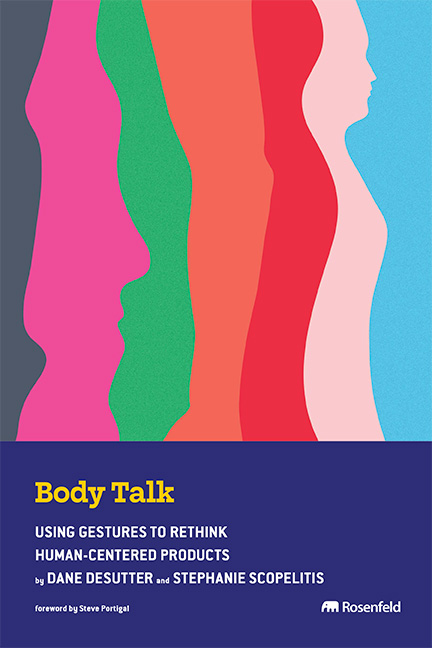


Body Talk

Using Gestures to Rethink Human-Centered Products
Human thinking and communication include more than words alone. By honing attention to non-verbal actions such as gestures, body posture, and gaze in a rich social-material environment, we show you how to attend to the subtleties of unspoken language and rediscover the human in Human-Centered Design. In Body Talk, we carry the reader through the end-to-end product arc with a focus on how attending to yours and others’ gestures deepen meaning. Explore the role of the body in enriching foundational research, supporting collaborative ideation, advancing and validating designs, and facilitating technical conversations to ground nascent technology in complex human experiences.
Who should read this book
Do you talk to users and customers, drive product design or strategy, or facilitate the teams that do? Whether you call yourself a researcher, designer, engineer, or product manager, you’ve probably got stories of a product or feature that seemed really promising but failed to land. Being unable to read and interpret gestures could be the reason behind that failure. If so, this book is for you.
If you’re a researcher, designer, leader, educator, healthcare professional, or facilitator whose work depends on understanding people and getting things done with them, this book is for you, too. Pull up a chair and listen to what the body has to say.
What you’ll take away
- Learn how gestures help people think and reveal their mental models.
- See how gestures communicate what words can’t capture.
- Learn how the thinking, communicating, and coordinating body work together.
- Discover how to “see” and spot gestures that matter.
- Evaluate and analyze gestures for communication and impact.
- Understand how gestures build belonging in teams and enable richer collaboration and design together.
- Understand the context of gestures by knowing your goals, the relationships at play, and how ideas move through collaboration.
- Prototype and build the right thing together.
- Learn how to analyze and interpret gestures in videos.
- See how AI and software can help you locate movement at scale and make video easier to search.
Human thinking and communication include more than words alone. By honing attention to non-verbal actions such as gestures, body posture, and gaze in a rich social-material environment, we show you how to attend to the subtleties of unspoken language and rediscover the human in Human-Centered Design. In Body Talk, we carry the reader through the end-to-end product arc with a focus on how attending to yours and others’ gestures deepen meaning. Explore the role of the body in enriching foundational research, supporting collaborative ideation, advancing and validating designs, and facilitating technical conversations to ground nascent technology in complex human experiences.
Who should read this book
Do you talk to users and customers, drive product design or strategy, or facilitate the teams that do? Whether you call yourself a researcher, designer, engineer, or product manager, you’ve probably got stories of a product or feature that seemed really promising but failed to land. Being unable to read and interpret gestures could be the reason behind that failure. If so, this book is for you.
If you’re a researcher, designer, leader, educator, healthcare professional, or facilitator whose work depends on understanding people and getting things done with them, this book is for you, too. Pull up a chair and listen to what the body has to say.
What you’ll take away
- Learn how gestures help people think and reveal their mental models.
- See how gestures communicate what words can’t capture.
- Learn how the thinking, communicating, and coordinating body work together.
- Discover how to “see” and spot gestures that matter.
- Evaluate and analyze gestures for communication and impact.
- Understand how gestures build belonging in teams and enable richer collaboration and design together.
- Understand the context of gestures by knowing your goals, the relationships at play, and how ideas move through collaboration.
- Prototype and build the right thing together.
- Learn how to analyze and interpret gestures in videos.
- See how AI and software can help you locate movement at scale and make video easier to search.
Testimonials
The most meaningful innovations come from seeing what others overlook. Body Talk helps product teams move beyond words to better understand human needs, making it an invaluable resource for anyone committed to human-centered design.
—Nick Smarrelli, Author, The Next Two Steps and Professor, Butler University
In the age of AI, Body Talk is a timely reminder that truly human-centered products still begin with human observation, including the gestures we often overlook. This is a must-read for all experience designers who are navigating the world of designing for humans and machines.
—Beth Ard, CEO, Customer Thrive Consulting
Body Talk provides a compelling new lens for human-centered design, showing how gestures reveal the needs, intentions, and insights that words alone often miss. Drawing on decades of research and practical experience, DeSutter and Scopelitis illuminate how the body supports thinking, communication, and collaboration, offering a powerful new approach to understanding people and designing experiences that truly fit human needs.
—Thérèse Dugan, PhD, Research leader and learning scientist
Arriving at a time when contextual data is more important than ever, Body Talk is a perspective-shifting resource for researchers, designers, and product teams alike. It brings us back to the most intimate source of meaning: what the body knows before we do.
—Vera Haussler, Anthropologist and design research lead
Body Talk makes a compelling case that the body has been the main character all along. By expertly refocusing our understanding of interaction on the gestures and physical behaviors that shape our lives, Scopelitis and DeSutter have created an essential guide for anyone creating immersive experiences, designing embodied technologies or seeking to build truly human-centered products and teams.
—Michelle Cortese, Design Director of Input and Interaction at Meta Reality Labs, author of Embodying the Machine
Table of Contents
Chapter 1: The Need to Go Deeper
Chapter 2: How the Body Talks
Chapter 3: How to “See” Gestures
Chapter 4: Understand Users’ Gestures
Chapter 5: Analyze Your Gesture Data
Chapter 6: Build Strong Teams That Belong
Chapter 7: Design Everyday Things Together
Chapter 8: The Body Points the Way
FAQ
These common questions and their short answers are taken from Dane DeSutter and Stephanie Scopelitis’ book Body Talk: Using Gestures to Rethink Human-Centered Products (2026). You can find longer answers to each in your copy of the book, either printed or digital version.
- Is gesture only about the hands?
No. Gestures can happen anywhere in or across the body; it’s a whole-body thing! It includes what you do with your hands, of course, but also your posture, gaze, how you orient toward or away from someone, and even the way you sit. A turned shoulder, a lifted chin, or even a cocked eyebrow in context are a type of gesture.
In this book, gestures refer to any visible bodily action that helps make meaning when people think, communicate, and coordinate with others. (See Chapter 1, “The Need to Go Deeper.”)


