Day 2- Looking Back…to Look Ahead
— Thank you all for sticking it out and having me today
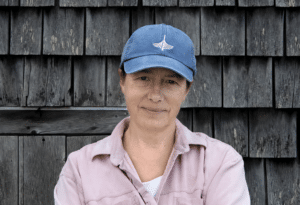
— This is history professor Heather Cox Richardson, who is behind ‘Letters from an American’, a newsletter about the history behind today’s politics
- Historian’s fond of understanding present need to get there
— Take inspiration for her, as second edition of interviewing users came out, and talking to people about it
- So what’s changed in ten years?
- I have always had mixed feelings about question
— Sometimes by talking a lot about stuff get asked to comment on where we’ve been and where we are
— Do have mixed feelings, in that connected more to being young
- Came into field long-time ago, and was field was well established then
— Doesn’t matter where we come in, we always stand on shoulders of giants
- Give provocation and thoughts
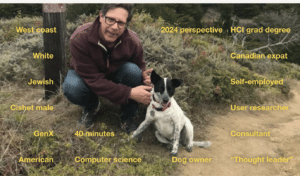
— This is my take on things, and highly biased by me and where I’m coming from
— You may think what’s point of story
- What else should be told, take should be good and to come up with this, did divergence about all things I could possibly think
— Goal to get to point and activity of looking back and collecting things, with so many more stories and people
- If we can carry any of that forward, can serve us for the better
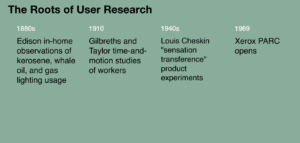
— So for the roots of UXR, and origin point is from Edison sending researchers to watch how people used to fuel their homes [whale oil, kerosene, gas]
— Next, in 1910s came time-motion studies, and fascinating to look at it
- 18 kinds of elemental motions called Thilbreths ( an inverse of inventor names the )
- 1940s, experiments with ‘sensation transference’ and do things to compare different products to each other and one of designs
- Captured feedback and complaints about products
- 1969, Xeroc Parc Opens was famous for technology, UX work, and early stuff from there
- Where Steve Jobs saw Xerox Star, the first windows mouse pointer user interface
- Xerox PARC did all kinds of UXR and still doing that today
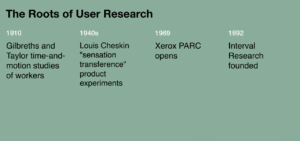
— Interval research in 1992, started by Paul Allen of Microsoft to do research and spin out companies from result of research
- Brenda Laurel did research with Cheskin Research, looking at girls and video games
- Whole separate storyline on games for girls
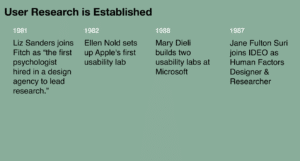
— Handful moments where UXR is established (Aaron Malone, Women of IXD project)
- 81 and 87 with agencies bringing in researchers to do and lead research
- Big picture contextual work
— Big computer companies at time and doing usability and commitment to build labs for usability
- Committing to certain kind of research
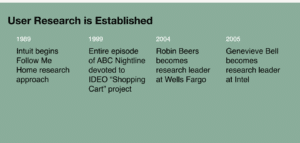
— 1989, Intuit creates follow-me-home, contextual inquiries with customers
- High profile corporate contextual work for how people do things and what they are trying to accomplish
— 1999, ABC Nightline devoted episode to IDEO ‘Shopping Cart’ project and it’s amazing moment
- Mainstreaming of UXR, and design thinking
— 2004-2005, see people within organizations start to take on leadership and have peers in other organizations
- Less chance of shouting things into void
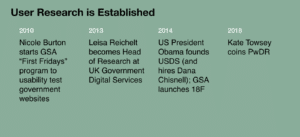
— 2010 start to see usability testing of websites within US federal government
— Founding 2014 of USDS and first hire is Dana Chisnell, famous UXR
- 18F another effort at time
— Kate Towsey coins term of PwDR (People Who Do Research)
- Great moment that gave what was going on a name, and articulate difference between researchers and people who happened to do UXR
- Beginning of period we are in now
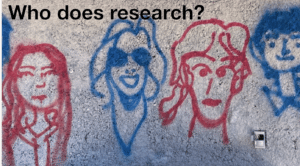
— Raises thorny question of who does research
- Based on role, title, and people doing research and consultancies
- People in tech companies, and techn consultancies
- Ask: Who does research and faces start to emerge
— Question of who does what produces turmoil within disciplines
- Need for insight, than people who can officially deliver it, and researchers like us to be better at asking questions, and figuring out so what
— All factors are something to respond to, and downstream effects of our interventions
- Turmoil with quality of research and lack of clarity research brings
— Encourage us to treat all of this as complex systems and problem

— And what do mean of research?
- Use research as broader term to mean anything and everything and not discuss it
- Tedious and unhelpful one word to mean many kinds of things
— Further complications include:
- Risk of conflating methods with objectives, and different kinds of research and how it can help
- Inconsistent definitions of UXR exist

— Also have slides on truth to power, so will touch on it
— Discussion about consultancies
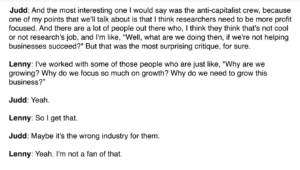
— The above quote is taken from a podcast where two people discuss fact of UXRs not willing to focus exclusively on company profit and growth
- Sense of not being in field if don’t agree with it
— Speaking from my bias as consultant
- Shift over time relative to corporate consultancies in the 80s
- Idea of truth-to-power role, and corporate capture being a real thing
— To me, research is not just about profit and growth, and UXRs advocate for people, as well as branding and positioning
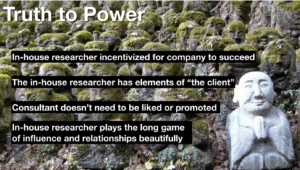
— Culture has shifted, and consultants like myself are in relative minority of field
- Researchers incentivized to succeed when company succeeds, but consultants don’t necessarily need to be liked or promoted
- If promotion tied to corporate incentive, changes how you work
- Meeting corporate research leaders who spoke jargon, and couldn’t explain product that made sense to a civillian
- In-house researchers can play a much longer game to build influence and change minds
— Back in-day had to watch out for client to sell product in field, and in-house researcher has elements of “client”
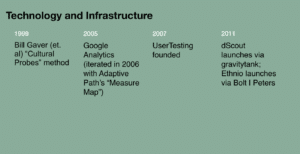
— Back to timeline and evolution of tech infrastructure
- 1999—Publication of cultural probes and workbooks in the mail
- 2005— Google Analytics was released and integrated with adaptive path
- 2007—User Testing Founded
- 2011—Dscout launches from Gravitytank consultancy, and Ethnio from Bolt | Peters
— Tools are coming out of design and UXR practices
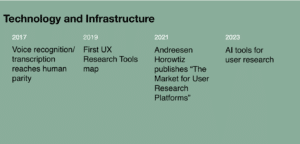
— Continuing the timeline
- 2017— Voice transcription determined to reach human parity
- Originally hard AI problem to solve
- 2019—First UX Research tools map, and looks like D&D game
- 2021— VC talk about money to be made in tools
- 2023— Intro of AI tools for user research [and field loses it’s mind]
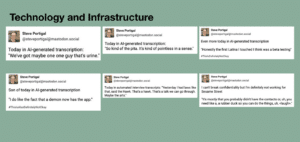
— Excerpts of transcript we got last year
- Line of AI used to be once, we figured out what to do something, was AI

— This is curse of good enough, and at arisk of this, with tools in general
- Accept transcription errors, with everything being there
- Software generated one, you need to see through hawks, urine, and demons to find it
— Risk of good enough trap
- Scrappy as coded term of not being wasteful, but aspect of saying something is good enough and not being seen as prima donna about transcripts
— Don’t know enough about AI tools, and run risk of good enough for these tools as well
— Attributed to MM: ‘We shape our tools, and tools shape us’
- Can lose track
— Prototyping with paper afforded as tool for feedback from person
- LoFi prototypes produce different responses than high-fidelity prototypes
- But tools work very easy at high-fidelity and researchers get pushed to work in lower-value tools
- Decades of literature that tells us what to use different levels of tools
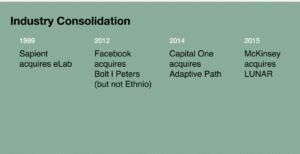
— Another macro trend fo industry consolidation, and consequence of buying in-house teams
- Losing design studio culture to broader corporate culture
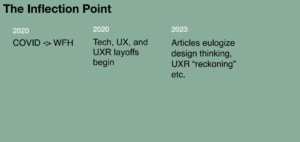
— Shift of covid to WFH, and layoffs begin
- UXR ‘reckoning’ and remote research as the overall default.
— Lose access to gestures and having minds blown by getting into someone else’s world
- Don’t take client into the world to have their minds blow and create change trying to create and lost access for day-long workshops
- Async delivery of researching findings
— Drama, anxiety and need to be influencers [and need to create angst and drama]
- So how to overcome role in trauma of past few years?

— Don’t know where you are at, but looking at what changed, let’s acknowledge our feelings from hope to despair
- Normal to have bunch of different feelings about something at same time

— We have all of these shifts, and uphill looking at history
- Personally feel ‘same as it ever was’, and ‘this is different’
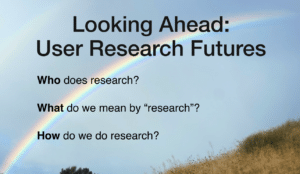
— So let’s look ahead at future. We’ll take a look at three future(s), as I don’t know what exact shape will be, but provocations against status quo
- Deliberately extreme
— First scenario deals with the rise of the machines
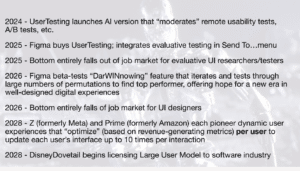
— Scenario where AI runs everything from 2024 to 2028
- Darwinnowing feature to churn through large number of permutation for top performer designs
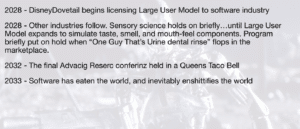
— After 2028 and beyond, we are in full dystopia with software fully eating the world, and ruining it
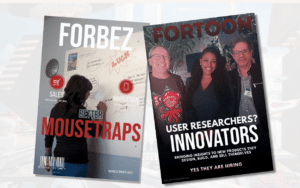
— Next one, is a short-story
- Decimation of UXR jobs continued
— UXR saw that entire team were out in the wilderness and began their own agencies and started product companies, social enterprises,
- Reclaimed agency for community and planet
- Took time to innovate incrementally and some succeeded
— End result of de-shittification, and went on VisionPro cast tour, and emphasized outcomes driving towards it
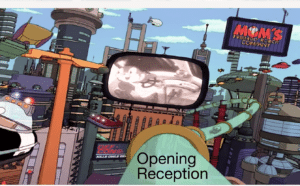
— Third scenario: Of opening reception short video
— Take time to launch ‘Yes/And’ corporation and conducting research for initiative and be fully global
- Believe UXR and capitalism should be tied together, as insights are a common good
- No reason for company to understand pathology of bad actors, and toll of content moderation, and user controls
- Active collaboration to build refine, launch products and services
— Give people information they need, in form to apply to create better products for world
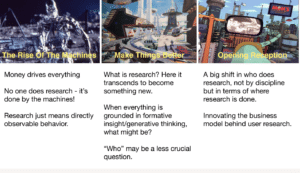
— Here’s a recap of how stories differ
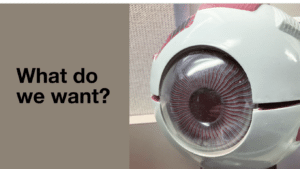
— So what do we want, as all futures challenge us to consider of what we want, if it isn’t the status quo
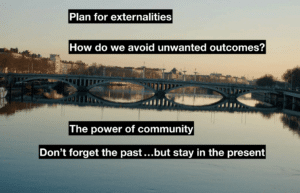
— Will continue to grapple with questions above and where it happens
— The future is not entirely ours
- Can plan for externalities and part of futures thinking and think about things and make future we can within constraints
- Here to give questions to think about it
— Power of community and good things to happen us when with, so lets think of how to treat each other
- We are on shoulders of giants, so don’t forget past and stay in present