
Day 1- The Dangers of Empathy: Toward More Responsible Design Research
— Thank you all for being here, and we are eager to share our work
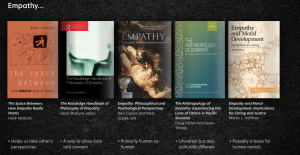
— What are the dangers of empathy? Empathy isn’t supposed to be dangerous, and often has been considered the basis of morality
-
Isn’t the problem that we don’t have enough of empathy, and isn’t empathy important to designers
— While valuable empathy has limitations, and it has come under scrutiny
-
People are re-examining empathy’s place as a singular place for good
— Even design legends like Don Norman are questioning the limits of empathy
— We shouldn’t remove empathy from design practice, but let’s talk what it can do versus what it can’t
-
Let’s discuss the limitations of empathy and how it can be enhanced by practices of care and curiosity
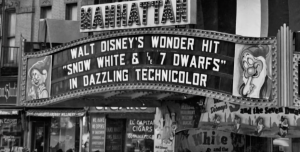
— In December 1937, Walt Disney was anxious about Snow White and Seven Dwarfs, as people were convinced it would fail
-
Disney had no idea how the audience would respond and whether the film would resonate
-
But the audience reacted incredibly emotionally to the film
-
Why? This was empathy, as audience felt their emotions were the same as the characters
-
— People can understand how a dramatic storyline can arouse empathy. Do designers?
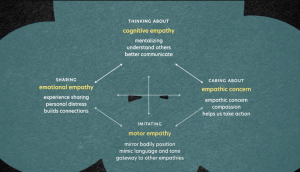
— Empathy consists of several meanings
-
Cognitive empathy, which involves mentally understanding how people feel
-
Emotional empathy and sharing others distress
-
Empathic concern to drive us to action
-
Motor empathy to mirror body language of others
— Empty is elastic and stretches to any situation and ourselves
-
But we might not be able to read things right
— Matching another person’s state doesn’t mean we know what entire experience is like for them their in shoes
— There is no definition of empathy across science, and mis-match between research and practice leads to gap in efficiency
— All forms of empathy enable us to escape ourselves and see others emotions
-
Think of Will Graham in the Hannibal series who is able to understand the minds of murderers and criminals
-
Empathy is pointed on both ends and is our ability to take the perspective of others
— Without empathy, we set the table for confusion
-
With empathy we shift our center of gravity to another person, as it allows us to view our situation from multiple perspectives
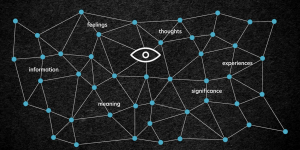
— We can understand person’s feelings attitudes and experiences, a relational web of information
-
We suspend ourselves in webs of significance that others have spun
-
Our goal will be to understand what people mean
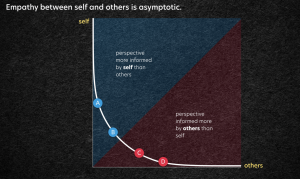
— Empathy is asymptotic though, and as we approach understanding of those around us, and don’t ever fully understand why they feel, and why they say it
-
We are feeling what we think others are feeling in their own way

— To illustrate this, consider Marcel Marcout’s Mask Maker film, which portray a mime that practices wearing different emotional masks like happiness or sadness
-
A laughing mask gets stuck on the mime’s face, and the mime has to blind himself to take it off his face
-
Marcout’s mime displays an unfortunate feature of empathy:
-
Empathy is pointed on both ends, but taking on the feelings of others has reciprocal impact on us
-
So we avoid situations of empathy to avoid emotions and burnout
-
-
These negative consequences are one example of its limitations
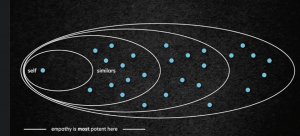
— Moreover, empathy is most potent for those who are most similar to others
-
Think of meeting someone from your hometown in another city
-
Within these various regions of community there are many limitations of empathy
-
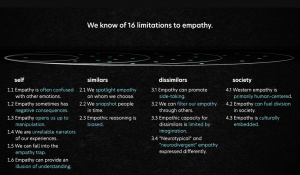
— Some limitations of empathy might affect us or others differently, and may pop-up in different domains like personal lives
-
We choose how to extend our empathy and spotlight it on specific individuals
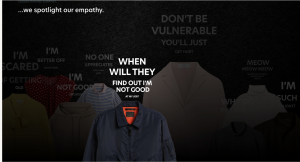
— This spotlight is a form of selection bias, and allows us to narrow our view, and focus on certain people
-
Empathy is near-sighted and myopic though, and we can neglect certain types of users who are not like us
— Empathy is also discussed in a Neuro-typical way versus how Neuro-diverse people describe it
-
There is a double empathy problem and a mis-match between Nero-Diverse and Neuro-Typical, from conversation styles and disconnect for difficulty interacting and mis-understandings
-
Neither side can see the others empathy as empathy
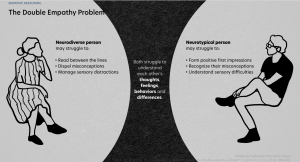
— Empathy in design thinking is in Neuro-Typical ways, and not for Neuro-Diverse individuals
-
Empathy is also culturally embedded with Western values, morals, and expectations
— These expectations can lead us to asking fewer questions, and have the illusion of understanding, as we think we might understand what’s going on too quickly
-
Approaching any situation with the mindset of “I don’t fully understand” leads to through explanation
— Hi there, my name’s Meah and I’m a graduate interaction design student at the University of North Texas who will walk you through three short case studies on the limits of empathy

— We’ll begin with the Astro-1 mission that was a response to the failed Challenger launch, which moved NASA’s culture from prioritizing launch dates to mission safety,
— So my cohort of grad students came up with a space exhibition to engage the senses
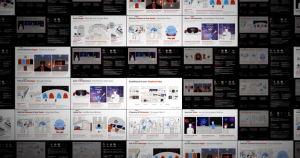
— We created 13 storyboards that show-cased innovative ways to demonstrated innovative ways for the Astro 1 exhibition within a Smithsonian affiliate museum
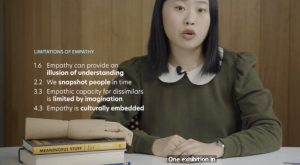
— We encountered the following limitations of empathy
-
The illusion of understanding
-
Snapshoting people in a moment in time
-
Our empathic concern being limited by our imagination
-
Empathy being culturally embedded
— The resources provided will have more details on these failure, so let’s share how to address them with the project
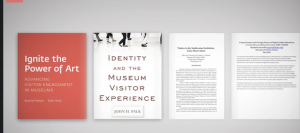
— We had the illusion of understanding who went into museums, and how to get them excited
— We developed personas, but none of them represented the experiences of our interviewees
-
There was no middle ground between the person who was eager to go to a museum, and someone who was unenthusiastic
-
UXR leads you to thinking you’ve covered your bases, but we had the illusion of understanding, and missed a large group of people who let us create a better set of personas
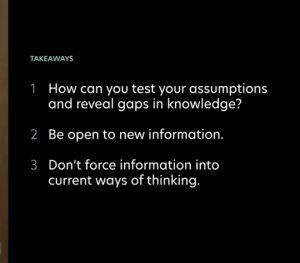
— Here’s what you can do to avoid the illusion of knowledge for your next project
-
Figure out how to test and reveal gaps of knowledge in info
-
Be open to new info that comes in
-
Don’t shoe-horn information into current ways of thinking
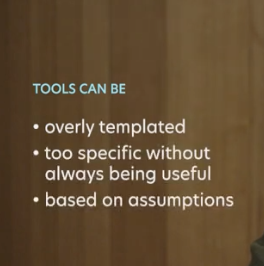
— Next, don’t rely too heavily on a specific tool to crystalize user insights
-
Badly designed personas, create stereotypes, not archetypes
— You need to avoid side-taking and fueling divisions
-
While empathy creates connection with others, it can also create an in-group empathy as well
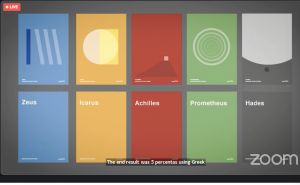
— For example with the UK’s Ministry of Justice research on the prison population, placing value judgments would lead to misrepresentation and avoid looking at certain quantitative and qualitative data
-
There was a risk of side-taking and fueling division, by excluding demographic information to avoid stereotyping
— Instead the team came up with a radical way to present case information
-
We feel pressured to accept design artifacts as they are,
-
The UK team came up with interaction with artifacts to fit needs, and reimagined what a persona could be
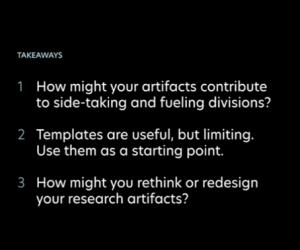
— So let’s think how to rethink or redesign artifacts,
-
How might your artifacts contribute to side-taking and fueling divisions?
-
Templates are useful, but limiting, and should be used as a starting point
-
Think how you can rethink or redesign research artifacts
— Common sense is not always common practice
— Next let’s consider the idea of undeliverables
— Clinton Carlson a professor at Notre Dame, who was asked to create a poster to raise funds for AIDS awareness in Africa
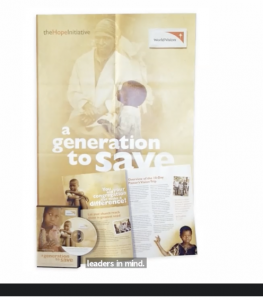
— This poster was designed with audience of western donors in mind, and not people on the ground
— Remember, when work goes out in the world, intention doesn’t go out with it’s use
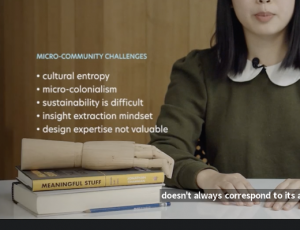
— So researchers can run the risk of extracting insights form participants for what is ‘useful’, and discard what isn’t
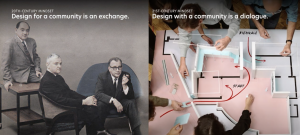
— Dialogues with community are ongoing, and when designers and UXRs are helicoptering a solution this leave gaps in the process
— Instead, we need to allow the community to design, and to let people to design as group,
— This allows restorative justice, to avoid filtering empathy, or snapshotting people in a moment in time
— We need to shift from synthesizing output, or an exchange, to creating discussions that the community can help in
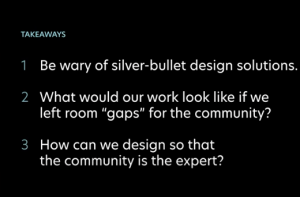
— What would design and research look like, so that community was the expert?
-
We need to be wary of silver-bullet design solutions
-
We need to understand what our work would look like if we left room ‘gaps’ for the community?
-
How can we design so that the community is the expert?
— We hope this talk has settled unsettled some uncertainties about empathy with this talk
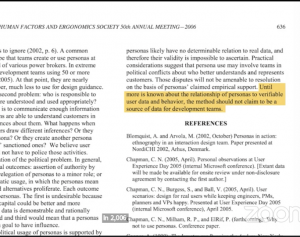
— In 2006, researchers at Microsoft advised against using personas, as over 200 had been created
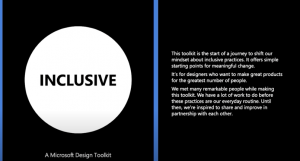
— In 2015, designers responded with inclusive design toolkit, and reimagined tools in ways that benefit users and company
-
In 2023, Microsoft updated toolkit, and continues to see research as journey

— Maps are useful, but things change and are dynamic, and we would like UXR to not be a map, but it a compass instead
-
For only as we move forward, do we see how the world changes, and we can change how things go along the way
— We hope this talk provides a compass for you to move forward
Questions
-
Love examples form MoJ project. Feel you need photos and sketches of person and realistic names?
— Cassini: I’ve encountered this, and there is a risk of locking into a kind of person when building a persona, and that can be limiting
— Meah: Perhaps steering away form sketches or faces, can provide inclusive research
-
How often do you share findings with research participants? What are benefits and cons of this process?
— Cassini: If try to do research on people, they should have the opportunity to say whether we as UXRs, got it right or wrong
-
If we choose the path, we share findings as much as possible
— Meah: When we choose to use personas we invite people to help build them and not have them passively react to it


